Prøve GULL - Gratis
ON THIN AIR
Down To Earth
|August 01, 2021
Agriculture students demonstrate how aeroponics, once a niche and costly cultivation method, can help urban households

SOMETIME IN the late 1990s, US space agency NASA teamed up with an agro-biology company and a high-impact space life research center, both based in the US, to embark on an ambitious experiment. The aim was to grow plants aboard the Mir space station, which operated in low Earth orbit. In 1997, the team negated the fundamental agricultural requirements—soil, sunlight, and intensive water for irrigation—and successfully grew adzuki beans in microgravity. The cultivation technique, known as aeroponics, was well established in the 1940s. But it had remained largely confined to research and innovation till the NASA experiment demonstrated its potential as an effective and efficient means of growing plants anywhere. While NASA has since used the technique to successfully grow a variety of crops, including lettuce, mustard, and radishes, in space, aeroponics has also captured popular imagination here on Earth.
Aeroponics is essentially an indoor farming technique in which plants grow in a controlled environment that is free from soil or any other aggregate media. Roots hang suspended in the air while a nutrient solution is sprayed as a fine mist. Spraying is a specialized process that, through clock-work precision and factory-like settings, can imitate plant growth across multi-level chambers, which remain lit by led lights of different calibrations. Such a system does not require much land and can be set up in a vertical manner. As per NASA water usage in the system reduces by an impressive 98 per cent. Since the roots get the nutrients directly, fertilizer usage also decreases by 60 percent. Pesticides are fully eliminated, as the absence of soil reduces the chances of diseases.
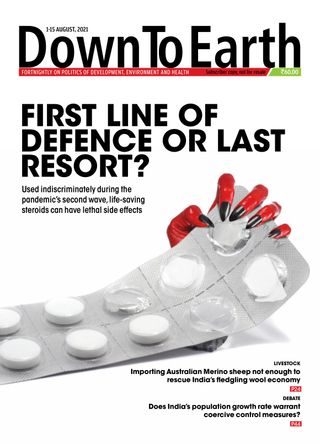

Denne historien er fra August 01, 2021-utgaven av Down To Earth.
Abonner på Magzter GOLD for å få tilgang til tusenvis av kuraterte premiumhistorier og over 9000 magasiner og aviser.
Allerede abonnent? Logg på
FLERE HISTORIER FRA Down To Earth

Down To Earth
Bitter pill
THE WEB SERIES PHARMA EXPOSES HARSH TRUTHS OF THE PHARMACEUTICAL INDUSTRY, WHERE PROFIT OFTEN BECOMES MORE IMPORTANT THAN HUMAN HEALTH

3 mins
January 16, 2026
Down To Earth
CHAOS IN-DEFINITION
The Aravallis are perhaps India's most litigated hill range. More than 4,000 court cases have failed to arrest their destruction. The latest dispute concerns a narrow legal definition of this geological antiquity, much of which has been obliterated by mining and urban sprawl. While the Supreme Court has stayed its own judgement accepting that definition, it must see the underlying reality and help reconcile development and national security with conservation.
19 mins
January 16, 2026
Down To Earth
BITS: INDIA
Indore has recorded 16 deaths and more than 1,600 hospitalisations between December 24 and January 6.
1 min
January 16, 2026

Down To Earth
GUARANTEE EXPIRES
India's rural employment guarantee law is replaced with a centrally controlled, budget-capped scheme. Is this an attack on the right to work?
3 mins
January 16, 2026

Down To Earth
BLOOM OR BANE
Surge of vibrant pink water lilies in Kuttanad, Kerala, provides socio-economic benefits, but the plant's ecological impacts must be understood
4 mins
January 16, 2026
Down To Earth
INVISIBLE EMPLOYER
Field and academic evidence shows sharp falls in casual agricultural employment at places where groundwater access declines
3 mins
January 16, 2026

Down To Earth
Schemed for erasure
Does the VB-G RAMG Act address structural weaknesses long observed in MGNREGA's implementation?
10 mins
January 16, 2026

Down To Earth
School of change
An open school in Panagar, Madhya Pradesh, aims to protect children of tribal settlements from falling into the trap of addiction
2 mins
January 16, 2026

Down To Earth
PULSE OF RESILIENCE
As a climate-ready crop, cowpea shows potential for widespread use in India
3 mins
January 16, 2026
Down To Earth
BITS GLOBAL
Britain recorded its hottest and sunniest year ever in 2025, the country's meteorological office said on January 2.
1 min
January 16, 2026
Translate
Change font size