Prøve GULL - Gratis
New Light On Dark Matter
Down To Earth
|November 16, 2020
Scientific research is unearthing new understanding on an old mystery

Deciphering the true nature of the mysterious dark matter—that constitutes 27 per cent of the Universe—has eluded scientists since it was discovered by Fritz Zwicky in 1933. Dark matter attracts everything through gravity; it competes with the equally mysterious dark energy that pulls apart everything in the Universe. These two competing forces shape the Universe at the largest scale. Dark energy, which constitutes 68 per cent of the Universe, is also the most plausible cause for the observed accelerated expansion of the Universe. This means that all the stars, planets and other celestial bodies—visible to us—make up only 5 per cent of the Universe. The rest is yet unknown. But new scientific evidence is now interpreting this mystery.
To explain current observations of the Universe, scientists say dark matter exists, but it does not emit, absorb or reflect light. This makes it difficult to detect. The only way that its existence can be inferred is through the gravitational pull it exerts on other matter in the form of stars, planets and other celestial objects.
That’s why astronomers look at galaxies and clusters of galaxies—the grandest structures of the Universe—to understand dark matter: what it is and why it exists in the first place. matter, and this increases the dark matter concentration in these clusters.
This, in turn, makes it easier for astronomers to search. Another place scientists have been looking is deep under the Earth’s surface where they have been detecting possible particles that could make up dark matter in Xenon tanks—the largest propellant tank made by humans—and even in rocks.
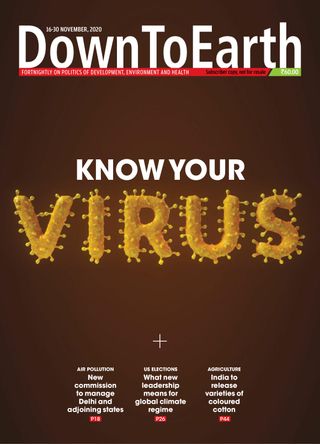

Denne historien er fra November 16, 2020-utgaven av Down To Earth.
Abonner på Magzter GOLD for å få tilgang til tusenvis av kuraterte premiumhistorier og over 9000 magasiner og aviser.
Allerede abonnent? Logg på
FLERE HISTORIER FRA Down To Earth

Down To Earth
THINK TWICE BEFORE FELLING SAL TREES
Many trees considered to be affected by sal borer in the 1990s are still alive today

1 mins
February 16, 2026

Down To Earth
EDGE OF SURVIVAL
Caste divides deny marginalised communities land, resources and essential aid, leaving them more vulnerable to climate disasters
6 mins
February 16, 2026

Down To Earth
A WISH LIST?
Union Budget for 2026-27 conveys the impression of a roll-call of intentions and ambitious proposals, with little detail on their formulation
6 mins
February 16, 2026
Down To Earth
Break down the gender wall
THE RULING National Democratic Alliance (NDA) government has been heavily invested in the goal to make India a developed economy by 2047.
2 mins
February 16, 2026

Down To Earth
MENSTRUAL HEALTH, NOW A FUNDAMENTAL RIGHT
In a landmark judgement, the Supreme Court has recognised menstrual health and hygiene as a fundamental right under Article 21 of the Constitution of India, which guarantees the right to life and dignity.
8 mins
February 16, 2026

Down To Earth
Of devolution and new disasters
The 16th Finance Commission pushes for changes in view of new fiscal and climatic conditions
11 mins
February 16, 2026
Down To Earth
Rising risks of plastics
NEGATIVE IMPACTS on human health due to emissions linked to the plastic lifecycle could double by 2040, according to a study published in The Lancet Planetary Health in January.
1 min
February 16, 2026

Down To Earth
GAP BETWEEN EPIDEMICS NARROWING
A watershed-based and landscape-level approach is needed to address forest degradation
2 mins
February 16, 2026
Down To Earth
WAITING TO STRIKE
Sal heartwood borer is considered the biggest threat to forestry in India, especially to the sal tree, where it lives and breeds.
11 mins
February 16, 2026

Down To Earth
A SPRING DELIGHT
Mustard flowers are not meant only for the eyes. Invite them to your plate once in a while
3 mins
February 16, 2026
Translate
Change font size