Prøve GULL - Gratis
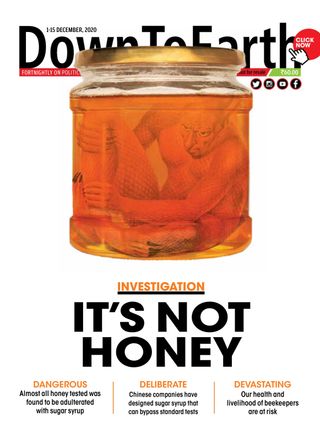
LABORATORY TESTS OF HONEY WE CONSUME
Down To Earth
|December 01, 2020
HONEY WHICH PASSED INDIAN STANDARDS FAILED WHEN TESTED USING EQUIPMENT THAT CAN DETECT MODIFIED SUGAR SYRUP
-

13 top and smaller honey brands were selected
Most of the top brands passed the laboratory tests for Indian standards
Laboratory in India didn't find adulteration of C3 and C4 sugar in these brands
However, most of the smaller brands failed the laboratory tests for Indian standards
Adulteration with C4 sugar is most common
But when all samples were sent to a top laboratory in Germany, the picture changed
Many samples passed in India failed on the Trace Marker for Rice (TMR) test
Almost all samples failed on Nuclear Magnetic Resonance Spectroscopy (NMR) test. Laboratory said, indicates adulteration/addition of sugar syrup
Of the 13 brands only three brands passed
Of the 22 samples only five samples passed test. Rest were adulterated
IT WAS now critical to understand the nature and extent of adulteration of honey sold to us and that we consumed.
So, in August 2020 we collected eight brands of processed honey that are typically available in the retail shops and commonly advertised. These samples were collected from stores in Delhi. These samples were sent for laboratory test to the Centre for Analysis and Learning in Livestock and Food (CALF) at National Dairy Development Board (NDDB) in Gujarat—which has a state of art facility for testing honey for all parameters set by FSSAI. The samples were to be tested as per the 2020 honey quality standards—to check for C4, C3 sugars, foreign oligosaccharides, specific rice marker (SMR).

Denne historien er fra December 01, 2020-utgaven av Down To Earth.
Abonner på Magzter GOLD for å få tilgang til tusenvis av kuraterte premiumhistorier og over 9000 magasiner og aviser.
Allerede abonnent? Logg på
FLERE HISTORIER FRA Down To Earth

Down To Earth
Bitter pill
THE WEB SERIES PHARMA EXPOSES HARSH TRUTHS OF THE PHARMACEUTICAL INDUSTRY, WHERE PROFIT OFTEN BECOMES MORE IMPORTANT THAN HUMAN HEALTH

3 mins
January 16, 2026
Down To Earth
CHAOS IN-DEFINITION
The Aravallis are perhaps India's most litigated hill range. More than 4,000 court cases have failed to arrest their destruction. The latest dispute concerns a narrow legal definition of this geological antiquity, much of which has been obliterated by mining and urban sprawl. While the Supreme Court has stayed its own judgement accepting that definition, it must see the underlying reality and help reconcile development and national security with conservation.
19 mins
January 16, 2026

Down To Earth
BITS: INDIA
Indore has recorded 16 deaths and more than 1,600 hospitalisations between December 24 and January 6.
1 min
January 16, 2026

Down To Earth
GUARANTEE EXPIRES
India's rural employment guarantee law is replaced with a centrally controlled, budget-capped scheme. Is this an attack on the right to work?
3 mins
January 16, 2026

Down To Earth
BLOOM OR BANE
Surge of vibrant pink water lilies in Kuttanad, Kerala, provides socio-economic benefits, but the plant's ecological impacts must be understood
4 mins
January 16, 2026
Down To Earth
INVISIBLE EMPLOYER
Field and academic evidence shows sharp falls in casual agricultural employment at places where groundwater access declines
3 mins
January 16, 2026

Down To Earth
Schemed for erasure
Does the VB-G RAMG Act address structural weaknesses long observed in MGNREGA's implementation?
10 mins
January 16, 2026

Down To Earth
School of change
An open school in Panagar, Madhya Pradesh, aims to protect children of tribal settlements from falling into the trap of addiction
2 mins
January 16, 2026

Down To Earth
PULSE OF RESILIENCE
As a climate-ready crop, cowpea shows potential for widespread use in India
3 mins
January 16, 2026
Down To Earth
BITS GLOBAL
Britain recorded its hottest and sunniest year ever in 2025, the country's meteorological office said on January 2.
1 min
January 16, 2026
Translate
Change font size