
Gå ubegrenset med Magzter GOLD
Få ubegrenset tilgang til over 9000 magasiner, aviser og premiumhistorier for bare
Prøve GULL - Gratis
Immune to Drought
Down To Earth
|May 16, 2017
Jhabua continues to flourish and maintain its status as a model district while many others fail

JHABUA IS a dramatic story because of the three key ingredients that are missing in most government programmes: political will, competent and committed bureaucratic support, and people’s participation”, wrote Anil Agarwal, founder editor of Down To Earth (dte), in 1998 after he visited the tribal district in Madhya Pradesh to witness the dramatic recovery of poor villages in the hilly area from extreme ecological degradation. It shows how poverty can be eradicated very fast and very cheaply, he noted.
Nearly two decades later, dte visits Jhabua again. At the outset, our fear was that the district might have suffered the same fate as other model villages that fell from grace after the initial enthusiasm of people and bureaucracy died down (see ‘Sukhomajri falls apart’, dte, February 16-29, 2017); watershed development structures that transformed the water-scarce region into a water-sufficient one might have silted up. Instead, what we see is a rare example of sustained bureaucratic will and continued participation of people.
The villages, scattered along the hill slopes and nestled in the valleys, resemble an oasis in the barren landscape of southwestern Madhya Pradesh. Contour trenches, up to 3-metre deep, crisscross the slope of almost every hill in sight, while check dams dot the streams and the Nugami, the only river flowing through the district. The once denuded hill tops and slopes remain covered by mixed-species plantations. All the 818 villages in the district have ponds and dugwells that yield water round the year. Government data shows that 2,400 water conservation and harvesting structures and 730 microirrigation projects were built in Jhabua during 2009-10 alone. The groundwater level has risen from 7 m below the ground level (mbgl) in the 1990s to 4 m now.
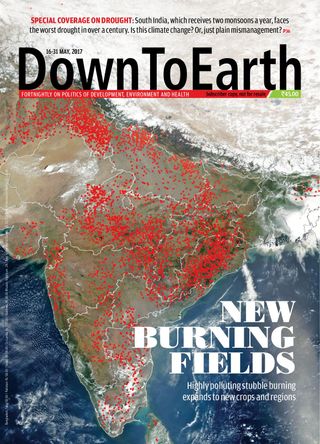

Denne historien er fra May 16, 2017-utgaven av Down To Earth.
Abonner på Magzter GOLD for å få tilgang til tusenvis av kuraterte premiumhistorier og over 9000 magasiner og aviser.
Allerede abonnent? Logg på
FLERE HISTORIER FRA Down To Earth

Down To Earth
THINK TWICE BEFORE FELLING SAL TREES
Many trees considered to be affected by sal borer in the 1990s are still alive today

1 mins
February 16, 2026

Down To Earth
EDGE OF SURVIVAL
Caste divides deny marginalised communities land, resources and essential aid, leaving them more vulnerable to climate disasters
6 mins
February 16, 2026

Down To Earth
A WISH LIST?
Union Budget for 2026-27 conveys the impression of a roll-call of intentions and ambitious proposals, with little detail on their formulation
6 mins
February 16, 2026
Down To Earth
Break down the gender wall
THE RULING National Democratic Alliance (NDA) government has been heavily invested in the goal to make India a developed economy by 2047.
2 mins
February 16, 2026

Down To Earth
MENSTRUAL HEALTH, NOW A FUNDAMENTAL RIGHT
In a landmark judgement, the Supreme Court has recognised menstrual health and hygiene as a fundamental right under Article 21 of the Constitution of India, which guarantees the right to life and dignity.
8 mins
February 16, 2026

Down To Earth
Of devolution and new disasters
The 16th Finance Commission pushes for changes in view of new fiscal and climatic conditions
11 mins
February 16, 2026
Down To Earth
Rising risks of plastics
NEGATIVE IMPACTS on human health due to emissions linked to the plastic lifecycle could double by 2040, according to a study published in The Lancet Planetary Health in January.
1 min
February 16, 2026

Down To Earth
GAP BETWEEN EPIDEMICS NARROWING
A watershed-based and landscape-level approach is needed to address forest degradation
2 mins
February 16, 2026
Down To Earth
WAITING TO STRIKE
Sal heartwood borer is considered the biggest threat to forestry in India, especially to the sal tree, where it lives and breeds.
11 mins
February 16, 2026
Down To Earth
A SPRING DELIGHT
Mustard flowers are not meant only for the eyes. Invite them to your plate once in a while
3 mins
February 16, 2026
Translate
Change font size