Prøve GULL - Gratis
Hostile Space
Down To Earth
|May 01, 2019
A six-month stay in space induces physiological changes to the human body. A trip to Mars will be thrice that duration. Can astronauts survive the ordeal?

IN THE FIRST 58 years as a spacefaring species, humans have mastered lower Earth orbit and missions to the moon. We are now in an age where not only government agencies such as NASA and Roscosmos have access to space, we now have commercial entities pushing the boundaries and ambitions for missions to Mars.
It took three days for the crew of the Apollo missions to reach the moon, a mere 0.38 million km away. On current technology, a mission to Mars will take around seven months to travel 55 million km, and this is if the planets align (literally) to make the journey shorter. A successful manned mission to Mars would arguably be the greatest achievement in human history. After decades of research on spaceflight, one crucial question remains: is it possible to send humans to Mars and return them in a healthy condition?
A mission to Mars presents significant physiological and psychological challenges. The body has evolved in a 1G environment on Earth, so our skeletal (movement) muscles, bones, balance (vestibular) system and our engine (the cardiovascular system) are all adapted to work effectively here on Earth.
Once in space, the body will begin to adapt to an environment without gravity, where physical and physiological capabilities are surplus to requirement. These changes take place on six-month missions to the International Space Station but it is a whole magnitude greater on a potential 18-month mission to Mars, where there is greater exposure to space radiation, limited space to exercise, and of course, three times the duration.
Skeletal muscles spend all waking hours resisting gravity and stopping us from crumbling to the floor. In space, muscle of the size and strength we are familiar with are excessive, so the body begins to get rid of them.
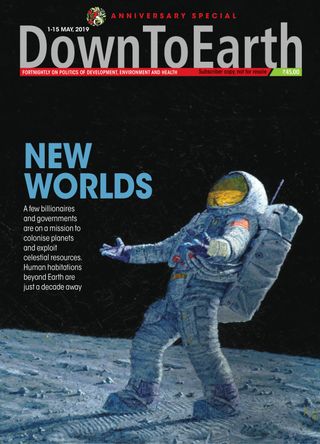

Denne historien er fra May 01, 2019-utgaven av Down To Earth.
Abonner på Magzter GOLD for å få tilgang til tusenvis av kuraterte premiumhistorier og over 9000 magasiner og aviser.
Allerede abonnent? Logg på
FLERE HISTORIER FRA Down To Earth
Down To Earth
Popular distrust
THE WORLD seems to be going through a period of stasis despite facing an unfathomable polycrisis.

2 mins
February 01, 2026
Down To Earth
CONSERVE OR PERISH
Periyar Tiger Reserve has rewritten Indian conservation by turning poachers into protectors and conflict into coexistence
5 mins
February 01, 2026

Down To Earth
'Rivers need to run free'
From Tibet to West Bengal, the Brahmaputra is the pulse of communities and ecosystems along its course. But what are the risks the river faces through human interventions, particularly dams, discusses journalist, author and filmmaker SANJOY HAZARIKA in his new book, River Traveller.
4 mins
February 01, 2026

Down To Earth
India is facing up to its innovation lag
There are signs now that India is acknowledging the superior strides made by China in a frontier technology like Al
4 mins
February 01, 2026

Down To Earth
Competing concerns
What are the repercussions of the EU-Mercosur pact that have made European farmers protest against the free trade agreement?
4 mins
February 01, 2026

Down To Earth
From fryer to flight
Sustainable fuel made from used cooking oil can play a pivotal role in helping India achieve its aviation emission reduction goals. Measures to collect this oil must be revamped
4 mins
February 01, 2026

Down To Earth
ACCESS OPEN
An amendment to India's nodal forest conservation law opens up forests across India to commercial exploitation by the paper industry
6 mins
February 01, 2026
Down To Earth
DRINK FROM TAP CAN BE A REALITY
As cities across India struggle to supply safe piped water, Odisha offers a success story
2 mins
February 01, 2026

Down To Earth
GREAT DRYING
The Earth is hotter than at any point in the past 100,000 years, with 2023-25 becoming the warmest three-year period on record and also breaching the 1.5°C threshold for the first time. One fallout is dwindling freshwater.
22 mins
February 01, 2026

Down To Earth
Green redemption
Restoration of grasslands of Kerala's Pampadum Shola National Park, once dominated by invasive Australian wattles, see a return of streams and native species
1 mins
February 01, 2026
Translate
Change font size