
Gå ubegrenset med Magzter GOLD
Få ubegrenset tilgang til over 9000 magasiner, aviser og premiumhistorier for bare
Prøve GULL - Gratis
Fields On Fire
Down To Earth
|May 16, 2017
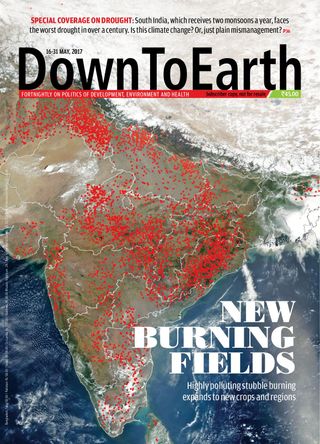
The pattern of burning crop residue in India is changing. The practice is no longer limited to the post-monsoon crop of rice or the northern states of Punjab and Haryana
JITENDRA, SHREESHAN VENKATESH, ISHAN KUKRETI, KUNDAN PANDEY, DEEPANWITA NIYOGI and POLASH MUKERJEE travel to five states across the country to study the trend.
-

ON APRIL 20, there was a piece of good news for residents of Delhi from the sky, literally. A satellite image released by the American space agency, NASA, showed that incidents of crop residue burning in Delhi’s neighbouring states of Punjab and Haryana had significantly reduced compared to last year. But the joy was short-lived as subsequent images showed a spike in crop residue burning from the two states.
A year ago, when the Delhi government implemented the second edition of the odd-even vehicle restriction during April 15-30 to fight air pollution, the Central Pollution Control Board, to everyone’s surprise, found that the pollution levels had increased during the experiment. This put a question mark on the efficacy of the emergency measure. Clean air campaigners and members of the Environment Pollution (Prevention & Control) Authority (EPCA), a body appointed on the Supreme Court’s directive to oversee environmental issues in the National Capital Region, went through volumes of data to understand this paradox. That answer came from an image sent by a NASA satellite. The image showed that the smoke from crop residue burning in Punjab and Haryana had travelled to the national capital, causing the rise in air pollution.
“But farmers don’t burn the rabi wheat crop residue, because it is an important fodder. We knew then that there was widespread burning post-paddy harvest—from October end till mid-November each year. This was happening because farmers in Punjab and Haryana were caught in a vicious time cycle—they had to harvest rice and cultivate wheat in a space of 10-15 days. Rice straw was not a useful fodder, but we did not know about the burning of wheat residue,” explains Bhure Lal, former bureaucrat and now chairperson of EPCA. What then is happening? Why are farmers burning valuable fodder? Is this only about Punjab and Haryana? No.

Denne historien er fra May 16, 2017-utgaven av Down To Earth.
Abonner på Magzter GOLD for å få tilgang til tusenvis av kuraterte premiumhistorier og over 9000 magasiner og aviser.
Allerede abonnent? Logg på
FLERE HISTORIER FRA Down To Earth

Down To Earth
THINK TWICE BEFORE FELLING SAL TREES
Many trees considered to be affected by sal borer in the 1990s are still alive today

1 mins
February 16, 2026

Down To Earth
EDGE OF SURVIVAL
Caste divides deny marginalised communities land, resources and essential aid, leaving them more vulnerable to climate disasters
6 mins
February 16, 2026

Down To Earth
A WISH LIST?
Union Budget for 2026-27 conveys the impression of a roll-call of intentions and ambitious proposals, with little detail on their formulation
6 mins
February 16, 2026
Down To Earth
Break down the gender wall
THE RULING National Democratic Alliance (NDA) government has been heavily invested in the goal to make India a developed economy by 2047.
2 mins
February 16, 2026

Down To Earth
MENSTRUAL HEALTH, NOW A FUNDAMENTAL RIGHT
In a landmark judgement, the Supreme Court has recognised menstrual health and hygiene as a fundamental right under Article 21 of the Constitution of India, which guarantees the right to life and dignity.
8 mins
February 16, 2026

Down To Earth
Of devolution and new disasters
The 16th Finance Commission pushes for changes in view of new fiscal and climatic conditions
11 mins
February 16, 2026
Down To Earth
Rising risks of plastics
NEGATIVE IMPACTS on human health due to emissions linked to the plastic lifecycle could double by 2040, according to a study published in The Lancet Planetary Health in January.
1 min
February 16, 2026

Down To Earth
GAP BETWEEN EPIDEMICS NARROWING
A watershed-based and landscape-level approach is needed to address forest degradation
2 mins
February 16, 2026

Down To Earth
WAITING TO STRIKE
Sal heartwood borer is considered the biggest threat to forestry in India, especially to the sal tree, where it lives and breeds.
11 mins
February 16, 2026

Down To Earth
A SPRING DELIGHT
Mustard flowers are not meant only for the eyes. Invite them to your plate once in a while
3 mins
February 16, 2026
Translate
Change font size