Prøve GULL - Gratis
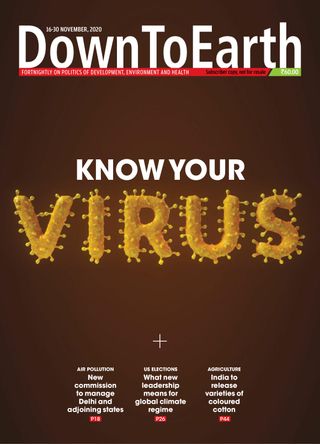
AGE OF VIRUS
Down To Earth
|November 16, 2020
The much-scorned, dreaded biological entities are also the highly misunderstood beings

ONCE UPON a time, just as life was taking shape on Earth, there was a free-roaming cell. It was fiercely independent. As time passed, it developed an intimate relationship with another of its kind, which predated LUCA—the last universal cellular ancestor. In the beginning, the relationship was symbiotic. But over the period, as the forefather of LUCA embarked on a journey to acquire complex traits, the primitive roamer opted for a simpler, parasitic life. So much so, that one by one it started renouncing its genes, essential for supporting life, until it was left with a few strands and became indistinguishable from the nonliving. Eventually it was unable to replicate independently and accepted the fate of an obligate intracellular parasite—a virus.
Some scientists would like to narrate this story, of the origin of virus, a little differently. They would like to start from the forefather of LUCA that possessed mobile genetic elements—pieces of genetic material capable of moving around within a genome. This characteristic continues to be part of the modern cell; in fact, in humans about 50 per cent of the genome is thought to be mobile elements. At some point, some of the genome of this primordial cell—forefather of LUCA—acquired a few structural proteins and gained the ability to exit the cell and spread as an infectious agent, or a virus.
Both the narrations are based on the assumption that cells existed before viruses. What if it’s the other way round? Some scientists postulate a scenario in which viruses existed in a pre-cellular world as self-replicating genetic elements—RNS (ribonucleic acid) or DNA (deoxyribonucleic acid) molecules. Over time these units, became more organised, complex and even synthesised proteins required for the formation of their shell, known as capsid.

Denne historien er fra November 16, 2020-utgaven av Down To Earth.
Abonner på Magzter GOLD for å få tilgang til tusenvis av kuraterte premiumhistorier og over 9000 magasiner og aviser.
Allerede abonnent? Logg på
FLERE HISTORIER FRA Down To Earth

Down To Earth
THINK TWICE BEFORE FELLING SAL TREES
Many trees considered to be affected by sal borer in the 1990s are still alive today

1 mins
February 16, 2026

Down To Earth
EDGE OF SURVIVAL
Caste divides deny marginalised communities land, resources and essential aid, leaving them more vulnerable to climate disasters
6 mins
February 16, 2026

Down To Earth
A WISH LIST?
Union Budget for 2026-27 conveys the impression of a roll-call of intentions and ambitious proposals, with little detail on their formulation
6 mins
February 16, 2026
Down To Earth
Break down the gender wall
THE RULING National Democratic Alliance (NDA) government has been heavily invested in the goal to make India a developed economy by 2047.
2 mins
February 16, 2026

Down To Earth
MENSTRUAL HEALTH, NOW A FUNDAMENTAL RIGHT
In a landmark judgement, the Supreme Court has recognised menstrual health and hygiene as a fundamental right under Article 21 of the Constitution of India, which guarantees the right to life and dignity.
8 mins
February 16, 2026

Down To Earth
Of devolution and new disasters
The 16th Finance Commission pushes for changes in view of new fiscal and climatic conditions
11 mins
February 16, 2026
Down To Earth
Rising risks of plastics
NEGATIVE IMPACTS on human health due to emissions linked to the plastic lifecycle could double by 2040, according to a study published in The Lancet Planetary Health in January.
1 min
February 16, 2026

Down To Earth
GAP BETWEEN EPIDEMICS NARROWING
A watershed-based and landscape-level approach is needed to address forest degradation
2 mins
February 16, 2026
Down To Earth
WAITING TO STRIKE
Sal heartwood borer is considered the biggest threat to forestry in India, especially to the sal tree, where it lives and breeds.
11 mins
February 16, 2026
Down To Earth
A SPRING DELIGHT
Mustard flowers are not meant only for the eyes. Invite them to your plate once in a while
3 mins
February 16, 2026
Translate
Change font size