Prøve GULL - Gratis
YOGA & PEACE
Heartfulness eMagazine
|January 2021
DEEPAK CHOPRA speaks with DAAJI about the role Yoga has to play in bringing about world peace. This is an excerpt from their conversation broadcast on International Day of Peace, September 21, 2020. That documentary is available at https://heartfulness.org/en/international-day-of-peace/.

Daaji: Namaste sir.
Deepak Chopra: Daaji, it is a great honour to be with you and celebrate World Peace Day. I was thinking, as I was getting online to speak with you, of the basic Yamas and Niyamas that are the basis of all of our yogic tradition. And if you look at the Yamas in order, it all starts with ahimsa. Ahimsa is the first Yama, which means to be established in non-violence.
The great sage Patanjali says that when we are firmly established in peace-consciousness ourselves, then all beings around us cease to feel hostility. So you are actually to do nothing but be peaceful yourself, and bring the presence of peace wherever you go. If you do that, then people around you will feel peaceful, not by what you say, not even by what you do, but just by your presence.
That is the great gift of Patanjali, when he says the first lesson of Yoga is to start with ahimsa. Then you start with satya. Satya is truth. When you have satya added to ahimsa, you automatically have asteya. Asteya means you don’t covet anything, because you are totally fulfilled within yourself. And from that experience of asteya, nonstealing, non-covetousness, nonjealousy, comes what Patanjali calls aparigraha, which means detachment from the fruits of action, which ultimately leads to the best use of your energy, your vital energy, your vital force.
And so, on World Peace Day, I think it is very appropriate for us to celebrate the great yogic traditions of India that also talk about the Niyamas – cleanliness, shaucha; fulfilment that comes from self-study or
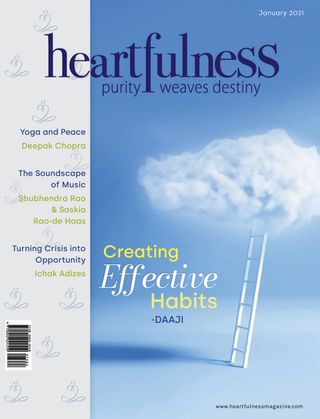

Denne historien er fra January 2021-utgaven av Heartfulness eMagazine.
Abonner på Magzter GOLD for å få tilgang til tusenvis av kuraterte premiumhistorier og over 9000 magasiner og aviser.
Allerede abonnent? Logg på
FLERE HISTORIER FRA Heartfulness eMagazine

Heartfulness eMagazine
A Touch of Heaven
Irish singer and teacher, EILISH BUTLER, combines the mystical chant of Saint Hildegard von Bingen (1098-1176) with the evolutionary path of Uncovering the Voice, satisfying her passion for mystical spirituality and music.

2 mins
November 2025

Heartfulness eMagazine
FROM INNER STILLNESS TO OUTER AGENCY:
How Heartfulness Builds an Internal Locus of Control and Workplace Success
3 mins
November 2025

Heartfulness eMagazine
Virtual Intelligence
Author and cultural commentator CHARLES EISENSTEIN extends last month's argument about virtual substitutes hollowing out reality-this time to Al's imitation of intimacy-and points to what only embodied relationships can restore.
10 mins
November 2025

Heartfulness eMagazine
Grace Is the Creative Spark
Do you sometimes feel that life is blessed and things are unfolding effortlessly, without force or struggle? Some people say it is because of “grace” or “God’s grace.
5 mins
November 2025

Heartfulness eMagazine
Zuri's Guiding Light
A luminous fable from LIAA KUMAR on self-trust, belonging, and inner guidance.
3 mins
November 2025

Heartfulness eMagazine
I AM
In a quiet meditation on desire, stillness, and the witnessing Self, JARNA KHIMANI traces the shift from seeking to being.
3 mins
November 2025

Heartfulness eMagazine
Courage: From Relief to Presence
JASON NUTTING on why relief is temporary-and how courage, rooted in the heart, endures.
3 mins
November 2025

Heartfulness eMagazine
Embracing The Value Within
DR. ROXANNE M. ST. CLAIR on seeing the value in you—and in others—and making it a daily practice.
4 mins
November 2025
Heartfulness eMagazine
Gratitude's Gift
A Creston woman recently recounted her experience in a checkout line.
2 mins
November 2025

Heartfulness eMagazine
HAPPINESS and Gut Health
Q: How does gut health influence mental well-being, and can practices like meditation actively support a healthier digestive system? The gut is often called the second brain because it has over 500 million neurons that constantly talk to the brain through the vagus nerve.
2 mins
November 2025
Translate
Change font size