Prøve GULL - Gratis
Intuitive Science: THE HEART Is The KEY
Heartfulness eMagazine
|February 2020
DR. NATWAR SHARMA shares his experience and ideas about the intuitive role of the heart and its critical place in our lives.

One day my wife and I were watching our twoyear-old having fun in the playground. Suddenly she expressed concern that the little one was beginning to develop a fever. The physician in me immediately dismissed it – the symptoms simply did not add up. A few hours later, to my astonishment, he was burning with fever! Instead of snubbing me with an “I told you so,” my wife silenced me with her intuition and premonition regarding our son’s health.
What is intuition? And where does it come from? From my own experience as a mainstream doctor and therapist, as well as a layperson, I am convinced that it is the heart that is the seat of intuition, the sixth sense.
The HeartMath Institute has been researching the physiological mechanism of the heart and how it communicates with the brain and processes information, what are emotions, and how they are perceived or sensed. Among these, their landmark research is about pre-stimulus response, which is nothing but the science of intuition. In one such very interesting study, conducted by the institute, different images capable of stimulating emotions like fear, joy, grief and so on, were displayed one after the other in front of a sample group of the population, and the heart-rhythm activity, or the heart-rate variability (ECG), and the brain responses (EEG) were recorded in each case. It was observed that people were able to sense the emotion before the image was displayed. While both the heart and the brain received the pre-stimulus information about 4 to 5 seconds before being exposed to a future emotional image randomly selected by the computer, the heart actually received the information 1.5 seconds before the brain.1
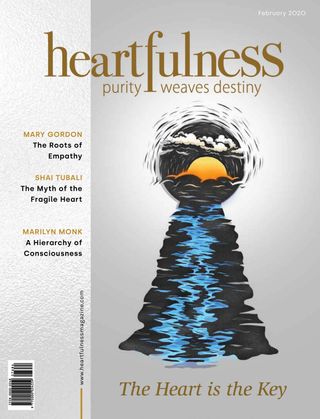

Denne historien er fra February 2020-utgaven av Heartfulness eMagazine.
Abonner på Magzter GOLD for å få tilgang til tusenvis av kuraterte premiumhistorier og over 9000 magasiner og aviser.
Allerede abonnent? Logg på
FLERE HISTORIER FRA Heartfulness eMagazine

Heartfulness eMagazine
A Touch of Heaven
Irish singer and teacher, EILISH BUTLER, combines the mystical chant of Saint Hildegard von Bingen (1098-1176) with the evolutionary path of Uncovering the Voice, satisfying her passion for mystical spirituality and music.

2 mins
November 2025

Heartfulness eMagazine
FROM INNER STILLNESS TO OUTER AGENCY:
How Heartfulness Builds an Internal Locus of Control and Workplace Success
3 mins
November 2025

Heartfulness eMagazine
Virtual Intelligence
Author and cultural commentator CHARLES EISENSTEIN extends last month's argument about virtual substitutes hollowing out reality-this time to Al's imitation of intimacy-and points to what only embodied relationships can restore.
10 mins
November 2025

Heartfulness eMagazine
Grace Is the Creative Spark
Do you sometimes feel that life is blessed and things are unfolding effortlessly, without force or struggle? Some people say it is because of “grace” or “God’s grace.
5 mins
November 2025

Heartfulness eMagazine
Zuri's Guiding Light
A luminous fable from LIAA KUMAR on self-trust, belonging, and inner guidance.
3 mins
November 2025

Heartfulness eMagazine
I AM
In a quiet meditation on desire, stillness, and the witnessing Self, JARNA KHIMANI traces the shift from seeking to being.
3 mins
November 2025

Heartfulness eMagazine
Courage: From Relief to Presence
JASON NUTTING on why relief is temporary-and how courage, rooted in the heart, endures.
3 mins
November 2025

Heartfulness eMagazine
Embracing The Value Within
DR. ROXANNE M. ST. CLAIR on seeing the value in you—and in others—and making it a daily practice.
4 mins
November 2025
Heartfulness eMagazine
Gratitude's Gift
A Creston woman recently recounted her experience in a checkout line.
2 mins
November 2025

Heartfulness eMagazine
HAPPINESS and Gut Health
Q: How does gut health influence mental well-being, and can practices like meditation actively support a healthier digestive system? The gut is often called the second brain because it has over 500 million neurons that constantly talk to the brain through the vagus nerve.
2 mins
November 2025
Translate
Change font size