
Gå ubegrenset med Magzter GOLD
Få ubegrenset tilgang til over 9000 magasiner, aviser og premiumhistorier for bare
Prøve GULL - Gratis
Are All Cooperative Banks Risky?
The Hindu Business Line
|September 25, 2019
Some are prone to weak governance and reluctance to adopt technology

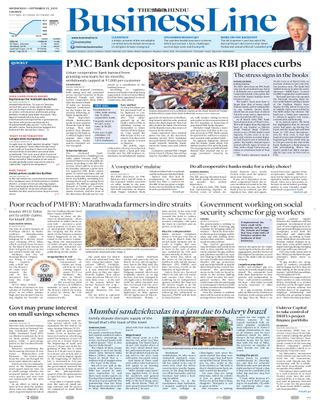
The Reserve Bank of India placing Mumbai-based Punjab and Maharashtra Cooperative Bank (PMC Bank) under directions for six months has rattled depositors.
As of March 2019, PMC Bank had outstanding deposits of ₹11,600 crore, of which, demand deposits were nearly ₹2,300 crore, and the balance were term deposits.
If you are a depositor in another cooperative bank, the recent incident is bound to be distressing news for you. But PMC Bank is not an isolated case. The regulator has, time and again, issued directions against other co-operative banks. While it may not be right to paint all cooperative banks with the same brush, there are a few points to be kept in mind before parking money in your friendly neighbourhood cooperative bank.
Is it regulated?
Cooperative banks, defined as small-sized units in the cooperative sector, operate both in urban and non-urban centres. These banks have mostly been centred around communities and localities lending to small borrowers and businesses. Traditionally, the co-operative structure is divided into two parts – rural and urban.
The rural cooperative credit system in India is primarily mandated to ensure the flow of credit to the agriculture sector. The short-term co-operative credit structure operates with a three-tier system – Primary Agricultural Credit Societies (PACS) at the village-level, Central Cooperative Banks (CCBs) at the district-level, and State Cooperative Banks (StCBs) at the State-level.
Primary Cooperative Banks (PCBs), also referred to as Urban Cooperative Banks (UCBs), cater to the financial needs of customers in urban and semi-urban areas.

Denne historien er fra September 25, 2019-utgaven av The Hindu Business Line.
Abonner på Magzter GOLD for å få tilgang til tusenvis av kuraterte premiumhistorier og over 9000 magasiner og aviser.
Allerede abonnent? Logg på
Translate
Change font size