Prøve GULL - Gratis
TURN TO CHAPTER THREE
Outlook
|August 17, 2020
The national education policy promises ‘large-scale’ changes, but can it complete unfinished lessons

A is for apple, B for ball, C for curveball—because someone has to walk the cat that defined Indian school and college education since British colonialists seeded the subcontinent with the Western primer. But the cat comes as a default setting, no matter how much one tries to move it aside. That’s the case with education policies of the past; the cat among the pigeons. That also brings to context the revised national education policy (NEP), overhauled on PM Narendra Modi’s watch after 34 years. Will it keep pace with a hyper looping century, where Windows and Androids shift shape with changing seasons? Time will tell, although history has seldom been kind to change.
Take the 1968 attempt for perspective, when Indira Gandhi’s government announced the first NEP that stressed the need for “a radical reconstruction” of the system to improve its quality, expand opportunities, provide free and compulsory education to all children up to 14, and focus on science/tech and “cultivation of moral values”. The user manual for this policy based on recommendations of the Kothari Commission—the aka for the more business-like Indian Education Commission (1964-66)—had all the to-dos that would touch the lives of every citizen, empower them to contribute towards “national progress and security”, promote “sense of common citizenship and culture”, and strengthen “national integration”. But the product didn’t sell. Education was a state subject constitutionally and the states didn’t buy the policy primarily because of their reservation towards a proposed uniform educational structure—the 10+2+3 system (ten years till matriculation, two years in pre-degree/higher secondary, and three years for college graduation).
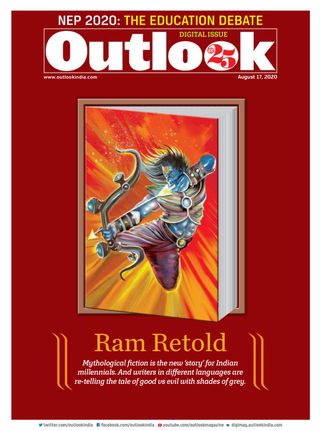

Denne historien er fra August 17, 2020-utgaven av Outlook.
Abonner på Magzter GOLD for å få tilgang til tusenvis av kuraterte premiumhistorier og over 9000 magasiner og aviser.
Allerede abonnent? Logg på
FLERE HISTORIER FRA Outlook
Outlook
Harnessing AI for a Future-Ready India
Eminent leaders from government, industry, and academia deliberated and explored the various facets of Al's impact on education and societal progress, aligning with national goals. The future of education cannot be designed in silos. It must be co-created by governments that set direction, universities that nurture inquiry, industries that bring scale, and society that provides purpose.

1 mins
March 01, 2026
Outlook
Adrift Identities
The term 'ethnicity' has always been a murky concept for me. It would not be a stretch to claim that I have always felt considerably estranged from culture itself, like a balloon left adrift in the air, floating in limbo, unknowing of its origin and destination.
3 mins
March 01, 2026

Outlook
The Memory Keepers
A handful of media enterprises have worked hard to keep the Dalit diasporic community informed of their roots and responsibilities
5 mins
March 01, 2026

Outlook
Everyday Muslim
As Hindi cinema, by and large, continues to fail to create films depicting the regular life of an Indian Muslim sans stereotyping, The Great Shamsuddin Family comes as a breath of fresh air
6 mins
March 01, 2026

Outlook
Anatomy of a Horror
In September 2025, survivor Marina Lacerda stood before the US Capitol and spoke publicly about Jeffrey Epstein for the first time. Her story, along with the account of Haley Robson, echoed the trajectory of many other victims, revealing a pattern of grooming, coercion and silence that endured for decades, and raising uncomfortable questions about power, accountability and whether justice has truly been served to Epstein's victims
9 mins
March 01, 2026

Outlook
The Audience is Present
Marina Abramović's work is active, alive and pressingly contemporary. At an uncannily youthful 79, she exudes an intimidating calm, despite the brutal images she guided us through at her lecture on the history of performance art last week at the Kochi-Muziris Biennale-from live fireworks against a man's leg to an eyeball being sliced open
6 mins
March 01, 2026

Outlook
The Master Manipulator
As a perfect facilitator, Jeffrey Epstein extended the perks of his sociopathic zeal-the kind of fun suitable for the world of dark web-to his peers. He offered a glimpse into some of the world's bigwigs without their masks
9 mins
March 01, 2026

Outlook
The Woman with the Dragon Tattoo
Epstein survivor Virginia Giuffre's memoir was written in the hope of building a world where the powerful are held to account. It was published months after she died of suicide in 2025
5 mins
March 01, 2026

Outlook
Writing with Fire
The repeated, inhumane, and systematically careless violation of the basic tenet of universal value is what the Epstein files have made public
5 mins
March 01, 2026

Outlook
Teflon of Power
In the US, the Epstein disclosures have opened a window into the lives of the rich and the famous, but no action has been taken. In Europe, however, heads have rolled
7 mins
March 01, 2026
Translate
Change font size