
Gå ubegrenset med Magzter GOLD
Få ubegrenset tilgang til over 9000 magasiner, aviser og premiumhistorier for bare
Prøve GULL - Gratis
THE ABSENT HELMSMAN
Outlook
|February 17, 2020
The leaderless surge on the streets is also a symptom: of a political vacuum

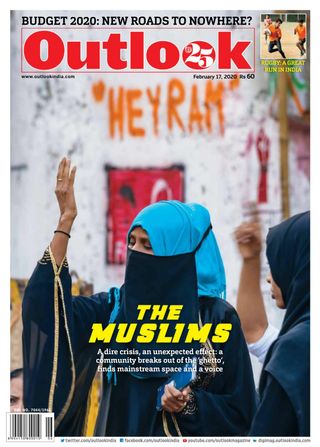
A stark fact. It’s the world’s largest democracy, one-fifth of the planet’s population. And one-fifth of that—India’s largest minority, the Muslims—have never had a collective political platform that directly represents them in independent India. The fact relates, in a way, to the very fitness of Indian democracy. The burden of ensuring their well-being has always been outsourced to ‘secular’ parties (who have borne it with very indifferent success). Why? Because the idea of Muslim political representation has a risky, dangerous past. After all, the fear of under-representation is what bought support for the Muslim League, eventually leading to Partition and its infinite madness. Any loud, visible Muslim assertion thus stokes those subterranean fears. Its bequest: a stark political vacuum.
And so, the first towering Muslim leader with a pan-India acceptance across communities—Maulana Abul Kalam Azad—is perhaps also the last one who answers to that description. The erudite Azad, India’s first education minister, leaves behind a template that’s almost inconceivable now. And invites the question. Can’t a Muslim leader be not just ‘only for Muslims’?A potential answer to that comes from the streets. Look at the ongoing anti-CAA agitations. They possess one striking facet: they are leaderless. There is no group or political party or leader who or that is, or claims to be, the one propelling them. At one level, that frames the political orphanhood of Muslims. But also, very saliently, the agitation is turning a whole battery of notions on their head. Yes, it’s an agitation that has the Muslim community at its centre—a natural consequence of how the CAA/NRC process is seen to leave them singularly and most vulnerable. But it’s also a

Denne historien er fra February 17, 2020-utgaven av Outlook.
Abonner på Magzter GOLD for å få tilgang til tusenvis av kuraterte premiumhistorier og over 9000 magasiner og aviser.
Allerede abonnent? Logg på
FLERE HISTORIER FRA Outlook
Outlook
'Why GDP Growth Doesn't Always Translate Into Votes'
The recent election results have once again shown that economic growth alone does not guarantee electoral victory.

3 mins
June 06, 2026

Outlook
Lights, Camera, Othering
The establishment of Israel has been accompanied by a national cinema devoted to negating and erasing the Palestinian Other
5 mins
June 06, 2026

Outlook
Goodbye to All That
Booker-winning British author Julian Barnes' Departure(s) is a unique hybrid work: playful, philosophical, whimsical
4 mins
June 06, 2026

Outlook
Collapse of Trust
As the NEET-UG 2026 paper leak forced the cancellation of India’s biggest medical entrance exam, more than 22 lakh aspirants find themselves trapped in uncertainty
11 mins
June 06, 2026

Outlook
NO LONGER A TWELFTH MAN
Bihar cricket, which has languished in the shadows for long, is all set to improve its strike rate, thanks to Vaibhav Sooryavanshi, the new Bihari kid on the block
5 mins
June 06, 2026
Outlook
BLAZE OF GLORY
The challenges of being a celebrity cricketer at a young age can be tough to handle
5 mins
June 06, 2026

Outlook
THE SWASHBUCKLERS
A new generation of fearless stars is emerging and finding its feet at the very top of an extremely competitive cricketing environment
5 mins
June 06, 2026

Outlook
THE TEEN TORNAD
At the age of 15, Vaibhav Sooryavanshi is already a cricketing legend
10 mins
June 06, 2026
Outlook
A Journey to Remember
The prerecorded message crackled over the din in the compartment: ‘Welcome to the Shatabdi Express.
4 mins
June 06, 2026

Outlook
Crossing Borders
Ruth Martin is the translator of German-Iranian author Shida Bazyar’s novel The Nights are Quiet in Tehran (originally written in German), which has been shortlisted for the 2026 International Booker Prize.
4 mins
June 06, 2026
Translate
Change font size