
Gå ubegrenset med Magzter GOLD
Få ubegrenset tilgang til over 9000 magasiner, aviser og premiumhistorier for bare
Prøve GULL - Gratis
Storing The Change
Outlook
|November 27, 2017
Cheaper and better batteries are set to revolutionise the concept of energy storage. Here is the tech spark that triggered the illuminating possibility of clean energy.

When Chetan Maini rolled out Reva, India’s first electric car, in 2001, he used 250-kg lead-acid batteries that ran for about 80 km and took eight hours to charge. Today, the best lithium ion (li-ion) batteries, he says, could take you, for the same weight of batteries, roughly 600 km, last five times longer and charge in less than an hour. “It’s still going to cost a lot more, of course, and yet it’s no small transition. And it’s been getting better every year,” says Bangalore-based Maini. Better, because the cost of li-ion batteries has come down almost eight per cent every year, on an average, in the past 15 years.
The next generation of batteries—and people are looking beyond li-ion—could potentially offer more energy density and possibly fix some of those niggles seen in consumer devices, the fires especially. And, while new battery technology doesn’t exactly roll out into the market as quickly as new mobile phone models do, the pace, from a chemistry point of view, has been dramatic. If it weren’t so, points out one expert, we would still be stuck with nickel-cadmium. And, yes, we wouldn’t be talking about the iPhone X, or smartphones in the first place.
“The fundamental change has been in terms of cost reduction. We were talking about $500 per kilowatt hour (kWh) some years ago; today we talk about $250 per kWh. So the cost has halved in just four or five years,” says Venkat Srinivasan of the Argonne National Laboratory in the US, where he heads the Collaborative Centre for Energy Storage Science. “Countries are now talking about having aggressive targets because they feel this is within reach. It doesn’t sound like fusion or something that is always 20 years away.”
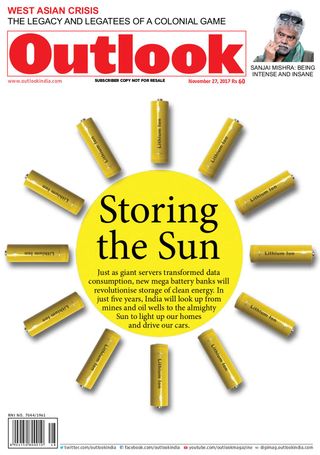

Denne historien er fra November 27, 2017-utgaven av Outlook.
Abonner på Magzter GOLD for å få tilgang til tusenvis av kuraterte premiumhistorier og over 9000 magasiner og aviser.
Allerede abonnent? Logg på
FLERE HISTORIER FRA Outlook

Outlook
'Why GDP Growth Doesn't Always Translate Into Votes'
The recent election results have once again shown that economic growth alone does not guarantee electoral victory.

3 mins
June 06, 2026

Outlook
Lights, Camera, Othering
The establishment of Israel has been accompanied by a national cinema devoted to negating and erasing the Palestinian Other
5 mins
June 06, 2026

Outlook
Goodbye to All That
Booker-winning British author Julian Barnes' Departure(s) is a unique hybrid work: playful, philosophical, whimsical
4 mins
June 06, 2026

Outlook
Collapse of Trust
As the NEET-UG 2026 paper leak forced the cancellation of India’s biggest medical entrance exam, more than 22 lakh aspirants find themselves trapped in uncertainty
11 mins
June 06, 2026

Outlook
NO LONGER A TWELFTH MAN
Bihar cricket, which has languished in the shadows for long, is all set to improve its strike rate, thanks to Vaibhav Sooryavanshi, the new Bihari kid on the block
5 mins
June 06, 2026

Outlook
BLAZE OF GLORY
The challenges of being a celebrity cricketer at a young age can be tough to handle
5 mins
June 06, 2026

Outlook
THE SWASHBUCKLERS
A new generation of fearless stars is emerging and finding its feet at the very top of an extremely competitive cricketing environment
5 mins
June 06, 2026

Outlook
THE TEEN TORNAD
At the age of 15, Vaibhav Sooryavanshi is already a cricketing legend
10 mins
June 06, 2026

Outlook
A Journey to Remember
The prerecorded message crackled over the din in the compartment: ‘Welcome to the Shatabdi Express.
4 mins
June 06, 2026

Outlook
Crossing Borders
Ruth Martin is the translator of German-Iranian author Shida Bazyar’s novel The Nights are Quiet in Tehran (originally written in German), which has been shortlisted for the 2026 International Booker Prize.
4 mins
June 06, 2026
Translate
Change font size