
Gå ubegrenset med Magzter GOLD
Få ubegrenset tilgang til over 9000 magasiner, aviser og premiumhistorier for bare
Prøve GULL - Gratis
Spotlight On The Dark Zones In The Ishrat Case
Outlook
|March 14, 2016
The spotlight is put on PC. And away from the dark zones in the Ishrat case.

In the wise words of the German philosopher Nietzsche, there are no facts in politics, only interpretations. Last week, just as a perpetually outraged nation had finished interpreting a glorious chapter on ‘nationalism’ comprising fake tweets, photoshopped pictures, doctored videos and false statements, the tuition masters were readying a chapter on ‘terrorism’, this one built on manual changes made to documents, for interpretation. Uniting the two chapters was a common strand: Pakistan.
If the first chapter was aimed at showing up students and teachers of India’s finest liberal arts institution as “anti-national”—and scaring their brethren across the country into silence—the second is aimed at further shaming a 19-year-old girl who has been dead for 12 years. If the first chapter was co-authored by ministers, policemen, mediamen and academicians owing allegiance to those in power, the second is being written by former bureaucrats no longer owing allegiance to those who were in power.
Ishrat Jahan, a BSc student from Guru Nanak Khalsa college, Mumbai, might never have thought of JNU. But the renewed attempt by the Modi government to paint her as a terrorist, allegedly on her way to kill him in 2004, when he was Gujarat CM, should surely interest some JNU scholar, who might want to learn at precisely what moment, in a liberal democracy, does it become legal to kill even a terrorist in cold blood. As the tale of the Congress-yukt UPA government’s two affidavits of 2009—one linking her to the Lashkar-e-Toiba and the other scratching out such a reference—played out, it seemed to validate widely held perceptions. But, as Nietzsche predicted, few had time for the most crucial questions:
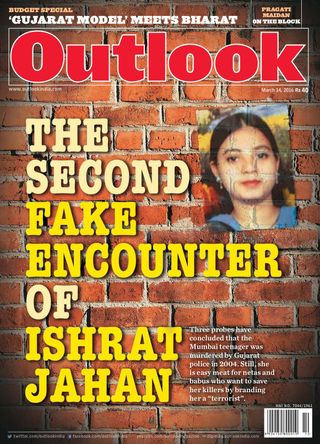

Denne historien er fra March 14, 2016-utgaven av Outlook.
Abonner på Magzter GOLD for å få tilgang til tusenvis av kuraterte premiumhistorier og over 9000 magasiner og aviser.
Allerede abonnent? Logg på
FLERE HISTORIER FRA Outlook
Outlook
'Why GDP Growth Doesn't Always Translate Into Votes'
The recent election results have once again shown that economic growth alone does not guarantee electoral victory.

3 mins
June 06, 2026
Outlook
Lights, Camera, Othering
The establishment of Israel has been accompanied by a national cinema devoted to negating and erasing the Palestinian Other
5 mins
June 06, 2026

Outlook
Goodbye to All That
Booker-winning British author Julian Barnes' Departure(s) is a unique hybrid work: playful, philosophical, whimsical
4 mins
June 06, 2026
Outlook
Collapse of Trust
As the NEET-UG 2026 paper leak forced the cancellation of India’s biggest medical entrance exam, more than 22 lakh aspirants find themselves trapped in uncertainty
11 mins
June 06, 2026

Outlook
NO LONGER A TWELFTH MAN
Bihar cricket, which has languished in the shadows for long, is all set to improve its strike rate, thanks to Vaibhav Sooryavanshi, the new Bihari kid on the block
5 mins
June 06, 2026
Outlook
BLAZE OF GLORY
The challenges of being a celebrity cricketer at a young age can be tough to handle
5 mins
June 06, 2026
Outlook
THE SWASHBUCKLERS
A new generation of fearless stars is emerging and finding its feet at the very top of an extremely competitive cricketing environment
5 mins
June 06, 2026

Outlook
THE TEEN TORNAD
At the age of 15, Vaibhav Sooryavanshi is already a cricketing legend
10 mins
June 06, 2026
Outlook
A Journey to Remember
The prerecorded message crackled over the din in the compartment: ‘Welcome to the Shatabdi Express.
4 mins
June 06, 2026

Outlook
Crossing Borders
Ruth Martin is the translator of German-Iranian author Shida Bazyar’s novel The Nights are Quiet in Tehran (originally written in German), which has been shortlisted for the 2026 International Booker Prize.
4 mins
June 06, 2026
Translate
Change font size