Prøve GULL - Gratis
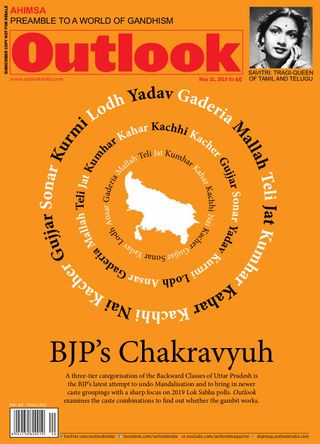
Mandal In The Jungle
Outlook
|May 21, 2018
Is the UP state government’s decision to classify OBCs in three subcategories based on relative backwardness, for the purposes of reservation, long-overdue justice for overlooked groups? Or is it an unnuanced move that will only ignite social division?

IN a bygone era, members of the Kahar social group were ordained to carry their supposed betters around in palanquins—a vocation prescribed and sanctified by the caste system. The Kahars of Uttar Pradesh, Madhya Pradesh, Bihar and elsewhere, for generations bore the burden of bridal parties and hearses alike. They also fetched water for wedding feasts and heaved onto their shoulders supplies that oiled the wheels of trade.
Their caste-based occupation, relegated to the sidelines by modern transportation, consigned Kahars to the margins of society. Today, their traditional calling, romantically depicted in film, music and literature, is an outmoded quirk. For, Kahars have cast off their ritualistic burdens and taken to agriculture, labour and modest service or commercial work. They now seek an economic and political salience that a numerically small, disadvantaged caste (around three per cent in UP) finds hard to come by.
Hence, in recent years, Kahars have tried to forge strategic affiliations based on social or occupational links with dozens of other castes. “Most backward groups, including Kahars, tend to remain socially distant from even other OBC castes who more or less share the same socio-economic status. As a result, even if we struggle as one to secure our rights, only a select few end up enjoying those rights,” says Prakash Kahar, a Supreme Court advocate who leads one of many efforts to unite Kahars with members of other caste groupings such as Manjhi, Mallah, Nonia, Bind and Ravani. Altogether, Kahar argues, a united front of several dozen communities would create a pressure group of up to 20 per cent of the population. This would give their platform, the Kahar Mahasangh, clout enough to bargain with any government for jobs, civic amenities and educational services.

Denne historien er fra May 21, 2018-utgaven av Outlook.
Abonner på Magzter GOLD for å få tilgang til tusenvis av kuraterte premiumhistorier og over 9000 magasiner og aviser.
Allerede abonnent? Logg på
FLERE HISTORIER FRA Outlook

Outlook
Get the Right Partner
The broking industry is now in a price-war phase, but cost is no longer the key differentiator. The choice will depend on how you plan to use a broking platform

4 mins
July 06, 2026

Outlook
Balanced Fertilizer Push for India
As India faces fertilizer import shocks; Deepak Shah, Chairman of CCFI calls for shift to high NUE solutions for food security and growth.
2 mins
July 06, 2026

Outlook
India’s Anaemia Paradox
From disputed estimates to hidden causes, India’s anaemia story is entering a new phase, one that could reshape how the country understands and addresses a condition affecting millions
5 mins
July 06, 2026

Outlook
Record Placements Anchor PIMR Legacy
Prestige Institute of Management and Research, Indore (Deemed to be University): Anchoring Three Decades of Academic Vanguard and Frontier Leadership
3 mins
July 06, 2026

Outlook
Clinical Excellence in High precision Radiation Therapy
Driven by the conviction that healing begins with humanity, radiation oncologist Dr. Amit Jain has impacted countless lives
2 mins
July 06, 2026

Outlook
A Paradise Worth Protecting
Ancient rainforests, endemic and rare mammals, birds and reptiles, exotic species of trees, breathtaking corals and indigenous tribes... Great Nicobar is home to all this and a lot more
5 mins
July 06, 2026
Outlook
Your Future Starts Here
Adichunchanagiri University (ACU), nurturing visionary thinkers, global leaders, and bold entrepreneurs who are ready to drive impact in a fast-evolving digital economy
3 mins
July 06, 2026

Outlook
Building a Sustainable Airport Ecosystem in Bengaluru
At Kempegowda International Airport Bengaluru (BLR Airport), sustainability is a guiding philosophy shaping infrastructure, operations, growth, resilience and workplace culture.
4 mins
July 06, 2026
Outlook
Intelligent Imaging for Smarter Healthcare
Dilip Bhosale, shares with Outlook, how Agfa Radiology Solutions is leveraging advanced digital technologies, workflow automation and global expertise to shape the future of diagnostic imaging in India in conversation with Aditi Chakraborty
2 mins
July 06, 2026

Outlook
Advancing the Future of Oncology in Eastern India
A champion of accessible and patient-centred cancer care, Dr Soma Mukhopadhyay is leading NCRI Hospital towards new standards of excellence in oncology
2 mins
July 06, 2026
Translate
Change font size