Prøve GULL - Gratis
How Start-Ups Die!
Outlook
|March 20, 2017
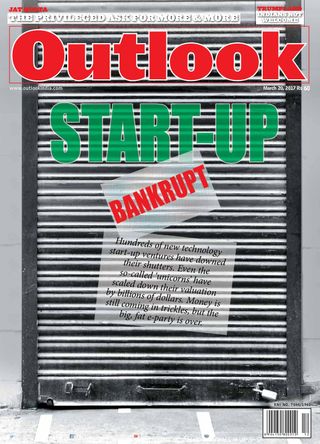
They were to inherit the earth. Start-ups, the playfield of the young and the restless, have had a hard reality check. What gives?

We don’t know the ceremonial rites followed at the collective ‘start-up funeral’ in Bangalore last month—was it cremation, or burial? And if the latter, was it in foetal position, in padmasana or standing upright? Upside down, nose first, may have been appropriate for some of them. That would visually match the steep clines observed on the performance graphs. Yes, many of them are still fighting. And yes, in India we believe in rebirth. But the story of the post hype years is most elegantly caught in some startling data.
Last week, there were talks of the beleaguered e-commerce major Snapdeal getting some much-needed oxygen supply from the funding arm of Softbank. The piece of statistic to zoom in on was the valuation: the seven-year-old company, set up by two Wharton and IIT-D alumni, was being considered at under $3 billion. That’s less than half of the $6.5-7 billion it commanded when it last raised funds just a year ago, in February 2016. This came weeks after Snapdeal sacked some 600 people and wound down some of its non-core businesses like Shop.
In December 2016, after running it for four years, India’s largest e-commerce company Flipkart pressed the shutdown button on DigiFlip, a company it had started to sell computers and accessories. Around the same time, Flipkart’s logistics arm Ekart discontinued its hyperlocal delivery and its courier service. This January, a Fidelity-managed mutual fund pegged the valuation of Flipkart at $5.56 billion. Just a year-and-a-half ago, in May 2015, at its peak, Flipkart commanded a valuation of $15.5 billion. An erosion of $10 billion in less than two years (to get the scale, that’s more than the whole NREGA outlay for 2017-18).

Denne historien er fra March 20, 2017-utgaven av Outlook.
Abonner på Magzter GOLD for å få tilgang til tusenvis av kuraterte premiumhistorier og over 9000 magasiner og aviser.
Allerede abonnent? Logg på
FLERE HISTORIER FRA Outlook

Outlook
Hating Dating
For many women, dating in their 30s and 40s is defined less by romance than by exhaustion, confusion and a sense of emotional attrition

2 mins
February 21, 2026

Outlook
Rage of Betrayals
THIS is a popular poem often shared when anyone talks of the 4B movement in South Korea. The women in this movement boycott the world of men; boycott heterosexual marriage, relationships, sex, and giving birth.
2 mins
February 21, 2026

Outlook
Class and Caste
Caste hierarchies continue to exist in everyday life and across campuses. Due to the persistence of caste in schools and colleges, long believed to be places for upward mobility and rational thought, these institutions end up becoming spaces where questions of \"merit\", cultural capital, language and access-or the lack of thereof-are highlighted and ridiculed. The discrimination persists from Kashmir to Kerala. From delayed degrees and stalled promotions to verbal abuse, professional isolation, and sometimes death, these case studies underscore not isolated instances but a pattern
18 mins
February 21, 2026

Outlook
The Misuse Myth
A close look at reported cases over the past ten years shows that there is no pattern of rampant misuse of the SC/ST Act in universities or higher education institutions
6 mins
February 21, 2026
Outlook
The Higher, The Lower
What is clear is that the entrenched caste hierarchy feels that power is slipping out from their grasp
6 mins
February 21, 2026
Outlook
Writing is Acting by Another Name
My wife spots him first while my attention is focused on the bucket of theatre popcorn (medium, salt and caramel mix). I look up and there he is. Pico Iyer, great travel writer, essayist, novelist, columnist, humanist, and in recent years, friend and correspondent. While the rest gasp when Timothee Chalamet appears in Marty Supreme, we gasp when Pico does.
3 mins
February 21, 2026

Outlook
Sins of Savarnatva
The upper castes believe that the UGC regulations are a death knell to their own existence
6 mins
February 21, 2026

Outlook
Invisible Labour, Visible Costs
Women shoulder disproportionate emotional and domestic work, shaping how they view intimacy and relationships
2 mins
February 21, 2026

Outlook
Between textbooks and court orders
From first choice to uncertainty as HIMSR-Jamia Hamdard dispute leaves students stranded
5 mins
February 21, 2026

Outlook
Aggressive Victimhood Versus Predictable Protests
The current controversy around the UGC regulations is meant neither to promote social justice and equity nor hurt the interests of the dominant castes. It's meant for the two to be at loggerheads and further consolidate their support behind the BJP-RSS combine
5 mins
February 21, 2026
Translate
Change font size