Prøve GULL - Gratis
FIND A MANAGER, MY LORD
Outlook
|February 03, 2020
Vacancies, poor judicial infrastructure keep India’s justice delivery system in cuffs

THE judiciary is one of the most complicated cogs in the governance machinery. Spread over each and every taluka of the country, it comprises of over 17,891 judges at the district/taluka level, about 676 judges at the high court level and 33 judges in the Supreme Court. We estimate a staff of approximately 32,000 bureaucrats supporting the high courts, with the graph rising at the district/taluka level. It is the judiciary that has to recruit these bureaucrats, manage its own physical and digital infrastructure, and plan for future requirements. The central and state governments have an army of IAS officers et al to help in planning and execution, but the managerial functions of the judiciary are discharged almost exclusively by the high court judges, who have to juggle it with their adjudicatory role. Little surprise then that judicial administration is mismanaged at such an epic scale.
Every now and then, you see the Supreme Court get bellicose on the high courts. In an ongoing litigation initiated suo motu by the former Chief Justice of India, all high court registrars and state chief secretaries were hauled up in open court for their failure to fill judicial vacancies and build more district-level judicial infrastructure. The court directed, for good measure, that timelines prescribed by the amicus curiae be adhered to. But these timelines are not made in consultation with those who have to execute the works: the state/district executive departments. The Supreme Court, of course, has the best interests of the judiciary in mind here, but the nature of the problem, including the financing, is such that it cannot be solved through judicial diktats.
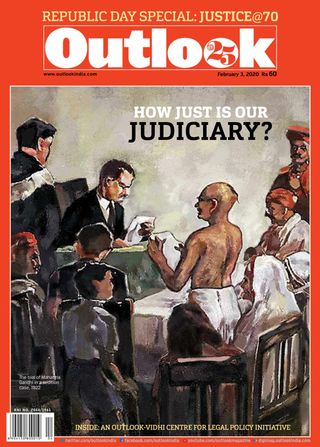

Denne historien er fra February 03, 2020-utgaven av Outlook.
Abonner på Magzter GOLD for å få tilgang til tusenvis av kuraterte premiumhistorier og over 9000 magasiner og aviser.
Allerede abonnent? Logg på
FLERE HISTORIER FRA Outlook

Outlook
The Width of the Gulf
The Iran crisis has exposed the fragility of the Gulf's traditional security paradigm while forcing its states to confront a more complex and uncertain strategic environment

4 mins
May 11, 2026
Outlook
Broadcasting Without Rules
While critics say the prime minister's recent televised address to the nation violated the poll code, is there a need to address the deeper structural gaps in the airspace framework?
5 mins
May 11, 2026
Outlook
The Final Countdown
THE longest and toughest fight in the four states and a union territory that went to polls in this blistering hot poll season has been in West Bengal.
2 mins
May 11, 2026

Outlook
House Full
From Bill burning, to a star debuting in the political arena and the tussle with the Centre, the precursor to the Tamil Nadu elections was full of drama. Will the climax be as dramatic?
7 mins
May 11, 2026

Outlook
Derided We Fall
The deeper concern is not about Pakistan's diplomatic ambitions, but about our own interpretive habits
5 mins
May 11, 2026

Outlook
The Merchant of Images
Raghu Rai, the pioneer of photojournalism in India, had a way of bringing out the soul of a picture
1 mins
May 11, 2026
Outlook
While Women Lead
Women voters may not have stood in front rows in election rallies, but they were at the centre this election. Their centrality to Tamil Nadu's political story did not begin today
5 mins
May 11, 2026

Outlook
A Persistent Unrest
Nearly three years since ethnic violence first tore through Manipur, the casualties and the cumulative toll of conflict keep accumulating. Even as the current political climate in India continues to be defined by the reverberations in mainstream poll-bound states, in Manipur, peace appears to have adopted the form of a managed illusion: one that is brittle, fragile and heavily policed
5 mins
May 11, 2026

Outlook
The State of the Provinces
During the elections this time, national and political voices have joined hands to weaken the national compact
4 mins
May 11, 2026

Outlook
Irreconcilable Impasse
The shadowboxing between the US and Iran keeps the world guessing about whether the next move will reopen talks or reignite conflict
4 mins
May 11, 2026
Translate
Change font size