Prøve GULL - Gratis
CORRECTIVE SURGERY UNDER THE DOME
Outlook
|February 03, 2020
The judiciary has served India well. Yet it suffers from grave maladies that can corrode public confidence in it. This is a prescription to cure the illness.

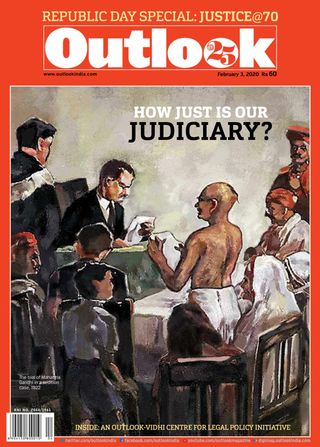
“DIFFERENT parts of the Constitution will act and react on each other and the court will have to decide questions arising from such a situation... discharging its duties as perhaps no other court has so far been called upon to do.” With these words of the first Chief Justice of India, Harilal Kania, the nation’s judicial system as we know it today, with the Supreme Court, high courts and the subordinate judiciary, started functioning on January 28, 1950. As it turns 70, there is much to be proud of—the judiciary has been the nation’s moral conscience, speaking truth to political power, upholding the rights of citizens, mediating Centre-state conflicts, providing justice to the rich and poor alike, and on several momentous occasions, saving democracy itself. Despite its achievements, a gap between the ideal and reality has been becoming clear over the years: justice delivery is slow, appointment of judges is mired in controversy, disciplinary mechanisms scarcely work, hierarchy rather than merit often appears to be the grundnorm, women are severely under-represented, and constitutional matters often languish in the Supreme Court for years. As Justice Chelameswar said in his dissent in the NJAC judgment, the courts must reform, so that they can preserve. In this spirit, here are seven reforms for the Indian judiciary at seventy:
1. Reduce hierarchy

Denne historien er fra February 03, 2020-utgaven av Outlook.
Abonner på Magzter GOLD for å få tilgang til tusenvis av kuraterte premiumhistorier og over 9000 magasiner og aviser.
Allerede abonnent? Logg på
FLERE HISTORIER FRA Outlook

Outlook
The Big Blind Spot
Caste boundaries still shape social relations in Tamil Nadu-a state long rooted in self-respect politics

8 mins
December 11, 2025
Outlook
Jat Yamla Pagla Deewana
Dharmendra's tenderness revealed itself without any threats to his masculinity. He adapted himself throughout his 65-year-long career as both a product and creature of the times he lived through
5 mins
December 11, 2025

Outlook
Fairytale of a Fallow Land
Hope Bihar can once again be that impossibly noisy village in Phanishwar Nath Renu's Parti Parikatha-divided, yes, but still capable of insisting that rights are not favours and development is more than a slogan shouted from a stage
14 mins
December 11, 2025

Outlook
The Lesser Daughters of the Goddess
The Dravidian movement waged an ideological war against the devadasi system. As former devadasis lead a new wave of resistance, the practice is quietly sustained by caste, poverty, superstition and inherited ritual
2 mins
December 11, 2025

Outlook
The Meaning of Mariadhai
After a hundred years, what has happened to the idea of self-respect in contemporary Tamil society?
5 mins
December 11, 2025

Outlook
When the State is the Killer
The war on drugs continues to be a war on the poor
5 mins
December 11, 2025

Outlook
We Are Intellectuals
A senior law officer argued in the Supreme Court that \"intellectuals\" could be more dangerous than \"ground-level terrorists\"
5 mins
December 11, 2025
Outlook
An Equal Stage
The Dravidian Movement used novels, plays, films and even politics to spread its ideology
12 mins
December 11, 2025
Outlook
The Dignity in Self-Respect
How Periyar and the Self-Respect Movement took shape in Tamil Nadu and why the state has done better than the rest of the country on many social, civil and public parameters
5 mins
December 11, 2025

Outlook
When Sukumaar Met Elakkiya
Self-respect marriage remains a force of socio-political change even a century later
7 mins
December 11, 2025
Translate
Change font size