Prøve GULL - Gratis
Big Brother And A Little Black Goat
Outlook
|February 12, 2018
Perumal Murugan re-enters the world of letters with a novel that depicts an outlier's struggle to live and love in a society where privacy is history

The main problem with getting Poonachi’s ear pierced was the set of questions it would provoke. ‘Where was she born? What was her mother’s name? Who raised her mother? How much was she bought for?’ The couple who owned Poonachi would have to respond to such questions. If they replied that they had received the newborn as a gift, that a man who looked like Bakasuran, the gluttonous demon, had given her away, the authorities might register a case of false testimony.
Accusations would be flung at the couple like arrows. ‘If he was in possession of a kid whose ears were not pierced, he might be an enemy of the regime,’ the authorities would declare. If they were to ask, ‘How did you come into contact with him? What else have you received from him?’ the couple would have no answer. The regime had the power to turn its own people, at any moment, into adversaries, enemies and traitors.
After taking everything into account, they decided to wait for ten or fifteen days. In that time, the pregnant goat in their yard would have delivered her litter. Her first pregnancy had yielded just one kid; the next few uniformly yielded two kids each. They could easily club Poonachi with two newborns and claim a litter of three. Her puny shape would support that claim. Her black colour was a problem, however. Most of the goats in the state were white. A few were brown, but black ones were rare. Once upon a time, so the lore went, the state teemed with black goats. Since they could not be recognised in the dark when engaged in any criminal activity, the regime had, it was rumoured, deliberately wiped them out. Even so, black goats could still be spotted here and there. Their colour provoked instant hostility. When they saw Poonachi, the officials would go on the alert immediately.
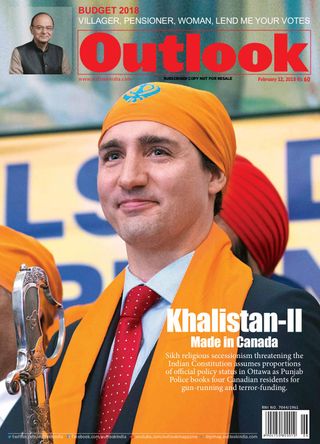

Denne historien er fra February 12, 2018-utgaven av Outlook.
Abonner på Magzter GOLD for å få tilgang til tusenvis av kuraterte premiumhistorier og over 9000 magasiner og aviser.
Allerede abonnent? Logg på
FLERE HISTORIER FRA Outlook

Outlook
Get the Right Partner
The broking industry is now in a price-war phase, but cost is no longer the key differentiator. The choice will depend on how you plan to use a broking platform

4 mins
July 06, 2026

Outlook
Balanced Fertilizer Push for India
As India faces fertilizer import shocks; Deepak Shah, Chairman of CCFI calls for shift to high NUE solutions for food security and growth.
2 mins
July 06, 2026

Outlook
India’s Anaemia Paradox
From disputed estimates to hidden causes, India’s anaemia story is entering a new phase, one that could reshape how the country understands and addresses a condition affecting millions
5 mins
July 06, 2026

Outlook
Record Placements Anchor PIMR Legacy
Prestige Institute of Management and Research, Indore (Deemed to be University): Anchoring Three Decades of Academic Vanguard and Frontier Leadership
3 mins
July 06, 2026

Outlook
Clinical Excellence in High precision Radiation Therapy
Driven by the conviction that healing begins with humanity, radiation oncologist Dr. Amit Jain has impacted countless lives
2 mins
July 06, 2026

Outlook
A Paradise Worth Protecting
Ancient rainforests, endemic and rare mammals, birds and reptiles, exotic species of trees, breathtaking corals and indigenous tribes... Great Nicobar is home to all this and a lot more
5 mins
July 06, 2026

Outlook
Your Future Starts Here
Adichunchanagiri University (ACU), nurturing visionary thinkers, global leaders, and bold entrepreneurs who are ready to drive impact in a fast-evolving digital economy
3 mins
July 06, 2026

Outlook
Building a Sustainable Airport Ecosystem in Bengaluru
At Kempegowda International Airport Bengaluru (BLR Airport), sustainability is a guiding philosophy shaping infrastructure, operations, growth, resilience and workplace culture.
4 mins
July 06, 2026
Outlook
Intelligent Imaging for Smarter Healthcare
Dilip Bhosale, shares with Outlook, how Agfa Radiology Solutions is leveraging advanced digital technologies, workflow automation and global expertise to shape the future of diagnostic imaging in India in conversation with Aditi Chakraborty
2 mins
July 06, 2026

Outlook
Advancing the Future of Oncology in Eastern India
A champion of accessible and patient-centred cancer care, Dr Soma Mukhopadhyay is leading NCRI Hospital towards new standards of excellence in oncology
2 mins
July 06, 2026
Translate
Change font size