
Gå ubegrenset med Magzter GOLD
Få ubegrenset tilgang til over 9000 magasiner, aviser og premiumhistorier for bare
Prøve GULL - Gratis
Countering Stealth
Geopolitics
|June 2017
When introduced in 1988 with the unveiling of the Lockheed F-117 Nighthawk fighter, stealth proved to be a game changing technology that turned the clock back for the erstwhile Soviet Union, which had nearly caught up with the West in military aviation technology. Stealth succeeded decisively because it proved expensive to emulate and difficult to counter for US adversaries. What does the future portend for stealth?

Stealth Overview
Stealth or Low Observability (LO), in aircraft is achieved by impairing an adversary's ability to detect the aircraft. Aerial threats can be detected using active sensors such as radars or passive electro optical, IR and electronic sensors. Because of its accuracy and effectiveness under all ambient conditions, radar is the preferred sensor. Therefore, stealth focuses heavily on eluding radar detection.
Radar Stealth
Electromagnetic radiation from a radar scatters from bodies smaller than the wavelength of the radiation. Some of the scattered radiation is reflected right back to the transmitter/receiver (Tx/Rx) of the radar resulting in a 'radar signature.' Radar stealth is achieved through airframe shaping that deflects (bounces off) radiation, instead of scattering it.
The effectiveness of the stealth shaping depends on the wavelength at which the radar is operating. If target size is greater than the radar wavelength, emissions are mostly deflected (bounced off); very little radiation is reflected back to the Tx/Rs resulting in a low 'radar signature'.
Shaping features, good at 3 cm radar wavelength are ineffective at 1 m wavelength; the radiation is scattered over a wide range of angles.
Tactical fighter-sized stealth aircraft such as the F-22 or F-35 are shaped to deflect wavelengths ranging from decimetre S-Band through centimetre X-band to sub-centimetre Ku-band; the band range in which most surveillance radars, acquisition radars, surface-to-air missile engagement radars, fighter-borne air intercept radars, and missile radar seekers operate.
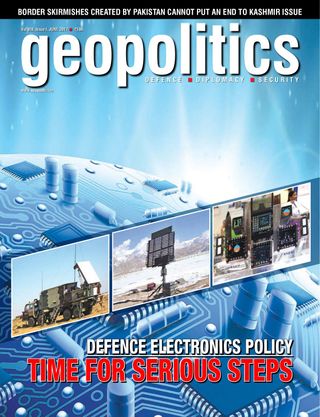

Denne historien er fra June 2017-utgaven av Geopolitics.
Abonner på Magzter GOLD for å få tilgang til tusenvis av kuraterte premiumhistorier og over 9000 magasiner og aviser.
Allerede abonnent? Logg på
FLERE HISTORIER FRA Geopolitics
Geopolitics
Tata expands Morocco push with LAMV offer
After securing an order for its WhAP 8x8 armoured vehicle from the Royal Moroccan Army, Tata Advanced Systems Limited is now actively promoting its Light Armoured Multipurpose Vehicle in the same market.

1 min
February 2026
Geopolitics
Armenia eyes India's Astra Missile for Su-30SM fleet
Armenia is in advanced discussions with India to acquire the Astra beyond-visual-range air-to-air missile, signalling a deepening of defence ties between the two countries.
1 min
February 2026
Geopolitics
SUVI V1 becomes India's first Type-Certified UAV
In India's unmanned aviation sector has reached a significant regulatory milestone with Okulo Aerospace announcing that its SUVI V1 platform has received Type Certification from the Directorate General of Civil Aviation.
1 min
February 2026

Geopolitics
Swan Defence wins Oman naval training ship contract
Swan Defence and Heavy Industries has secured a defence export contract from the Government of the Sultanate of Oman for the construction and supply of an advanced naval training ship for the Royal Navy of Oman.
1 min
February 2026

Geopolitics
HAL'S 'DHRUV' BET
Hindustan Aeronautics Limited (HAL) is attempting a careful reset of the Dhruv helicopter narrative, positioning the platform simultaneously as a cornerstone of India's future civil helicopter market and as a rehabilitated workhorse returning to frontline maritime service.
2 mins
February 2026
Geopolitics
India Offers Su-30MKM Upgrade to Malaysia
India has offered a midlife modernisation package for Malaysia's fleet of 18 Sukhoi Su-30MKM fighters, marking a significant step in bilateral defence-industrial cooperation.
1 min
February 2026
Geopolitics
Astra upgrade rooted in indigenous R and D
Recent reports linking the Indian Air Force's Astra missile upgrades to Chinese PL-15 technology have been firmly dismissed by defence officials and scientists.
1 min
February 2026

Geopolitics
COMMAND OR COMPLIANCE? RECLAIMING THE SPIRIT OF MILITARY INITIATIVE
What does it truly mean to be a military leader in a democracy? It is a question sparked by the recent controversy surrounding General Manoj Naravane's memoir. While the government always has the final say, a great general shouldn't just wait for instructions; they must lead with confidence, give honest advice, and take decisive action on the battlefield. KARAN KHARAB highlights why India needs a military culture that rewards bold Initiative over hesitation and \"seeking orders.\"
8 mins
February 2026
Geopolitics
India's integrated air combat plan from Mk1A to MkIII
India's combat aviation landscape is entering a defining phase, marked by parallel developments in aircraft production and missile technology that together reflect a broader push toward operational self-reliance.
3 mins
February 2026

Geopolitics
DEFENCE BUDGET 2026-27: FOCUS ON CAPITAL ACQUISITIONS
While there is an overall increase in the latest defence budget, the statistics only tell half of the story, explains AMIT COWSHISH
11 mins
February 2026
Translate
Change font size