
Gå ubegrenset med Magzter GOLD
Få ubegrenset tilgang til over 9000 magasiner, aviser og premiumhistorier for bare
Prøve GULL - Gratis
Collecting Minerals In Estonia
Rock&Gem Magazine
|November 2016
Calcite Crystals from the Kukersite Oil Shale.

When I told my colleagues that I was moving to Estonia, I received a lot of criticism. “What are you doing?” they asked. “Estonia has no mineralization!” they said. I held my head high and announced that Estonia has no mineralization because the science has not been performed. They laughed and told me that, during the Soviet occupation, the most elite of scientists scoured the country and came up with nothing. The only thing that can be found in Estonia, they claimed, is phosphorite and oil shale.
To their credit, they are almost correct. Estonia does possess the largest phosphorite deposit in the entirety of continental Europe (it’s actually number 14 on the EU list of critical minerals), and the oil shales that have been found in the northern areas of the country are well known and researched. In fact, the Soviets exploited the uranium from this site during their occupation of Estonia, and processed it into usable material for their nuclear weaponry. Russia has detonated at least four nuclear devices using material derived from Estonian uranium.
The city of Sillamäe, in Ida-Viru County, northeastern Estonia, was once the headquarters of the Russian nuclear program. It’s known as the “Secret City”. Beginning in 1958, the city was sealed by the Soviet government. You could liken it to Los Alamos in the United States. It’s where the smartest scientists were sent to conduct their top-secret experiments, which led to the development of the Soviet nuclear arsenal.
The city was guarded and access was severely restricted. Its location was even removed from maps as a security measure. The world only became aware of the place after the fall of the Soviet Union in 1989. Today, the radioactive dumps left behind by the processing plant are listed among the four most dangerous places in Europe.
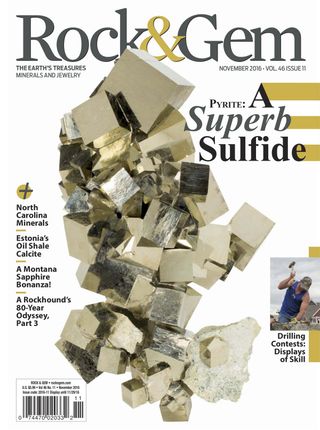

Denne historien er fra November 2016-utgaven av Rock&Gem Magazine.
Abonner på Magzter GOLD for å få tilgang til tusenvis av kuraterte premiumhistorier og over 9000 magasiner og aviser.
Allerede abonnent? Logg på
FLERE HISTORIER FRA Rock&Gem Magazine

Rock&Gem Magazine
THIS SUMMER, PICK STONY FLOWERS
Several rock and mineral formations look for all the world like flowers frozen in stone: chrysanthemum stones, flower agate, desert roses and poppy jasper.

6 mins
June 2026
Rock&Gem Magazine
An Ocean's Worth of Water in Earth's Deep Mantle
Water is key to life as we know it. When seeking life beyond our planet, Earth and planetary scientists always seek out planets and moons suspected to harbor liquid water either on the surface or beneath icy crusts.
1 min
June 2026
Rock&Gem Magazine
Hexagonal Diamonds?
Only available from the lab!
1 min
June 2026
Rock&Gem Magazine
While the World Drowns, Greenland Rises
With a mile-thick ice sheet covering 80% of its surface, Greenland accounts for a fifth of current sea level rise as that ice melts on an increasingly warm Earth.
1 min
June 2026
Rock&Gem Magazine
Argyle Diamonds
When the Argyle mine in Western Australia closed in 2020, it marked the end of one of the most remarkable chapters in modern mineral history.
2 mins
June 2026
Rock&Gem Magazine
CHANGING MINERAL MARKETS
As Rock & Gem celebrates its 55th anniversary—no small feat for a print magazine in the digital age—the hottest commodities on today’s mineral markets are lithium, the rare-earth elements and gold.
3 mins
June 2026
Rock&Gem Magazine
Grandpa's Agate Diggings
Finding Moss Agate on the Grande Ronde River
7 mins
June 2026
Rock&Gem Magazine
Does This Fossil Reveal a Whole New Kingdom of Life?
They would have looked strange in the so-called Rhynie chert landscape of the ancient Scottish Highlands 407 million years ago.
1 min
June 2026
Rock&Gem Magazine
From Maps to Satellites: Rockhounding's Tech Evolution
Rock and mineral collecting has come a long way, but the biggest changes have really occurred in just the past few decades.
5 mins
June 2026
Rock&Gem Magazine
BELLY of the DRAGON
A Rockhound's Guide
4 mins
June 2026
Translate
Change font size