
Gå ubegrenset med Magzter GOLD
Få ubegrenset tilgang til over 9000 magasiner, aviser og premiumhistorier for bare
Prøve GULL - Gratis
How Cubism Tried To Create A New Language
Philosophy Now
|October/November 2017
Stuart Greenstreet wonders why Cubist communication failed to catch on.

In 1906 Pablo Picasso painted a portrait of Gertrude Stein, an American avant-garde writer and art collector who had settled in Paris. To the complaint that the picture did not look like her, Picasso replied “No matter, it will.” What he meant is that when people had got used to ‘reading’ his new way of representing things they would be able to see the portrait’s likeness to Mrs Stein.
Picasso finished the Stein portrait two years before producing any of his explicitly Cubist works, and before the term ‘Cubism’ was invented. But it foreshadows Cubism through the influence of Cézanne’s late paintings, with their shifting, mobile viewpoint. However, Picasso and Cézanne had crucially different attitudes to their work. Cézanne drew his inspiration from his immediate visual reaction to the objects before him; whereas Picasso famously claimed “I paint objects as I think of them, not as I see them.” From 1908 onwards he was drawn to creating art according to his own internal vision.
A New Perspective on Art
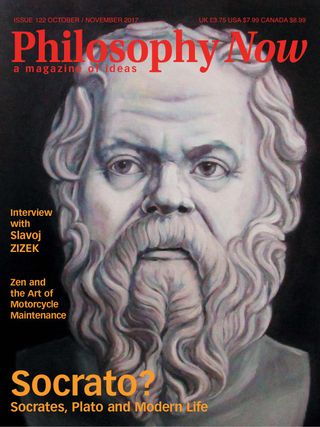

Denne historien er fra October/November 2017-utgaven av Philosophy Now.
Abonner på Magzter GOLD for å få tilgang til tusenvis av kuraterte premiumhistorier og over 9000 magasiner og aviser.
Allerede abonnent? Logg på
FLERE HISTORIER FRA Philosophy Now

Philosophy Now
The Possibility- Bearing Animal
Raymond Tallis explores a twilight zone.

7 mins
February/March 2026

Philosophy Now
Amazing Times at the Pub Agora
John Douglas Mullen is a philosophical bar fly on the wall.
8 mins
February/March 2026
Philosophy Now
Friedrich Nietzsche (1844-1900)
Hilarius Bogbinder considers the all too human life of the notorious iconoclast.
11 mins
February/March 2026

Philosophy Now
Heisenberg's Philosophy of Quantum Mechanics
Kanan Purkayastha explains how Werner Heisenberg's 1925 paper turned the quantum theory of the early 1900s into the quantum mechanics of today.
10 mins
February/March 2026
Philosophy Now
Cicero & the Ideal of Virtue
Abdullah Shaikh explores Cicero's ideas about the core Roman principle of virtus.
13 mins
February/March 2026

Philosophy Now
ROPE
Les Jones has a Nietzschean take on a Hitchcock thriller.
6 mins
February/March 2026
Philosophy Now
What Have the Romans Ever Done For Us?
Salve! This issue's theme is Roman Philosophy. But as the rebels in Monty Python's Life of Brian asked, what have the Romans ever done for us? The question seems relevant here; we are philosophers, not archaeologists.
2 mins
February/March 2026
Philosophy Now
Paul Guyer
Paul Guyer is an American philosopher and a leading scholar of both Immanuel Kant and aesthetics. AmirAli Maleki interviews him about Kant's political and moral vision.
9 mins
February/March 2026
Philosophy Now
Identity in the Age of Connectivity
Sara Asran explores the dynamics of identity online.
6 mins
February/March 2026
Philosophy Now
A Very Short History of Critical Thinking
Luc de Brabandere summarises a long history through key figures of thought.
7 mins
February/March 2026
Translate
Change font size