
Gå ubegrenset med Magzter GOLD
Få ubegrenset tilgang til over 9000 magasiner, aviser og premiumhistorier for bare
Prøve GULL - Gratis
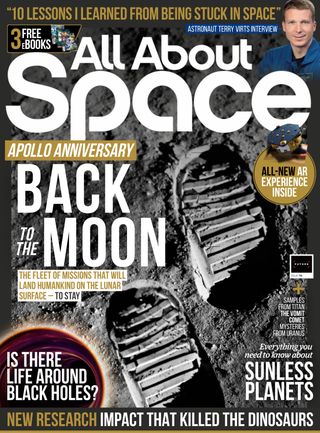
Could Life Exist Around Black Holes?
All About Space
|Issue 118
They warp time and space, but could they also nurture life?

From the coldest to the hottest regions, life on Earth has filled every conceivable ecological niche. It’s very likely life has evolved elsewhere, though despite our best efforts we haven’t seen any signs of it yet. What is truly amazing is that scientists have speculated that life could exist on planets in the neighbourhood of black holes.
Black holes are the most extreme and awe-inspiring objects in the universe. At the centre of virtually every galaxy, including our own Milky Way, resides a menacing black hole that greedily consumes everything that falls into it – from vast dust clouds and planets to whole solar systems.
In the early evolution of galaxy formation, stellar material spinning around black holes formed flattened accretion discs billions of times the mass of our Sun, and great jets of gas-fired out from them. These jets are like powerful beacons, 1,000 times brighter than our Milky Way, and are known as quasars. Much of the gas that fuelled quasars has run out in mature galaxies, but quasars can still be observed in very distant young galaxies.
The black hole itself is formed when a massive star has exhausted all its hydrogen and helium gases, causing it to violently explode and triggering its inner core to collapse in on itself. The outermost region of the black hole is the event horizon, and beyond that point the escape velocity to get out of the hole’s gravitational pull is greater than the speed of light. Therefore nothing can escape this point of infinite density, known as the singularity.
If you do fall into a black hole it is a gruesome experience, as the intense gravitational field of the singularity will pull you into a long, thin strand. This process is rather aptly called spaghettification. Any object can be spaghettified, including entire stars.

Denne historien er fra Issue 118-utgaven av All About Space.
Abonner på Magzter GOLD for å få tilgang til tusenvis av kuraterte premiumhistorier og over 9000 magasiner og aviser.
Allerede abonnent? Logg på
FLERE HISTORIER FRA All About Space
All About Space UK
MYSTERIES OF THE UNI WHERE ARE ALL THE SPIRAL GALAXIES?
There are far fewer spiral galaxies than elliptical ones in the Supergalactic Plane, and scientists are keen to discover why

7 mins
Issue 161
All About Space UK
ZOMBIE STARS
+10 OTHER TERRIFYING SPACE OBJECTS
8 mins
Issue 161

All About Space UK
HOW TO BEAT LIGHT POLLUTION
Thought it was impossible to observe the wonders of the night sky from towns and cities? Think again. Follow our tips and tricks on successfully observing through sky glow
2 mins
Issue 161
All About Space UK
15 STUNNING STAR CLUSTERS
These beautiful stellar groupings are spattered across the cosmos
8 mins
Issue 161

All About Space UK
Eileen Collins "It was a difficult mission...we were the first to see Mir"
Having served as both the first female pilot and first female commander of NASA's Space Shuttle, Collins boosted the involvement of women in space exploration to a whole new level
9 mins
Issue 161

All About Space UK
MARS LEAKS FASTER WHEN IT'S CLOSER TO THE SUN
The Red Planet has lost enough water to space to form a global ocean hundreds of kilometres deep
2 mins
Issue 161
All About Space UK
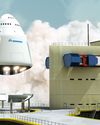
FUTURE TECH KANKOH-MARU
This ambitious reusable spacecraft will be capable of taking 50 people to and from orbit
2 mins
Issue 161
All About Space UK
THE FINAL FRONTIER
Beyond the reach of the Sun is a fascinating region of the cosmos that were only just beginning to explore
8 mins
Issue 161
All About Space UK
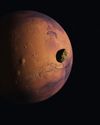
A long-lost moon could explain Mars' weird shape and extreme terrain
A long-lost moon could explain why Mars is so different from the other rocky planets in the Solar System. Today Mars has two tiny moons.
2 mins
Issue 161
All About Space UK
A sprinkling of cosmic dust may have helped kick-start life on Earth
Cosmic dust may have helped kick-start life on Earth. New findings challenge a widely held assumption that this wasn't a plausible explanation.
3 mins
Issue 161
Translate
Change font size