
Gå ubegrenset med Magzter GOLD
Få ubegrenset tilgang til over 9000 magasiner, aviser og premiumhistorier for bare
Prøve GULL - Gratis
Feed Trough Design Can Make A World Of Difference
Stockfarm
|November 2019
Feed trough design and management can have a significant impact on animal health without the producer even realising it, says Hannes Smit of Trogtek SA.

Hannes says that when it comes to equipment for cattle, including feed troughs, the most important factor is that it must be cattle resistant. “Cattle tend to push against each other, which can lead to broken equipment if it isn’t sturdy enough. This is the first principle of feed trough design.”
According to him, the second principle is efficacy, which means the feed trough must be used for its intended purpose. “Feeding must be done efficiently without wasting any feed. When using a self-feeder, the feed supply must be steady and consistent.
“Open feed troughs must be wide enough so that cattle can access it from either side to feed. They must be able to lift their heads to chew without any feed spilling onto the ground. The trough must also allow sufficient feeding space for the number of cattle for which it was designed.”
Feed trough size
The benchmark Hannes uses for size, is eight times the trough’s length. For instance, if you have a trough that is two metres long, it must be able to contain enough feed for 16 animals. In addition to the length, this type of trough needs to be 1m wide and approximately 300mm deep. If the principle of 1m for every eight head of cattle is applied in terms of length, it is adequate for rounding off cattle or feeding dairy cows.
In terms of depth, it is important to raise the trough off the ground. If the trough is 600mm high, it must be approximately 300mm deep and the space between the bottom of the trough and the ground must also be 300mm. This gap allows for the circulation of air underneath without dust being deposited in the trough. The volume of a trough that is 2m long, 1m wide and 300mm deep should be able to accommodate enough feed for 16 animals per day. A trough that is 3m long can accommodate an additional eight animals.
Feeding must be easy
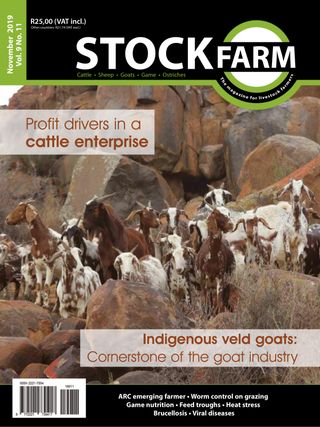

Denne historien er fra November 2019-utgaven av Stockfarm.
Abonner på Magzter GOLD for å få tilgang til tusenvis av kuraterte premiumhistorier og over 9000 magasiner og aviser.
Allerede abonnent? Logg på
FLERE HISTORIER FRA Stockfarm

Stockfarm
World School Milk Day: A national celebration of dairy
The Department of Basic Education (DBE), in partnership with Milk SA's Consumer Education Project (CEP), marked the national celebration of World School Milk Day (WSMD) at Mandlomsobo Primary School in Bronkhorstspruit on 26 September.

2 mins
January 2026

Stockfarm
A breed that you like will work with you
Data can't fix what selection broke, and your grandpa knew it.
4 mins
January 2026
Stockfarm
2025 Santam Agriculture Silage Competition: Wet conditions, winning silage
Plaas Media's twelfth Santam Agriculture National Silage Competition once again showcased impressive expertise among its participants.
4 mins
January 2026
Stockfarm
Unravelling the regulations for dairy and imitation dairy products
Regulation R1510 of 22 November 2019, which governs dairy and imitation dairy products, recently took centre stage during a webinar hosted by the Dairy Standard Agency (DSA). Thabang Rampa, manager of regulatory affairs at the DSA, provided a technical interpretation of key sections of the regulation, aimed at improving industry's understanding of the prescribed minimum compositional and labelling requirements.
3 mins
January 2026

Stockfarm
2025 ARC National Master Dairyman Awards: Top dairy farmers honoured
The Agricultural Research Council (ARC) announced the winners of its 2025 National Master Dairyman Awards during a ceremony held in November at Lanzerac Estate in Stellenbosch.
2 mins
January 2026
Stockfarm
Abattoirs: The hidden pulse of meat safety
In conversations regarding the meat supply chain, the first and final links tend to take prominence, while the work performed by the middlemen often goes unnoticed. Yet every link plays a vital role. The real question is: Do we truly understand the value each link adds? Or has ‘value addition’ become shorthand for 'price addition, leaving producers and consumers feeling the financial strain?
5 mins
January 2026

Stockfarm
Silage equipment you can't do without
Silage is an invaluable resource on many livestock farms but producing it is not always simple or cheap.
3 mins
January 2026
Stockfarm
The value of a vaccination programme for cattle
Vaccination is essential for any cattle operation, especially given the increasing risk of disease outbreaks. According to Dr Paul Reynolds, a veterinarian at the Warden and Vrede Animal Hospitals, vaccines are never developed arbitrarily. Each exists because a specific disease threat warranted it.
4 mins
January 2026
Stockfarm
Silage competition winners: Key success factors
The Santam Agriculture National Silage Competition once again delivered impressive results, maintaining its high standards and enthusiastic participation. This year’s judging spanned six key categories: nutrient composition, fermentation quality, aerobic stability, top-layer losses, compaction or density, and visual assessment.
2 mins
January 2026
Stockfarm
Why use a silage inoculant?
Producing high-quality silage is critical for any livestock operation, especially in regions where seasonal forage shortages are common. One of the most effective ways to improve silage fermentation and preservation is with a silage inoculant.
2 mins
January 2026
Translate
Change font size