Prøve GULL - Gratis
Too Early To Look For Jobs
Bureaucracy Today
|July 2017
On completion of three years in office even as Team Modi is disseminating its achievements to the public at large, Opposition parties, mainly the Congress, have projected a counter-narrative. The most damning indictment relates to the generation of a few hundred thousand jobs as against the BJP’s promise of creating 10 million every year. This is based on Labour Bureau data on eight sectors. These cover the workforce of just about 30 million (besides, there are methodological flaws in the estimation) as against the total employment of 470 million, including that in agriculture and the informal sector. Therefore, any inference using these numbers could be misleading.

Looking at the Indian job data in isolation would be a grave mistake. The more important aspects to look at are – investment in infrastructure like building roads, rails, ports, airports, affordable housing, toilets, electricity stations, schools and hospitals; creating a conducive policy environment for attracting private investment; increasing ease of doing business and pushing to small and medium enterprises.
The flaw in merely looking at jobs per se becomes apparent when one considers the fundamental fact that employment can only follow (not precede) investment in production-related activities. For instance, only after a road project is approved, all clearances obtained, land acquired and finances tied up can the work be started. Only then, jobs are created. You cannot put the cart before the horse!
So, a pertinent question to ask is whether the Modi Government has done the right things in all these areas. The answer is a resounding “yes”. There is evidence galore to demonstrate that it has acted with alacrity mobilizing necessary wherewithal to make it happen. Six broad areas of action need mention here.
First, the Modi Government has put an end to policy paralysis that had characterized the erstwhile UPA dispensation. We have a decisive Prime Minister who has a clear vision, knows what to do and what not to do and has the capacity to steer things on a well defined trajectory taking the entire Cabinet along. This ensures that decisions are taken on fast track and implemented within strict deadlines.
HELPING THE PVT CORPORATE
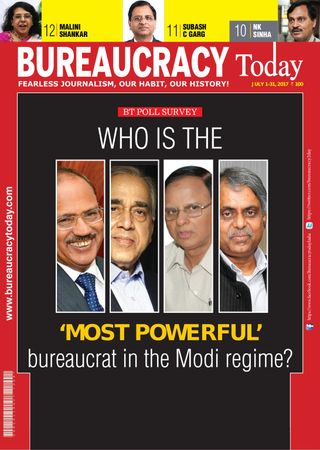

Denne historien er fra July 2017-utgaven av Bureaucracy Today.
Abonner på Magzter GOLD for å få tilgang til tusenvis av kuraterte premiumhistorier og over 9000 magasiner og aviser.
Allerede abonnent? Logg på
FLERE HISTORIER FRA Bureaucracy Today

Bureaucracy Today
Modi's ' make in India' & What Is Going Wrong With PSUs?
The year was 1930. The Great Depression had hit hard the world’s wealthiest and the mightiest nation, the United States of America.

9 mins
September 01 2016

Bureaucracy Today
After the Congress roadshow...
Congress President Sonia Gandhi’s Varanasi roadshow in August was important for more than one reason for both the party and its leaders. Banished from Uttar Pradesh governance for 27 long years, the Congress has been praying for an opportunity and a window that could start the process of its recovery and being relevant in State Assembly elections in 2017. A Bureaucracy Today report.
3 mins
September 01 2016

Bureaucracy Today
The Evolution of Fashion Retail in India
Organised retailing in India registered remarkable growth in the last decade owing to favourable demographics, growing consumer aspirations and brand consciousness. Correspondingly, the fashion category has a profound transformation over the years in terms of types and positioning of brands, formats, products and emergence of new players. The depth and variety of fashion brands took a quantum jump in shopping malls across all the sub-categories, including apparels, footwear, bags and accessories. Fashion retailers not only expanded in metros but also moved into Tier II and III cities as organised retail spaces started mushrooming in smaller towns.
3 mins
September 01 2016

Bureaucracy Today
Of Legal Quagmire and an Honest Bureaucrat
On august 16, 2016, the news of former coal secretary Hc Gupta, an accused in several coal scam cases, seeking to withdraw his personal bond to secure bail due to financial difficulties shook the entire bureaucracy. a week later, on august 27, he withdrew his petition seeking to take back his bail bond and agreed to “follow the normal legal procedure and practices”. observers opine that Gupta’s case is not just an incident of an “honest officer” finding himself unable to bear the huge cost of fighting litigation but it reflects “the deep-rooted malaise” in the indian administrative system which gives no protection to upright bureaucrats who are left all alone to fend for themselves for restoring their dignity and reputation. the incident, bureaucrats say, will demoralise officers to take any decision which will be detrimental to national interest. a Bureaucracy Today report.
3 mins
September 01 2016

bureaucracy today
how much protection is available to judges and magistrates?
after the recent supreme court observation that no public servant is entitled for the protective umbrella of section 197 of the code of criminal procedure, it is being debated whether this ruling applies equally to judges of the district courts or other subordinate courts in india.
3 mins
october 1-15,2016

bureaucracy today
five trends that will reshape the indian real estate market
among the many different factors influencing the way real estate is developed, transacted and used in india, there are five big major emerging trends that have both real-time and long-term significance.
4 mins
october 1-15,2016

Bureaucracy Today
Kill 19th Century Bureaucracy To Keep India Alive
On Independence Day this year, Indians heard Prime Minister Narendra Modi saying that his Government’s motto “is to reform, perform and transform”. On September 1, the US- headquartered think-tank, Carnegie Endowment for International Peace, noted: “India’s economy has grown rapidly in recent years, but the country’s bureaucratic quality is widely perceived to be either stagnant or in decline.” I think it is time to relook at overhauling the bureaucracy if we wish to realize the vision of Modi’s idea of India. Our country needs speed, efficiency and effectiveness in its entire chain of command. This is the prerequisite for realizing the vision of the greatest statesman of India.
4 mins
October 16-31, 2016

Bureaucracy Today
A Visit To Pakistan
A retired Indian Revenue Service officer, SK Goyal, reminisces here about his visit to Pakistan way back in 1978 and talks about the complex realities of the ties between the two nations.
3 mins
October 16-31, 2016

Bureaucracy Today
The man Behind the Successful Crackdown on Black Money Syndicate
Taking India a step closer towards making it a fully tax-compliant nation and unravelling the thick layers of the tax evasion circle, an Indian revenue Service officer, Dhruva Purari Singh, took upon himself the task of conducting a project based investigation under which he collected the database of money launderers, identified bogus companies and conducted a nationwide search to turn the “income Disclosure Scheme, 2016” into a grand success. While the nation was aware as to how Prime Minister Narendra Modi cracked a whip on tax defaulters, not many Indians knew about the intricacies of the undertaking by Dhruva Purari which makes it all the more pertinent to put him on the Cover Page of Bureaucracy Today.
6 mins
November 01 2016

Bureaucracy Today
India As An Oyster Of Global Dairy Industry
At present India is the largest milk producing and consuming country in the world with a compounded annual growth rate of 5%. The Government has been implementing the National Dairy Plan Phase I (201217). Its focus is on the development of the dairy industry for increasing its productivity, improving the village level milk procurement system and giving greater access to markets. However, it is also time for private sector players to provide extension services to farmers.
3 mins
November 01 2016
Translate
Change font size