Prøve GULL - Gratis
How Progressive Policy Has Enabled The Evolution Of Indian Automobile Industry
Bureaucracy Today
|February 01 2017
The stepping up of the Indian automobile sector began when the Ministry of Heavy Industries and Public Enterprises announced the Auto Policy 2002 to promote its integrated, phased, enduring and self-sustained growth. For the first time a national level policy support was declared to promote the sector as a lever of industrial growth and employment and to achieve a high degree of value addition in the country. However, the period of 2006-2016 was a step further from Auto Policy 2002.

Year 2000-2001: About 4.8 million vehicles were produced, 4.6 million vehicles were sold and 168 thousand vehicles were exported, valuing USD 308 million. Year 2015-2016: As many as 24 million vehicles were produced, 20.5 million vehicles were sold and 3.6 million vehicles were exported, valuing USD 8,463 million.
In just 15 years,the production of vehicles multiplied five times,their sales increased 4.4 times and their exports went up 22 times!
Such has been the growth story of the Indian automobile industry, one of the main pillars of our economy. It is rightly called the leading sunrise sector.
The period of 2006-2016 was a step further from Auto Policy 2002. It set growth targets for the automotive industry and recommended interventions to make India a global automotive hub. The Mission Plan envisaged making India the destination of choice in the world for design and manufacture of automobiles and auto components, with the output reaching a level of USD 145 billion (accounting for more than 10% of the GDP) and providing additional employment to 25 million people by 2016. It envisaged an increase in the automotive industry from the level of Rs 169,000 crore to reach Rs 561,200–Rs 731,400 crore by 2016.
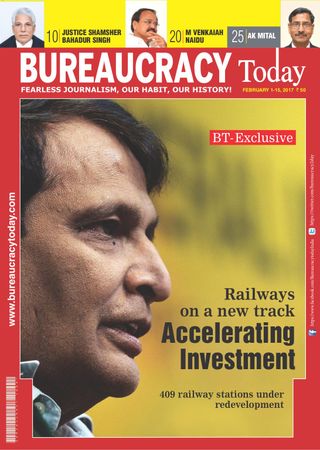

Denne historien er fra February 01 2017-utgaven av Bureaucracy Today.
Abonner på Magzter GOLD for å få tilgang til tusenvis av kuraterte premiumhistorier og over 9000 magasiner og aviser.
Allerede abonnent? Logg på
FLERE HISTORIER FRA Bureaucracy Today

bureaucracy today
has bureaucracy failed modi?
the ambitious swachh bharat abhiyaan, which was officially launched on october 2, 2014 amid much fanfare with prime minister narendra modi himself cleaning the road with a broom at rajghat in new delhi, was seen as a harbinger of change which would influence the behaviour of millions of indians who are notoriously known for dumping their wastes in public places. for months, bureaucrats wielding the broom also continued to dominate the media space. however, over two years since the campaign was launched, the cleanliness zeal, it seems, has taken a backseat. a reality check done by bureaucracy today in shastri bhawan in lutyens’ delhi which houses major central ministries indicates that those in the corridors of power are not readying themselves to become part of a new, clean and swanky india.

4 mins
january 16 - 31,2017

bureaucracy today
can cag audits be more innovative and transformative?
audit, if used properly, can become an effective aid to administration. the thumb rule is that audit must essentially capture the other side of the coin of governance. a responsive, relevant and responsible audit can only complement, supplement, support and strengthen quality governance. right audit themes, analysis and outcome can help administrators conduct a swot analysis of their strengths and weaknesses, providing deeper insights on missing issues to evaluate and take a midcourse corrective and preventive action, and help the government refocus to derive the planned outcome from projects and schemes.
4 mins
january 16 - 31,2017

bureaucracy today
increase import duty on stainless steel flat products: issda
bogged down by an unprecedented surge in imports in the last three years, especially from china, and to remain globally competitive, the indian stainless steel development association (issda) has recommended the government to increase the basic import duty on stainless steel flat products from 7.5% to 15% and to decrease the import duty on key raw materials like ferro nickel, pure nickel, ferro moly and stainless steel scrap to nil.
5 mins
january 16 - 31,2017

bureaucracy today
amritsar's emergence as a real estate hotspot
amritsar, famous for the golden temple, is the second largest city of punjab after ludhiana. it is also the most popular destination for non-resident indians in india. amritsar enjoys a strategic location with good connectivity to the prime cities of india. along with its excellent connectivity through road and rail transport, the city has an airport with a capacity of 150 commercial flights per week, both domestic and international. for the population of approximately 1.21 million in amritsar, a 31-kmlong brt corridor is nearing the completion stage to ease traffic congestion and improve public transportation in the city.
5 mins
january 16 - 31,2017

bureaucracy today
how much protection is available to judges and magistrates?
after the recent supreme court observation that no public servant is entitled for the protective umbrella of section 197 of the code of criminal procedure, it is being debated whether this ruling applies equally to judges of the district courts or other subordinate courts in india.
3 mins
october 1-15,2016

bureaucracy today
five trends that will reshape the indian real estate market
among the many different factors influencing the way real estate is developed, transacted and used in india, there are five big major emerging trends that have both real-time and long-term significance.
4 mins
october 1-15,2016

Bureaucracy Today
Is it a Crackdown or Creation of New Lords of Black Money Hoarders?
On the night of november 8 this year, Prime minister narendra modi appeared on national television to declare his Government’s decision to demonetise Rs 500 and Rs 1,000 currency notes, with a window of 50 days for a smooth transition. no doubt the move has hit those who have accumulated unaccounted black money. the Bureaucracy Today magazine analyses whether the move will stop the hoarding of black money in time to come.
15 mins
November 16-30, 2016

Bureaucracy Today
A Paradigm Project for the Future
What makes for a great development project in Morocco? Which qualities imbue an initiative with longevity and sustainability, enabling it to meet a whole range of interconnected material and emotional needs? Is there a single concept applicable to a specific geographical location that exceptionally embodies those qualities?
4 mins
November 16-30, 2016

Bureaucracy Today
Minority Shareholders 'Short-Changed' At Bombay House
The National Company Law Tribunal (NCLT) has turned down a request from Shapoorji Pallonji Group (SPG) vide its investment outfits, viz, Sterling Investment Corporation and Cyrus Investments, to initiate action against Tata Sons for the “oppression of minority interest and mismanagement”. It was done on the ground that the petitioner does not have the required minimum shareholding of 10%.
3 mins
June 1 - 31, 2017

Bureaucracy Today
Should You Buy Your Dream Home Now?
The RERA or the Real Estate Regulation Act has finally become a reality. Though there are still plenty of hiccups and it will obviously take some time for the industry to absorb all the facets of the Act, it should be kept in mind that the RERA is a process, not an event. Meanwhile, the foremost question in property buyers’ minds is - should they wait until the RERA process is streamlined, or can they go in for home purchase now?
3 mins
June 1 - 31, 2017
Translate
Change font size