
Gå ubegrenset med Magzter GOLD
Få ubegrenset tilgang til over 9000 magasiner, aviser og premiumhistorier for bare
Prøve GULL - Gratis
Reality of Universal Cancer Prevention & Cure
BioSpectrum Asia
|BioSpectrum Asia Dec 2021
Oncology is the largest pharmaceutical therapeutic area, and big pharma is investing billions of dollars in search of the elusive cancer cure. With all this investment and innovation, will we ever see a universal cancer cure? Let’s find out.
-

Oncology treatment has come a long way since the advent of chemotherapy in the 1940s. There have been tremendous advancements in the field of oncology, especially over the last two decades, resulting in improved quality of life and survival rates. There are more than 1,300 medicines and vaccines in development to tackle cancer, as of January 2021 (source: PhRMA). Many innovative therapies have been launched and pharmaceutical companies continue to invest significantly in oncology research to advance the cancer treatment market.
“Cancer has undergone huge changes in the last five years as new treatments that harness the immune system to restore the balance between cancer cells and healthy cells have been extensively evaluated. Drugs like PD-1/L1 inhibitors have revolutionised the treatment of late-stage melanoma, lung cancer and renal cancer, dramatically improving five-year survival rates,” said Daniel Chancellor, Thought Leadership Director, Informa Pharma Intelligence, UK.
“We also now have genetically modified cell therapies that produce impressive response rates for advanced forms of blood cancer. More generally, cancer populations are being defined not just by the tumor location but by an ever-growing list of biomarkers that have relevance for prognosis and the selection of appropriate targeted therapies. Chemotherapy is still an essential part of cancer treatment, but is increasingly being displaced or supplemented by innovative new cancer drugs,” added Chancellor.
The focus of cancer treatment is rapidly shifting from a traditional one-size-fits-all approach to precision medicine, tailored treatments for individual patients. Let’s look at the next wave of innovations making headlines in the cancer space:
Next wave of innovations
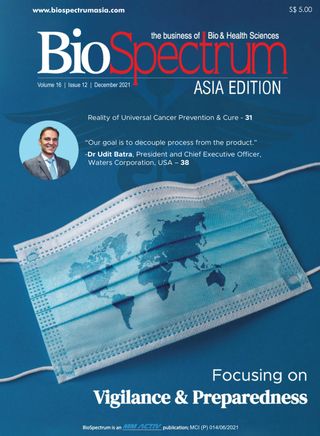

Denne historien er fra BioSpectrum Asia Dec 2021-utgaven av BioSpectrum Asia.
Abonner på Magzter GOLD for å få tilgang til tusenvis av kuraterte premiumhistorier og over 9000 magasiner og aviser.
Allerede abonnent? Logg på
FLERE HISTORIER FRA BioSpectrum Asia

BioSpectrum Asia
Alphamab Oncology appoints Fei Wang as Chief Financial Officer
Hong Kong-based Alphamab Oncology has announced the appointment of Fei Wang as the Chief Financial Officer (CFO).

1 min
BioSpectrum Asia April 2027

BioSpectrum Asia
CarbGeM inks MoU with DSS Imagetech to expand AI business in Indian market
DSS Imagetech, a leading player in medical and research imaging equipment, has announced the signing of a Memorandum of Understanding (MoU) with Japan-based CarbGeM Inc., a developer of artificial intelligence (AI)-powered life science solutions to expand its AI business in the Indian market.
1 min
BioSpectrum Asia April 2027
BioSpectrum Asia
PHCbi introduces LiCellGrow Cell Expansion System
PHC Corporation's Biomedical Division, a global provider of laboratory sample storage and cell cultivation solutions and subsidiary of Japan's PHC Holdings Corporation, has announced the launch of its new cell expansion system LiCellGrow for research use in Japan and other select countries worldwide.
1 min
BioSpectrum Asia April 2027

BioSpectrum Asia
CitiusTech appoints Dhaval Shah as Chief Business Officer - MedTech & Life Sciences
CitiusTech, a leading provider of healthcare technology services driving digital and AI excellence in India, has appointed Dhaval Shah to Chief Business Officer - MedTech & Life Sciences.
1 min
BioSpectrum Asia April 2027
BioSpectrum Asia
Thermo Fisher expands immunodiagnostics operations with new distribution centre in Uppsala
Thermo Fisher Scientific Inc. has announced the opening of a new 8,000-square-meter distribution & labeling centre supporting its immunodiagnostics business in Uppsala.
1 min
BioSpectrum Asia April 2027

BioSpectrum Asia
Harbour BioMed appoints Dr Jenny Xie as Head of Global External Innovation
Harbour BioMed, a global biopharmaceutical company focused on the discovery and development of novel antibody therapeutics in immunology and oncology, has announced the appointment of Dr Jenny Xie as Chief Scientific Officer, Immunology and Head of Global External Innovation.
1 min
BioSpectrum Asia April 2027

BioSpectrum Asia
Argo Biopharma ropes in Dr Gena Wang as CFO and CSO
China-based Argo Biopharmaceutical Co., a clinical-stage biotechnology company committed to developing next-generation siRNA therapies, has announced the appointment of Dr Gena Wang as Chief Financial Officer (CFO) and Chief Strategy Officer (CSO), effective March 1, 2026.
1 min
BioSpectrum Asia April 2027
BioSpectrum Asia
IISc launches "Moonshot" project on brain co-processors supported by Pratiksha Trust
The Indian Institute of Science (IISc), Bengaluru has launched an ambitious \"moonshot\" project to develop brain co-processors that combine neuromorphic hardware and artificial intelligence (AI) algorithms to enhance or restore brain function.
1 min
BioSpectrum Asia April 2027
BioSpectrum Asia
Korea designs model for accurate and scalable drug-drug interaction prediction
A research team from the School of International Engineering and Science at Jeonbuk National University (JBNU), South Korea, has developed DDINet, a lightweight and scalable model, specifically designed to predict interactions for new, unseen drugs.
1 min
BioSpectrum Asia April 2027

BioSpectrum Asia
Australia-Singapore study advocates role of intranasal vaccine booster against sarbecoviruses
Researchers at the Yong Loo Lin School of Medicine, National University of Singapore (NUS Medicine) and Monash University in Australia, have demonstrated that an intranasal vaccine booster may confer significantly stronger and broader immune responses, and provide robust neutralising antibody and resident T cell responses in the lung and nasal tissues, outperforming conventional mRNA booster vaccination.
1 min
BioSpectrum Asia April 2027
Translate
Change font size