
Gå ubegrenset med Magzter GOLD
Få ubegrenset tilgang til over 9000 magasiner, aviser og premiumhistorier for bare
Prøve GULL - Gratis
Breakthroughs in Rare Diseases Therapeutics
BioSpectrum Asia
|BioSpectrum Asia Feb 2024
2024 rings positive for those suffering from some kind of rare disease. On January 16, 2024, Vertex Pharmaceuticals and CRISPR Therapeutics announced that the US Food and Drug Administration has approved the use of Casgevy, a therapy that uses CRISPR gene-editing to treat the serious blood disorder, transfusion-dependent beta-thalassemia, marking the second major US regulatory approval for the emerging gene-editing technology. This approval is a testament to the breakthroughs in therapeutics for rare medical conditions.
-

The previous year witnessed many promising developments in the fight against rare diseases. The recent Casgevy's FDA approval for beta thalassemia comes just one month after the US drug regulator approved the use of Casgevy in treating sickle cell disease — which is notably the first time the CRISPR-based treatment received a regulatory green light in the United States.
Casgevy uses the novel CRISPR gene-editing technology to modify patients’ blood cells and transplant the modified cells back into the bone marrow, triggering an increase in the production of haemoglobin, according to the FDA.
Rare diseases are considered as a significant health challenge. Between 5,000 and 8,000 rare diseases have been identified and these diseases, though not prevalent like other diseases, as a group, affect 6 to 8 per cent of the global population. Rare diseases present unique problems for not only the individuals living with the rare medical condition but for caregivers, researchers, policymakers, and industries as well.
More than 80 per cent of rare diseases are caused by genetic or congenital aberrations, and 75 per cent present with a wide range of neurological symptoms and physical and intellectual disabilities. Sadly, rare diseases mostly affect children or young adults, and even worse, several siblings can be affected in the same family. As such, these diseases come with substantial hardship for both parents and patients. Hence, advancing therapies to cater to their wellbeing is of utmost critical.
Urgency for R&D
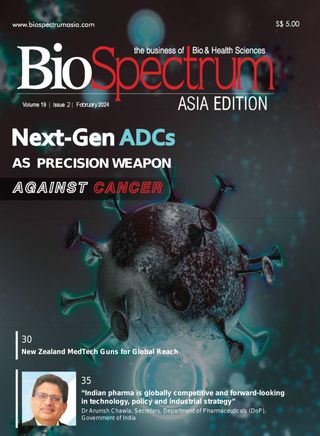

Denne historien er fra BioSpectrum Asia Feb 2024-utgaven av BioSpectrum Asia.
Abonner på Magzter GOLD for å få tilgang til tusenvis av kuraterte premiumhistorier og over 9000 magasiner og aviser.
Allerede abonnent? Logg på
FLERE HISTORIER FRA BioSpectrum Asia

BioSpectrum Asia
Alphamab Oncology appoints Fei Wang as Chief Financial Officer
Hong Kong-based Alphamab Oncology has announced the appointment of Fei Wang as the Chief Financial Officer (CFO).

1 min
BioSpectrum Asia April 2027

BioSpectrum Asia
CarbGeM inks MoU with DSS Imagetech to expand AI business in Indian market
DSS Imagetech, a leading player in medical and research imaging equipment, has announced the signing of a Memorandum of Understanding (MoU) with Japan-based CarbGeM Inc., a developer of artificial intelligence (AI)-powered life science solutions to expand its AI business in the Indian market.
1 min
BioSpectrum Asia April 2027
BioSpectrum Asia
PHCbi introduces LiCellGrow Cell Expansion System
PHC Corporation's Biomedical Division, a global provider of laboratory sample storage and cell cultivation solutions and subsidiary of Japan's PHC Holdings Corporation, has announced the launch of its new cell expansion system LiCellGrow for research use in Japan and other select countries worldwide.
1 min
BioSpectrum Asia April 2027

BioSpectrum Asia
CitiusTech appoints Dhaval Shah as Chief Business Officer - MedTech & Life Sciences
CitiusTech, a leading provider of healthcare technology services driving digital and AI excellence in India, has appointed Dhaval Shah to Chief Business Officer - MedTech & Life Sciences.
1 min
BioSpectrum Asia April 2027
BioSpectrum Asia
Thermo Fisher expands immunodiagnostics operations with new distribution centre in Uppsala
Thermo Fisher Scientific Inc. has announced the opening of a new 8,000-square-meter distribution & labeling centre supporting its immunodiagnostics business in Uppsala.
1 min
BioSpectrum Asia April 2027

BioSpectrum Asia
Harbour BioMed appoints Dr Jenny Xie as Head of Global External Innovation
Harbour BioMed, a global biopharmaceutical company focused on the discovery and development of novel antibody therapeutics in immunology and oncology, has announced the appointment of Dr Jenny Xie as Chief Scientific Officer, Immunology and Head of Global External Innovation.
1 min
BioSpectrum Asia April 2027

BioSpectrum Asia
Argo Biopharma ropes in Dr Gena Wang as CFO and CSO
China-based Argo Biopharmaceutical Co., a clinical-stage biotechnology company committed to developing next-generation siRNA therapies, has announced the appointment of Dr Gena Wang as Chief Financial Officer (CFO) and Chief Strategy Officer (CSO), effective March 1, 2026.
1 min
BioSpectrum Asia April 2027
BioSpectrum Asia
IISc launches "Moonshot" project on brain co-processors supported by Pratiksha Trust
The Indian Institute of Science (IISc), Bengaluru has launched an ambitious \"moonshot\" project to develop brain co-processors that combine neuromorphic hardware and artificial intelligence (AI) algorithms to enhance or restore brain function.
1 min
BioSpectrum Asia April 2027
BioSpectrum Asia
Korea designs model for accurate and scalable drug-drug interaction prediction
A research team from the School of International Engineering and Science at Jeonbuk National University (JBNU), South Korea, has developed DDINet, a lightweight and scalable model, specifically designed to predict interactions for new, unseen drugs.
1 min
BioSpectrum Asia April 2027

BioSpectrum Asia
Australia-Singapore study advocates role of intranasal vaccine booster against sarbecoviruses
Researchers at the Yong Loo Lin School of Medicine, National University of Singapore (NUS Medicine) and Monash University in Australia, have demonstrated that an intranasal vaccine booster may confer significantly stronger and broader immune responses, and provide robust neutralising antibody and resident T cell responses in the lung and nasal tissues, outperforming conventional mRNA booster vaccination.
1 min
BioSpectrum Asia April 2027
Translate
Change font size