Prøve GULL - Gratis
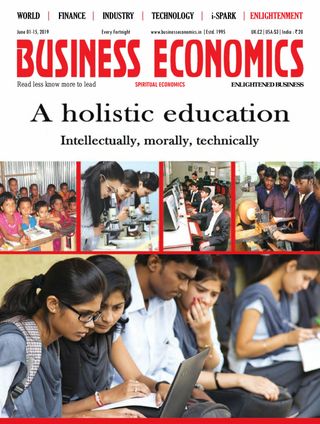
India Needs To Spend More On Education To Meet Future Challenge
BUSINESS ECONOMICS
|June 1-15, 2019
When Benjamin Franklin, the American polymath and a founding father of the United States of America said that “an investment in knowledge pays the best interest”, he had referred to its uses and not to its mere accumulation.

Franklin said it more than two centuries ago and his concept of the use of knowledge differed completely from what it means today.
Education today is largely considered as a mean to obtain gainful employment. Indeed, many organisations that evaluate the return on investment in education often do it on the basis of the employability quotient.
The data with regard to India are, unfortunately, quite alarming. According to the International Labour Organisation (ILO), India will again see its unemployment rate at 3.5% in 2018 and 2019, the same which was seen in 2017 and 2016. According to the latest data, there will be 18.9 million jobless people in India next year which will be a little more than 18.6 million for 2018.
One of the reasons behind this is that India has a small number of quality institutions in spite of the growth in the number of higher education providers. Consequently, a large number of self-financed private institutions have mushroomed to cater to the growing demand from the aspiring students. Many of these institutions lack requisite infrastructure facilities and qualified faculty. As a result, a large number of the students coming out of these institutions often lack the aptitude and skills which the employers, particularly in the corporate sector, are looking for.
The big challenge the country faces today is how education can be rewired to focus on imparting knowledge that responds to market demand. That is, how can education make students future-ready? It is critical for India to develop workable paradigms that addresses the knowledge revolution and the challenges the future workforce would need to address. Unless it happens, education and employability cannot be correlated.

Denne historien er fra June 1-15, 2019-utgaven av BUSINESS ECONOMICS.
Abonner på Magzter GOLD for å få tilgang til tusenvis av kuraterte premiumhistorier og over 9000 magasiner og aviser.
Allerede abonnent? Logg på
FLERE HISTORIER FRA BUSINESS ECONOMICS

BUSINESS ECONOMICS
Rupee has weakened
The rupee has weakened significantly over the past year, falling from 84.7 to 89.7 against the US dollar. Its depreciation has been even sharper against the euro (9.4 per cent) and the British pound (14.3 per cent). It has also lost value against the Japanese yen and the Chinese yuan. In nominal terms, therefore, the rupee has depreciated against all major global currencies.

1 mins
December 1 - 31, 2025

BUSINESS ECONOMICS
Foundations of Indian Yoga Philosophy
Yoga, in very simple terms, means union.
4 mins
December 1 - 31, 2025

BUSINESS ECONOMICS
The New Indian Professional: Work, Wealth & Wellness in 2026 Changing aspirations, consumption patterns, and lifestyle expectations
As 2025 draws to a close, a new archetype is emerging across India's corporate and entrepreneurial landscape.
4 mins
December 1 - 31, 2025
BUSINESS ECONOMICS
Where Rhythm Meets Divinity: A Three-Day Odyssey of Indian Classical Art
An Artistic Journey Through Dance, Melody & Tradition (27-29 November 2025)
3 mins
December 1 - 31, 2025
BUSINESS ECONOMICS
Bharat Electronics Ltd
BEL is a public sector undertaking (PSU) under the Indian government's Ministry of Defence.
2 mins
December 1 - 31, 2025

BUSINESS ECONOMICS
A New Crisis: Impact of US Tariff hikes on UP's Industries
Long-established industrial centres such as Kanpur, Moradabad, Bhadohi and Firozabad are currently facing severe disruptions due to the imposition of steep US tariffs.
2 mins
December 1 - 31, 2025

BUSINESS ECONOMICS
Nobel Prize in Physiology or Medicine 2025 Significance of the Laureates' Work in the Medical World
Mary E. Brunkow, Fred Ramsdell, and Shimon Sakaguchi have been awarded the 2025 Nobel Prize in Physiology or Medicine for their pioneering discoveries on peripheral immune tolerance—the mechanisms that prevent the immune system from attacking the body’s own tissues.
2 mins
December 1 - 31, 2025

BUSINESS ECONOMICS
The RBI's Balancing Act: Strategy and Execution in 2025
In 2025, the Reserve Bank of India (RBI) has adopted a cautious yet steady monetary policy, distinguishing itself from the more aggressive actions of several global central banks.
3 mins
December 1 - 31, 2025

BUSINESS ECONOMICS
From stagnation to surge: 10 reasons the Indian market rallied hard
The Indian stock market spent most of 2025 moving sideways in a narrow and frustrating band.
5 mins
December 1 - 31, 2025

BUSINESS ECONOMICS
Uttar Pradesh witnesses renovations of pilgrimage sites propelling multi-dimensional growth
Last month, Prime Minister Narendra Modi ceremonially hoisted the saffron flag, the Dharma Dhwaj, atop the Ram Temple in Ayodhya, marking the completion of the temple's construction.
3 mins
December 1 - 31, 2025
Translate
Change font size