Prøve GULL - Gratis
Why SA Leads The World In Effective Lucerne Hay Grading
Farmer's Weekly
|March 9, 2018
Lucerne is one of the most important hay crops in South Africa, but differences in quality can have a marked effect on livestock performance and profitability, especially in the dairy industry. Annelie Coleman asked agricultural economist Walter van Niekerk and lucerne specialist Dr Gerrie Scholtz about the benefits of the National Lucerne Trust’s lucerne grading system.
-

Lucerne hay is used in all livestock production, but is a particularly valuable resource in the dairy cattle industry. However, the quality of the feed is directly related to nutritional value.
For this reason, the National Lucerne Trust’s new lucerne hay quality index (NLQI) has become an indispensable tool for ascertaining the quality of lucerne, according to Walter van Niekerk, an agricultural economist at the University of the Free State.
STEADY IMPROVEMENT
Also known as alfalfa, lucerne (Medicago sativa) is a perennial flowering plant in the pea family Fabaceae. It was one of the earliest crops cultivated specifically for animal feed, and was grown for that purpose by the ancient Greeks and Romans.
By the time it was introduced into Germany in the 1500s, hybridisation had already occurred, resulting in, among others, M. falcate, an animal fodder crop tolerant to cold, drought and resistant to disease. More hybrid species followed, including the French or Mediterranean-type, Provence, which is of great importance in South Africa.
Today, lucerne growers have a wide variety of cultivars to choose from, and base their selection on factors such as dormancy or activity rating, crown height, fit for purpose (hay production or grazing), disease resistance, insect pest resistance, and forage yield. Plant breeding efforts use scientific methodology and technology to develop improved varieties.
Lucerne hay is commonly included in the diets of lactating dairy cows as it is a rich source of protein and energy. It ferments quickly and has a wide mineral profile while providing the fibre required for rumen health and butterfat synthesis in milk.
“Adding lucerne hay to dairy cow diets improves the digestibility of the total diet, resulting in increased dry material intake and subsequent higher milk production,” explains Van Niekerk.
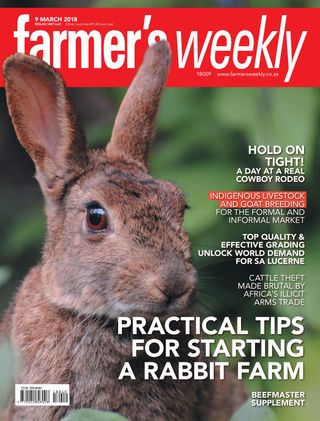

Denne historien er fra March 9, 2018-utgaven av Farmer's Weekly.
Abonner på Magzter GOLD for å få tilgang til tusenvis av kuraterte premiumhistorier og over 9000 magasiner og aviser.
Allerede abonnent? Logg på
FLERE HISTORIER FRA Farmer's Weekly

Farmer's Weekly
A new market and better access will boost agri growth
The trade protocol for stone fruit exports to China presents an opportunity for South African farmers to expand their production and generate foreign earnings

3 mins
February 27 - March 06, 2026

Farmer's Weekly
Beware of excessive inbreeding during livestock production
Mating of closely related animals on communal farms not only has monetary consequences, but also has an impact on the genetic make-up of livestock, animal performance, and fertility, says Shane Brody.
3 mins
February 27 - March 06, 2026
Farmer's Weekly
Good rain bodes well for grain yields, but disease and price pressure mounts
Above-average rainfall has improved soil moisture and boosted prospects for an above-average grain crop across the summer rainfall region. However, delayed planting, disease pressure, limited heat units and low grain prices mean producers remain cautious as the season enters a critical phase.
3 mins
February 27 - March 06, 2026

Farmer's Weekly
Serious misconduct does not mean automatic dismissal
A disciplinary hearing ensures that a fair procedure is followed and that there is a valid, substantive reason to justify the employee's dismissal
2 mins
February 27 - March 06, 2026
Farmer's Weekly
South Africa's magnificent gum trees
Since the 1830s, over 85 gum tree species have been successfully introduced to South Africa. Mike Burgess writes about the gum's destructive, invasive tendencies, but also its many gifts to South Africans.
2 mins
February 27 - March 06, 2026

Farmer's Weekly
Annual harvest celebration honours wine industry leaders for setting benchmarks
At the annual Wine Harvest Commemorative Event, held recently at Groot Constantia Wine Farm in Cape Town, top wine professionals were honoured for setting standards their peers can aspire to.
1 mins
February 27 - March 06, 2026
Farmer's Weekly
Notable increase in subtropical crops puts pressure on prices
Market conditions will dominate the list of concerns in the subtropical crops sector this year, as tariff volatility is expected to continue. The citrus, avocado, and macadamia industries are all expecting an increase in yields this year, increasing the pressure to balance supply and demand.
6 mins
February 27 - March 06, 2026
Farmer's Weekly
The high cost of cheap stitches
There is a particular brand of anxiety found in unrequited loyalty.
1 mins
February 27 - March 06, 2026

Farmer's Weekly
Zambia's silent crisis: why heat stress is the new frontier for public health
As temperatures in Zambia near 40°C, farmers face a hidden health emergency. Research led by medical scientist Anayawa Nyambe, a researcher at the University of Zambia, shows heat stress is driving widespread illness and cognitive decline in rural workers, yet the national health system remains largely blind to the risk.
5 mins
February 27 - March 06, 2026

Farmer's Weekly
Early emergence starts at planting with the Case IH Early Riser planter
By helping crops emerge sooner and more evenly, the Early Riser planter supports stronger establishment - laying the foundation for the season ahead.
2 mins
February 27 - March 06, 2026
Translate
Change font size