Prøve GULL - Gratis
Wheat Industry Plan Gains Momentum
Farmer's Weekly
|January 18, 2019
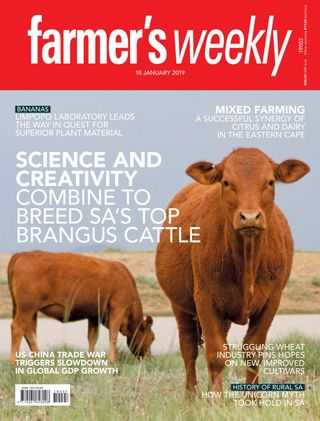
In 2012, South Africa’s wheat industry launched the Wheat Industry Plan to alleviate the country’s dependence on grain imports. Andries Theron, chairperson of Grain SA’s winter cereals working group, spoke to Glenneis Kriel about progress made with implementing the plan.

WHY WAS THE WHEAT INDUSTRY PLAN LAUNCHED?
The Wheat Forum, represented by producers, millers, bakers and researchers, launched the Wheat Industry Plan in 2012 due to concern that South Africa was becoming too dependent on wheat imports and that this could affect food security.
During the 1990s, South Africa produced over three million tons of wheat a year, and in some years this was more than could be used locally. By 2012, due to decreasing profitability, the area under production had shrunk from more than a million hectares to less than 500 000ha. Better-paying alternatives had become available, thanks to the development of genetically modified maize and soya bean.
To meet demand, wheat imports gradually increased as local production decreased, and since about 2012 we’ve been importing more wheat than we’ve produced. Initially, the Wheat Industry Plan was introduced to create a turnaround strategy, but it was later agreed to simply try to halt this trend for now.
HOW DID PROFITABILITY ISSUES AFFECT THE AREA OF PRODUCTION?
The Free State used to be seen as the breadbasket of South Africa. Nowadays, little wheat is produced in the province. Instead, the Western Cape produces roughly 50% of the total harvest and the irrigated areas of the Northern Cape grow about 25%.
HAVE FARMERS ADAPTED?
Many have adopted new technologies such as precision farming to reduce input costs and enhance farming efficiency, and they’ve also introduced conservation farming methods. The latter entail the use of minimum tillage, crop rotation and stubble retention, not only to reduce machine-related fuel costs, but also to alleviate the impact of drought by improving soil water-holding capacity.
WHAT DOES THE WHEAT INDUSTRY PLAN ENTAIL?

Denne historien er fra January 18, 2019-utgaven av Farmer's Weekly.
Abonner på Magzter GOLD for å få tilgang til tusenvis av kuraterte premiumhistorier og over 9000 magasiner og aviser.
Allerede abonnent? Logg på
FLERE HISTORIER FRA Farmer's Weekly

Farmer's Weekly
More about growing vegetable seedlings in trays
By considering various factors and tailoring care to specific vegetable needs, you can produce healthy, robust seedlings ready for transplanting into the garden, writes Shane Brody.

2 mins
March 27 - April 3, 2026

Farmer's Weekly
Prodigy of agriculture and land is now a presidential envoy
Wandile Sihlobo will be armed by state powers to accelerate any decision-making that the Presidency deems crucial to grow the sectors of agriculture and land
2 mins
March 27 - April 3, 2026

Farmer's Weekly
Notes from the Western Cape agricultural roadshow
We spent time last week engaging with agribusinesses and farmers in the Western Cape. The primary agricultural focus of the province is various fruits, citrus, table grapes, wine, wheat, barley, livestock, and aquaculture, among many value chains.
3 mins
March 27 - April 3, 2026

Farmer's Weekly
AGOA's promise fades under new US tariffs
Although the African Growth and Opportunity Act has been extended for another year, new US reciprocal tariffs have largely erased its duty-free benefits. Recent modelling shows sharp declines in African exports to the US, particularly in apparel-dependent economies such as Lesotho and Madagascar.
4 mins
March 27 - April 3, 2026
Farmer's Weekly
Egon Zunckel: a lifetime of learning from the soil
The Zunckel name is synonymous with no-till farming in South Africa. Egon Zunckel, a pioneer in the field and a passionate advocate for soil health, shared with Lindi Botha the lessons he has learnt over the years about building resilient soils and sustainable farming systems.
10 mins
March 27 - April 3, 2026
Farmer's Weekly
Researchers explore new tools to combat herbicide resistance
Research by students from Stellenbosch University aimed at combatting herbicide resistance was highlighted during a recent technical trial information day hosted by the Western Cape Department of Agriculture.
6 mins
March 27 - April 3, 2026

Farmer's Weekly
Lepas leaps into South Africa as the latest Chery-owned brand
Lepas has become Chinese carmaker Chery's latest local subbrand with the introduction of the L4 compact SUV. The Citizen's Charl Bosch reports.
2 mins
March 27 - April 3, 2026

Farmer's Weekly
La Rhone Limousins: a small mixed herd turned renowned stud
The Western Cape is not typically known for cattle farming, particularly in its fruit-growing regions. Yet nestled among the orchards below the mountains of Tulbagh is a Limousin stud that has made a name for itself. AJ du Toit of La Rhone Limousins spoke to Henning Naudé about producing high-quality genetics now found on farms in all nine provinces.
6 mins
March 27 - April 3, 2026
Farmer's Weekly
Nitrogen: no easy fix
Products that claim to herald a nitrogen revolution that will boost global food production are nothing more than snake oil, say scientists.
4 mins
March 27 - April 3, 2026

Farmer's Weekly
Potato soup
Rich, creamy, and indulgent, this soup is the ultimate in comfort food.
1 mins
March 27 - April 3, 2026
Translate
Change font size