Prøve GULL - Gratis
Low-chill Blueberry Production In Limpopo
Farmer's Weekly
|July 6, 2018
By securing planting rights to varieties bred to withstand warmer climates, Rosle Boerdery’s Charles Rossouw has become a leader in blueberry production in South Africa. Lindi Botha reports.

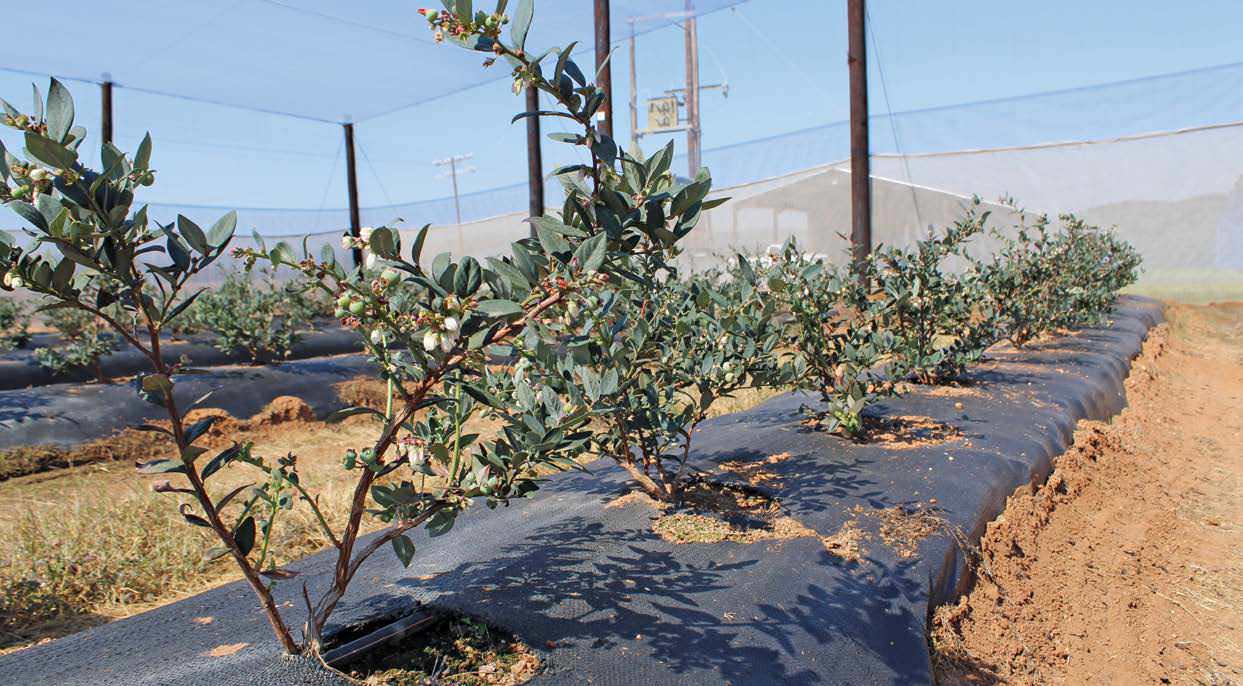
Hailed as a super food, blueberries are in growing demand worldwide, and to meet this need will require a significant boost in supply and innovation.
Blueberries normally require a high number of chilling units. In South Africa, blueberry farming has therefore been limited to colder climates, with 60% of production taking place in the Western Cape. However, in 2006, Charles Rossouw, owner of Rosle Boerdery in the Loskop Valley of Limpopo, saw an opportunity to plant blueberries on a large scale in this warmer climate after investigating low-chill varieties.
TAKING THE LONG VIEW
Rosle Boerdery has 800ha under production, of which 700ha are planted to citrus. The remaining 100ha were under grapes, and it was this land that Rossouw targeted for blueberries after realising that grapes were not the ideal crop for his farm.
“This is a summer rainfall region and it receives around 500mm annually. The last few years, however, have seen less rain and a good exchange rate, so the grapes have made money, but over the long term they’re not very profitable. Also, the cost of labour with grapes is incredibly high as it involves tending the vines, harvesting and packing.
“With blueberries, I have the same spraying programme as with grapes, but I start spending money on labour only once the harvest starts. Also, my exposure to risk is lower because when the rainy season starts I’ve already harvested the bulk of the blueberries.”
As traditional blueberries would not have done well in the higher temperatures of Groblersdal, Rossouw has purchased the rights to grow the ever-green Australian OZblu varieties, which have been specifically bred to forego dormancy and flourish with low chilling requirements.

Denne historien er fra July 6, 2018-utgaven av Farmer's Weekly.
Abonner på Magzter GOLD for å få tilgang til tusenvis av kuraterte premiumhistorier og over 9000 magasiner og aviser.
Allerede abonnent? Logg på
FLERE HISTORIER FRA Farmer's Weekly
Farmer's Weekly
Cash flow budgets: keeping farmers in control of liquidity, risk, and their survival
Profit doesn't guarantee a farm's survival - cash does. Cobus du Plessis explains why cash flow budgets are one of the most important yet underused financial tools on South African farms.

5 mins
February 27 - March 06, 2026

Farmer's Weekly
The toast of the Navy
The incredible story of the World War II-era Great Dane dog Nuisance being enlisted in the Royal Navy is well documented. Graham Jooste shared some entertaining anecdotes involving the canine shipmate.
6 mins
February 27 - March 06, 2026
Farmer's Weekly
Healthier soils deter destructive locusts
Locust swarms remain a serious global threat, capable of devastating crops, livelihoods and local economies across vast regions.
1 min
February 27 - March 06, 2026
Farmer's Weekly
Wheat crisis dominates Grain SA regional meetings
As the ongoing wheat crisis continues to erode producers' margins, emotions ran high at Grain SA's regional meeting in Moorreesburg in the Western Cape.
2 mins
February 27 - March 06, 2026

Farmer's Weekly
A FARMER'S EXPERIENCE
Street Wallet has been a game-changer for Mario Athanasopoulos, hydroponic production consultant and owner of Green City Farms.
1 mins
February 27 - March 06, 2026
Farmer's Weekly
Kesieberg Merino Stud Production Sale
The Kesieberg Merino Stud Production Sale was held on the farm Leeuwfontein on 4 February on behalf of Willie and Herman Henning.
1 min
February 27 - March 06, 2026

Farmer's Weekly
Not cheaper, just different: what you should know about farming in Mozambique
Although Mozambique is often viewed as a cheaper, easier farming location than South Africa, cost comparisons tell a more complex story. But while cross-border production presents real challenges, it also offers opportunities for complementary trade, diversification and regional food security, particularly when it comes to subtropical crops such as bananas.
10 mins
February 27 - March 06, 2026

Farmer's Weekly
The all-rounder anchoring South Africa's beef value chain
Louis Steyl, CEO of the Bonsmara Cattle Breeders' Society of South Africa, spoke to Octavia Avesca Spandiel about how the versatile Bonsmara breed anchors the country's beef value chain, delivering balanced performance, reproductive and feed efficiency, and carcass traits across extensive and intensive systems.
6 mins
February 27 - March 06, 2026

Farmer's Weekly
THE HITCHING POST
I'm a 60-year-old white woman who loves camping, animals, the outdoors, and watching sport.
2 mins
February 27 - March 06, 2026
Farmer's Weekly
Foot-and-mouth disease in pigs
Recently, the radio news mentioned an outbreak of foot-and-mouth disease (FMD) in pigs in South Africa.
2 mins
February 27 - March 06, 2026
Translate
Change font size