Prøve GULL - Gratis
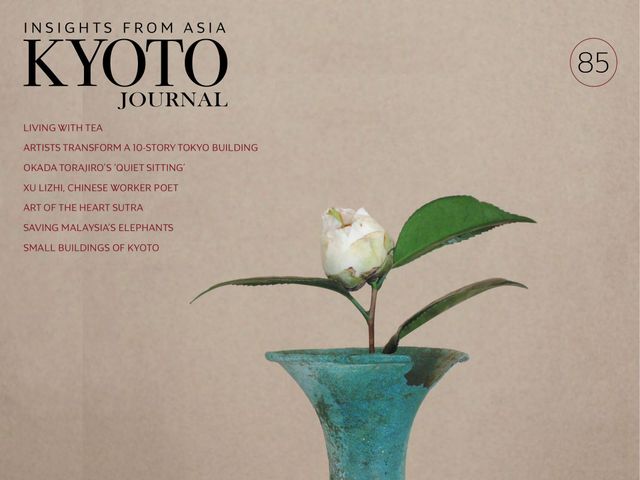
Kyoto Journal - Issue 85
Gå ubegrenset med Magzter GOLD
Lese Kyoto Journal sammen med 9000+ andre magasiner og aviser med bare ett abonnement
Se katalogAbonner kun på Kyoto Journal
Avbryt når som helst.
(Ingen forpliktelser) ⓘHvis du ikke er fornøyd med abonnementet, kan du sende oss en e-post på help@magzter.com innen 7 dager etter abonnementets startdato for full refusjon. Ingen spørsmål - lover! (Merk: Gjelder ikke for enkeltutgavekjøp)
Digitalt abonnement
Øyeblikkelig tilgang ⓘAbonner nå for å begynne å lese umiddelbart på Magzter-nettstedet, iOS, Android og Amazon-appene.
I dette nummeret
How do we give ourselves space and time to disengage our mental autopilot, re-awaken our senses, re-enter the present? Personal rituals can lend us focus, ease and grace, and release creativity.In Kyoto, green tea is not simply a beverage; it’s the essential ingredient in a ceremony that strips away inessentials and sets the scene for deeper resonances. Alexandra Ting interviews younger-generation practitioners at Toutousha, a teahouse “intoxicated with tea, or beauty.” Some prefer formal meditation: Okada Torajiro, profiled by Joshua Shapiro, developed his own form of simply sitting, during the intellectual ferment of the later Meiji era—noting however that if he had been teaching in the West, he might have used dance as his practice. Observing the play of human emotions is hardly new: Dola RC reports that since the 5th century, Indian playwrights, poets and artists have explored rasa, the “juice”—as in essence and energy—inherent in the responsive psyche. Even earlier, the Buddha famously noted the paradox that “form is emptiness, and emptiness is form”: Paula Arai introduces former scientist Iwasaki Tsuneo, who spent his last years inscribing that Heart Sutra illumination into images of the cosmos. As described by Mon Ooyama, Tokyo arts collective #BCTION’s invocation to creativity was a much faster burn— they took over a soon-to-be-demolished 10-story office tower, and within a month, transformed it into a short-lived monument to the quirkily mindful immediacy of street art (meanwhile incorporating a space for tea, and tea-master Matsumura Souryu, in one of the upper levels). Liane Wakabayashi, a self-taught artist, describes creating her Genesis Cards to encourage others to access and exercise their creative powers.
Kyoto Journal Description:
KJ is in many ways a unique publication. Firstly, it is not only non-profit, but also completely volunteer-based, over a very wide-reaching network. None of the editors – or contributors – are paid. We believe that KJ’s uniqueness extends to its editorial approach, its content – the range of topics covered – and to our approach to design.
A journal, whether public or private, is an ongoing means of looking afresh at the inhabited world, both social and natural. In selecting material for KJ we look for intelligent work that comes also from the heart. We are curious about society, beliefs, traditions and new developments — how people live, and live well — through the lens of Asian experience. Our generous contributors share valuable Asian insights through special features, interviews and profiles, fiction, poetry, photo-essays and reviews, in both omnibus and specially themed issues.
The unique aspect of KJ’s award-winning visual presentation is that our designers shape each story according to its individual content, without relying on templates. Each article is a separate exploration and finds its own form, while often existing in a deliberate interplay with other pieces, meaning that each issue adds up to more than the sum of its parts.
Our name, “Kyoto Journal,” also reflects more than a physical location. Kyoto is a place of deep spiritual and cultural heritage, and has been the measure of such things here in Japan for more than a millennium. Kyoto culture has looked deeply inwards (think Zen, and a host of related experiential paths) and has also drawn richly from outside, especially in relatively recent years since the Meiji modernization. Essentially, KJ is a community that transcends place, while respecting and celebrating regional and local identity.
We aim to make the best use of the media at hand in continuing to seek the essence of Asia. Care to join us?
Nylige utgaver

Issue 86
Issue 84
Issue 83
Issue 82
Issue 81
Issue 80
Relaterte titler
Anjali, BATJ
Shree Jagannath Yatra
Art Nation
Faces - The Magazine of People, Places and Cultures for Kids

Good Old Days
Dots x Circles Illustration

100+ Christmas Greetings
Amrapali Magazine Digital

Community Development Prospects
Reverie Magazine

31 Tales from Ramayan

Aazad Webzine

All About History Book of the American Revolution
Orgues Nouvelles(English)
Country Style Australia

The Prophetic Voice

Books by ik
Canvas UAE
Canvas BilArabia

ArtDog Istanbul English Edition
XplorPlanet Travel

Journey Around Lake Biwa

The Mimir Magazine: Learn Chinese & More

Charity Magazine

The 'Sip

Magic Whistle

Fil Magazine

Colours

Discovery Channel Magazine India

isparks