試す 金 - 無料
SPIN DOCTOR
Stereophile
|August 2024
There once was an ugly duckling

Forty years ago, as I was starting out on my audio journey, I railed against the flashy mainstream audio gear of the day. To me less was more, and I tried to convince my friends that my small, austere British-made audio rig, including what my friends jokingly called my Lynn Swanndek turntable (after the Steelers wide receiver), really did sound much better than their big silvery Japanese stacks loaded up with shiny knobs, switches, and meters. Audio was all about the sound after all, and I wasn't interested in some dazzling visual display that had nothing to do with what I was hearing. I gravitated toward gear that wasn't flashy or fancy looking, feeling that meant that the effort and expense to create it went where it counted most, to the parts that made it sound great.
While I've mellowed a bit over the decades, my basic attitude hasn't changed that much. I have owned a lot of pedestrian-looking but brilliant-sounding hi-fi equipment. Highlights include my Julius Futterman H3aa mono OTL amplifiers, with their unpainted aluminum chassis and Dymo labelmaker stickers printed out by Julius himself to identify the various connections and tube sockets, and my Croft Audio Vitale preamp, with its laughable attempts at bling: gold-plated knobs and a faceplate of roughly finished wood.
First place in the ugly stakes, however, has to go to my Symdex Epsilon loudspeakers (although Herb Reichert's legendary Jamaican-flag-painted refrigerator speakers, which had 15" Altec 416 woofers cut into the main doors and Altec 604 drivers cut into the freezer, may have given them a run for their money). The Symdex was the first speaker created by future Snell and Revel designer Kevin Voecks. When new, these speakers looked a bit like a skinnier Vandersteen Model 2, with fabric-wrapped cabinets and wood end caps, but I modified them to within an inch of their lives, turning them into very likely the ugliest speakers ever created.
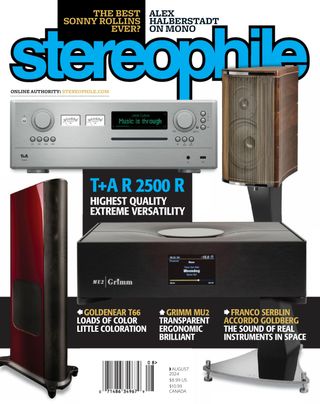

このストーリーは、Stereophile の August 2024 版からのものです。
Magzter GOLD を購読すると、厳選された何千ものプレミアム記事や、10,000 以上の雑誌や新聞にアクセスできます。
すでに購読者ですか? サインイン
Stereophile からのその他のストーリー
Stereophile
Wattson Emerson Digital
My story with Wattson Audio began about three years ago. It was my first encounter with a network bridge, at least within the context of our hobby.

12 mins
April 2026
Stereophile
Magico S2
When I was about 12 years old, my mother and I watched a movie on TV in which a ship closed in on a swimmer.
12 mins
April 2026

Stereophile
Current events
Hi-fi dealerships need to find creative new ways to get customers into their stores—to stoke their interest and to help new people feel welcome.
3 mins
April 2026

Stereophile
You can never have too much Trane on vinyl
As I listened to the newly remastered edition of John Coltrane's Complete 1961 Village Vanguard Recordings, I read through some critics' takes, which make it apparent just how far critics tend to trail the musicians they cover, the great ones at least.
3 mins
April 2026
Stereophile
HiFi Rose RD160
Lord knows I try to keep an open mind, but those good-measuring delta-sigma chip DACs rub me the wrong way.
13 mins
April 2026

Stereophile
MANUFACTURERS' COMMENTS
We extend our sincere thanks to Stereophile and to Jason Victor Serinus for their deeply engaged and perceptive evaluation of the M10. It is especially meaningful to see the amplifier’s core principles—control, stability, dynamic authority, and system matching through precise feedback and bias management—so clearly experienced and conveyed in listening.
2 mins
April 2026

Stereophile
LAiV Audio's Harmony GaNM monoblock
The first thing I noticed about the LAiV Audio GaNM monoblock amplifier¹ is its unusual shape and size; it occupies space differently than the other, more basic amplifiers on my rack.
11 mins
April 2026

Stereophile
RECORD REVIEWS
There are times when songwriters, particularly those who have been at it for a while, need a jolt, a shock to the system that gets their creative juices flowing again.
3 mins
April 2026
Stereophile
The Nighthawk soars
When people ask me what I do for a living, I reply that I'm a turntable setter upper.
11 mins
April 2026

Stereophile
Engagement vs sound quality
The more I listen to gear I'm reviewing as well as other people's hi-fis-the more I believe in intangibles. One of these intangibles is the art of system building.
12 mins
April 2026
Listen
Translate
Change font size