
Magzter GOLDで無制限に
10,000以上の雑誌、新聞、プレミアム記事に無制限にアクセスできます。
試す 金 - 無料
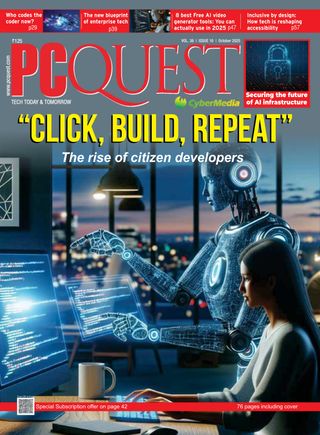
Securing the syntaxless shift
PCQuest
|October 2025
As no-code platforms scale, security can't be an afterthought. This deep dive explores how federated models, runtime observability, and AI-generated guardrails are reshaping how enterprises secure what they no longer codeat scale

Software development isn't what it used to be and security teams know it.
As no-code and low-code platforms (LCNC) become central to enterprise workflows, the old rulebook is starting to crack. No longer is software security just about code reviews, centralized control, and hard boundaries. In a world where applications are built without writing code, and workflows are powered by AI, security must evolve at design time not just deployment.
The new challenge isn't about plugging holes in code, it's about embedding intelligence into tools that anyone in the enterprise can use to build, integrate, and automate.
Let's unpack what this transformation demands.
Federated, not fragmented: The future of platform security
The debate between centralized and distributed security models isn't new. But in LCNC environments, the stakes are higher. A centralized approach offers tight control, uniform policy enforcement, and traceability but it slows things down. In fast-moving orgs with citizen developers, central bottlenecks can stifle innovation.
On the flip side, distributing security responsibilities across teams may unlock speed and autonomy but it risks inconsistent enforcement, patchy compliance, and exposure.
The answer? Federated security.
A federated model combines the best of both worlds:
- Central IT defines standards, policies, and baseline controls.
- Local teams implement those standards with guardrails built directly into their tools.
These embedded guardrails, design-time checks, access templates, encryption defaults, allow secure development to happen without needing constant oversight. Security becomes an invisible partner, not a blocker.
Guardrails at prompt speed
One of the most compelling promises of AI-driven development is automation.

このストーリーは、PCQuest の October 2025 版からのものです。
Magzter GOLD を購読すると、厳選された何千ものプレミアム記事や、10,000 以上の雑誌や新聞にアクセスできます。
すでに購読者ですか? サインイン
PCQuest からのその他のストーリー

PCQuest
When Software Drives the Machine Need for Enterprise-Grade Software
Cars used to fail because of broken parts.Now they fail because of broken code. As vehicles become rolling computers, enterprise-grade software, ruthless testing, and fail-safe architecture decide one thing: whether a car keeps moving safely at 100 km/h

2 mins
March 2026

PCQuest
AI on the ground Practical use cases of AI in large enterprise operations
AI isn't a side project anymore, it's the quiet operator inside global giants. It reads invoices, senses machine fatigue, tailors every customer moment, flags risk in real time, and feeds leaders sharper instincts. Scale just got smarter
3 mins
March 2026

PCQuest
From AI experiments in 2025 to enterprise scale in 2026: Why data foundations will decide the winners
Everyone's betting big on Al, but most are burning cash instead of building value. The hidden culprit? Dirty data, clunky processes, and missing context. What if fixing your foundation, not your algorithms, was the real AI game-changer?
4 mins
March 2026

PCQuest
How automation at the periphery is accelerating digital transformation
Digital transformation is not tearing down the core anymore. It is happening at the edges. With AI and automation layered onto existing systems, companies are cutting costs, boosting productivity by up to 40%, and scaling smarter without risking operational chaos
2 mins
March 2026

PCQuest
When AI moves from chips to racks
AI performance is no longer just about faster chips. It is about how racks, power, networking, and orchestration work together. As agentic AI grows, infrastructure must become predictable, open, and built for scale from day one
4 mins
March 2026

PCQuest
Designing enterprise AI systems that stay fair
In 2026, bias is no longer treated as a communications issue or a public relations headache.
6 mins
March 2026

PCQuest
HALO smart sensor
What if bathrooms, locker rooms, and isolated spaces could become safer without adding cameras?
2 mins
March 2026

PCQuest
Building enterprise AI that doesn't discriminate
Bias in enterprise AI is not a side issue. It starts in data pipelines, training systems, product design, and engineering workflows. As AI scales, fairness, transparency, and accessibility are becoming core software requirements
4 mins
March 2026

PCQuest
Bias travels faster than code
Bias in enterprise AI is not a surface issue. It enters through data, features, model training, APIs, and UI logic, then spreads across the stack. The technical response is shifting from audits to architecture, observability, and deployment controls
6 mins
March 2026

PCQuest
How hospitals can use AI without risking patient data
With the fast pace of adoption of Artificial Intelligence (AI) and digital health systems in Indian hospitals, issues related to the security of patient data are also increasing at an equal rate.
2 mins
March 2026
Listen
Translate
Change font size