
Magzter GOLDで無制限に
10,000以上の雑誌、新聞、プレミアム記事に無制限にアクセスできます。
試す 金 - 無料
Not all code is created equal
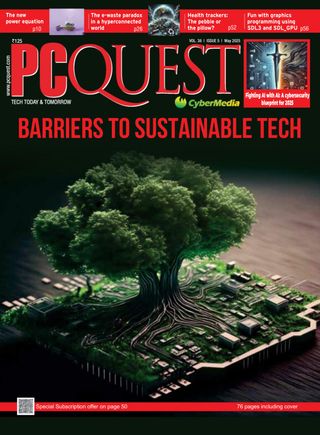
PCQuest
|May 2025
When code starts thinking green, emissions drop and performance soars. This is how smart tools, cleaner logic, and ESG-aware developers at Tech Mahindra are turning every line of code into a step toward net-zero. Sustainability, compiled
-

For most developers, “clean code” is about bug-free logic and functional elegance. But for Sandeep Chandna, Chief Sustainability Officer at Tech Mahindra, clean code has a deeper meaning—code that consumes less, emits less, and works smarter for the planet.
Chandna takes us behind the scenes of how one of India’s tech giants is weaving sustainability into software development—not just through policy, but through tools, metrics, and measurable results. This is not a story about greenwashing. It’s about green building—at the source code level.
We’re not just coding to deliver, we're coding to decarbonize
Chandna doesn’t hesitate. “We are leveraging advanced coding practices and frameworks to optimize energy consumption and promote sustainability in our software development processes.”
At the heart of this effort is Green CodeRefiner, a proprietary tool built using Azure OpenAl Service. Think of it as a sustainability-aware code optimizer—it transforms existing code into energy-efficient code without compromising functionality.
Some of its tangible impacts:
- Improves green impact scores by 20-40%
- Reduces Scope 2 emissions
- Integrates directly into DevOps workflows
- Boosts developer productivity by embedding energy intelligence at the coding level
This isn’t just clever tooling. It’s Tech Mahindra’s way of making sustainability a built-in feature of every application they deliver.
You can’t fix what you can’t see
The biggest obstacle? Visibility.

このストーリーは、PCQuest の May 2025 版からのものです。
Magzter GOLD を購読すると、厳選された何千ものプレミアム記事や、10,000 以上の雑誌や新聞にアクセスできます。
すでに購読者ですか? サインイン
PCQuest からのその他のストーリー

PCQuest
AI on the ground Practical use cases of AI in large enterprise operations
AI isn't a side project anymore, it's the quiet operator inside global giants. It reads invoices, senses machine fatigue, tailors every customer moment, flags risk in real time, and feeds leaders sharper instincts. Scale just got smarter

3 mins
March 2026

PCQuest
From AI experiments in 2025 to enterprise scale in 2026: Why data foundations will decide the winners
Everyone's betting big on Al, but most are burning cash instead of building value. The hidden culprit? Dirty data, clunky processes, and missing context. What if fixing your foundation, not your algorithms, was the real AI game-changer?
4 mins
March 2026

PCQuest
How automation at the periphery is accelerating digital transformation
Digital transformation is not tearing down the core anymore. It is happening at the edges. With AI and automation layered onto existing systems, companies are cutting costs, boosting productivity by up to 40%, and scaling smarter without risking operational chaos
2 mins
March 2026

PCQuest
When AI moves from chips to racks
AI performance is no longer just about faster chips. It is about how racks, power, networking, and orchestration work together. As agentic AI grows, infrastructure must become predictable, open, and built for scale from day one
4 mins
March 2026

PCQuest
Designing enterprise AI systems that stay fair
In 2026, bias is no longer treated as a communications issue or a public relations headache.
6 mins
March 2026

PCQuest
HALO smart sensor
What if bathrooms, locker rooms, and isolated spaces could become safer without adding cameras?
2 mins
March 2026

PCQuest
Building enterprise AI that doesn't discriminate
Bias in enterprise AI is not a side issue. It starts in data pipelines, training systems, product design, and engineering workflows. As AI scales, fairness, transparency, and accessibility are becoming core software requirements
4 mins
March 2026

PCQuest
Bias travels faster than code
Bias in enterprise AI is not a surface issue. It enters through data, features, model training, APIs, and UI logic, then spreads across the stack. The technical response is shifting from audits to architecture, observability, and deployment controls
6 mins
March 2026

PCQuest
How hospitals can use AI without risking patient data
With the fast pace of adoption of Artificial Intelligence (AI) and digital health systems in Indian hospitals, issues related to the security of patient data are also increasing at an equal rate.
2 mins
March 2026

PCQuest
DeFi in 2026: The rise of liquidity, privacy and decentralized exchanges
DeFi's teenage years are over. Liquidity now behaves like infrastructure, privacy is baked in with zero-knowledge math, and DEXS hum like borderless trading engines. What once felt scrappy now resembles parallel financial system-without gatekeepers
3 mins
March 2026
Listen
Translate
Change font size