試す 金 - 無料
A Guide to SSL 2.0: Security Flaws and Evolution to SSL 3.0
Open Source For You
|October 2024
The importance of cybersecurity cannot be overstated. The SSL 2.0 handshake protocol plays a great role in ensuring data remains secure and does not reach the wrong hands. But it does have some weaknesses, and hence the emergence of SSL 3.0.

While current internet standards implement TLS 1.3 (Transport Layer Security), we’ve made significant strides in securing communication over the internet. The journey began with the development of SSL (Secure Sockets Layer) 1.0, which was never publicly released due to serious flaws. This was followed by SSL 2.0, which introduced a handshake protocol before establishing a connection between the client and server. Every protocol has its own vulnerabilities, and to this day, no single protocol provides a completely secure solution. However, in cybersecurity, we continuously strive to develop ‘better’ solutions, recognising that while these may not be perfect, they are the best options available at present.
The SSL 2.0 handshake protocol aims to send ‘ClientHello’ from the client and ‘ServerHello’ from the server over an insecure channel, typically over a Transmission Control Protocol (TCP) connection. The purpose of these messages is to establish the parameters for the secure session that will follow, including negotiating the encryption methods and exchanging the necessary cryptographic data. This includes a ‘cipher suite’ which is a list of encryption algorithms such as RC4-MD5, DES-CBC-MD5, and RC2CBC-MD5 sent to the server to choose the most secure algorithm that both machines support, as shown in Figure 1.
The server responds with a ‘ServerHello’ message including the selected cipher suite, another random value (nonce), and the server’s certificate containing its public key. After these initial messages are exchanged, the process of key exchange and session establishment begins, and eventually, the communication is encrypted using the session key derived from the handshake process. This encryption secures subsequent data exchanges.
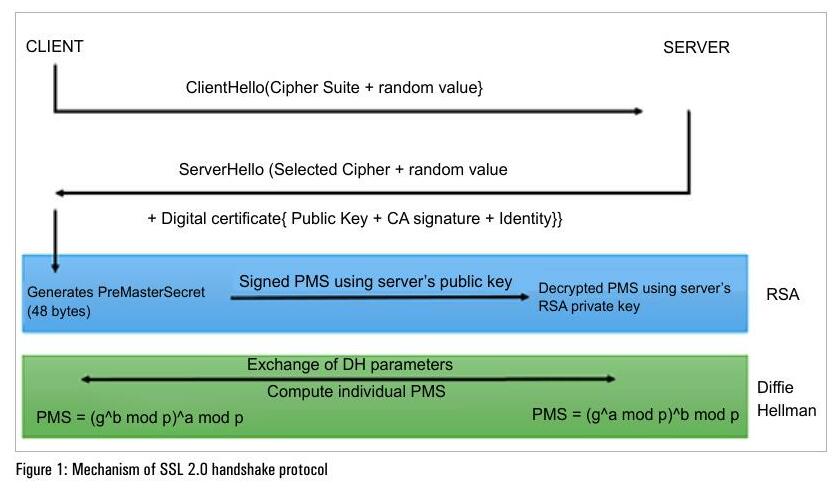 Key exchange methods

このストーリーは、Open Source For You の October 2024 版からのものです。
Magzter GOLD を購読すると、厳選された何千ものプレミアム記事や、10,000 以上の雑誌や新聞にアクセスできます。
すでに購読者ですか? サインイン
Open Source For You からのその他のストーリー

Open Source For You
Sending IoT Sensor Data to Public or Private Servers
This IoT system shows a simple and effective way to send sensor data using an ESP8266 microchip.

3 mins
March 2026

Open Source For You
Popular FOSS Tools for LLM Observability, Monitoring and Evaluation
This overview of popular tools for monitoring large language models also sheds light on how LLM-as-a-judge enhances their performance.
2 mins
March 2026
Open Source For You
Data Deduplication Done the Right Way
Deduplication helps to save space on Linux-based storage systems. Choose the right platform and check whether it meets your goals.
6 mins
March 2026

Open Source For You
The Relevance of Rubber Duck Debugging in the Age of AI
Discover why rubber duck debugging is a powerful process today. There's also a step-by-step guide on how to use it in the age of artificial intelligence.
4 mins
March 2026

Open Source For You
GitHub weighs turning off pull requests as AĬ slop floods projects
GitHub has formally acknowledged that AI-generated 'slop' is overwhelming open source projects, forcing maintainers to sift through poor pull requests (PRS), abandoned submissions and guideline violations - and is now considering restricting or even disabling pull requests, the core mechanism of open collaboration.
1 min
March 2026

Open Source For You
Global banks are deploying Ethereum's Layer-2 stack
Banks are standardising on Ethereum's open source stack as production financial infrastructure, shifting from experimental pilots and proprietary blockchains to live Layer-2 networks for tokenised deposits, interbank payments, and cross-border settlement.
1 min
March 2026

Open Source For You
OpenClaw's creator joins OpenAl
In a move that reinforces its commitment to open development rather than acquisition, OpenAI has brought Peter Steinberger, founder of OpenClaw, into the company while placing the popular AI agent under a foundation structure to ensure it remains open source.
1 min
March 2026
Open Source For You
LibreOffice 26.2 comes with native Markdown support
LibreOffice 26.2 has been released by The Document Foundation, strengthening its position as a fully free and open source office suite for Windows, macOS, and Linux, with support for more than 120 languages.
1 min
March 2026

Open Source For You
Indian government mandates labelling of Al-generated content and quicker deletion of illegal deepfakes
India has introduced sweeping AI content rules that immediately place pressure on social platforms and open source AI ecosystems to label, trace and rapidly remove AI Open ource synthetic media at scale.
1 min
March 2026
Open Source For You
I2C and I3C: How Modern Devices Communicate
I3C and I2C are both two-wire communication protocols that help exchange data between multiple devices. While I3C preserves the simplicity of I2C, it introduces new features suited for today's sensor-rich devices.
8 mins
March 2026
Listen
Translate
Change font size