
Magzter GOLDで無制限に
10,000以上の雑誌、新聞、プレミアム記事に無制限にアクセスできます。
RNA, Not DNA, Is the Key to Life
Scientific American
|September 2025
DNA holds our genetic blueprints, but its cousin, RNA, conducts our daily lives
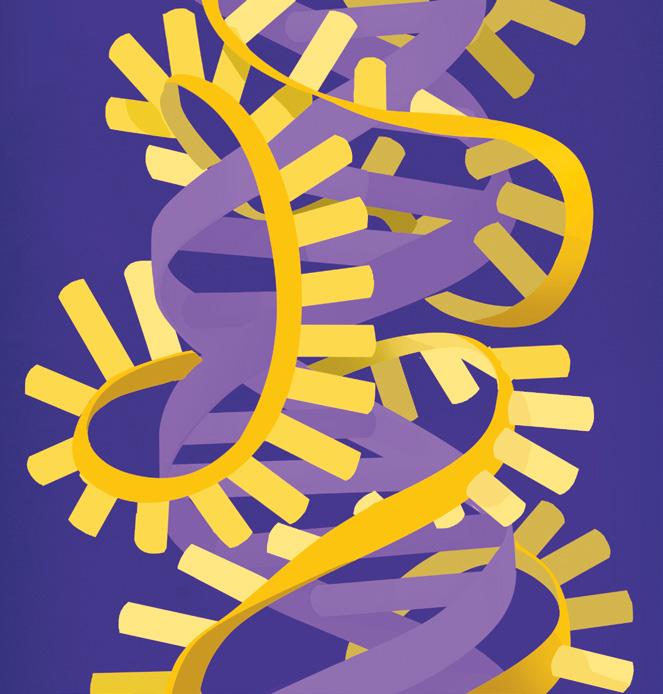
IN 1957, JUST FOUR YEARS AFTER Francis Crick and other scientists solved the riddle of DNA’s structure—the now famous double helix—Crick laid out what he called the “central dogma” of molecular biology, which his colleague James Watson later said implied that biological information flows inexorably from DNA to RNA to proteins. Although Watson was oversimplifying, the message was that the purpose of the double helix in our chromosomes is to hold, in encoded form, blueprints for the proteins that build and maintain our bodies. DNA’s chemical cousin, RNA, was the messenger that carries DNA instructions from the double helix in the cell’s nucleus to the protein-making machinery, called the ribosome, scattered around the cell.
Molecular biology’s mission, it seemed, was to decipher those genetic instructions. But in recent years researchers have discovered a dizzying array of “noncoding” RNA (ncRNA) molecules that do something other than ferry DNA instructions for proteins. They perform a surprisingly wide range of biochemical functions. It now seems that our genome may be at least as much a repository of plans for vital, noncoding RNA as it is for proteins. This shift in thinking has been “revolutionary,” says Thomas Cech, who shared the 1989 Nobel Prize in Chemistry with Sidney Altman for discovering RNA molecules, called ribozymes, that can catalyze biochemical reactions. “DNA is old stuff, 20th-century stuff,” Cech says. “It’s a one-trick pony. All it does is store biological information, which it does exquisitely well. But it’s inert—it can’t do anything without its children, RNA and proteins.”

このストーリーは、Scientific American の September 2025 版からのものです。
Magzter GOLD を購読すると、厳選された何千ものプレミアム記事や、10,000 以上の雑誌や新聞にアクセスできます。
すでに購読者ですか? サインイン
Scientific American からのその他のストーリー

Scientific American
Probiotic Hope and Hype
Despite their popularity, supplements with billions of \"good\" microbes help only a few illnesses, research shows

3 mins
January 2026

Scientific American
Mondays Really Are More Stressful
The start of the workweek can be a biologically measurable stressor, with consequences for long-term health that can stretch into retirement
4 mins
January 2026
Scientific American
Tiny Display
An e-paper breakthrough brings extremely high-resolution color
2 mins
January 2026
Scientific American
Fine-Feathered Snack
A bat's tracker documents a dramatic midair hunt
2 mins
January 2026

Scientific American
OUR ROBOTIC PICTURE
Will mechanical helpers ever be commonplace at home, at work and beyond?
11 mins
January 2026

Scientific American
"Use Your Words" Can Be Good for Kids' Health
Writing or expressing feelings can help adults mentally and physically. Kids are no different
5 mins
January 2026

Scientific American
Distant Diplomacy
Unrelated species “talk” and understand one another to avoid threats
2 mins
January 2026
Scientific American
Behind the Nobel
A 2025 winner reflects on the mysterious T cells that won him the prize
5 mins
January 2026

Scientific American
A Suite of Killers
Heart ailments, kidney diseases and type 2 diabetes actually may be part of just one condition. It's called CKM syndrome
10 mins
January 2026
Scientific American
Static Launch
Tiny worms leap toward their fruit fly hosts with an electric “tractor beam”
3 mins
January 2026
Listen
Translate
Change font size