試す 金 - 無料
In the Heat of the Night
Scientific American
|July/August 2025
Hot nights lead to lots of hospitalizations. There are ways to keep your cool
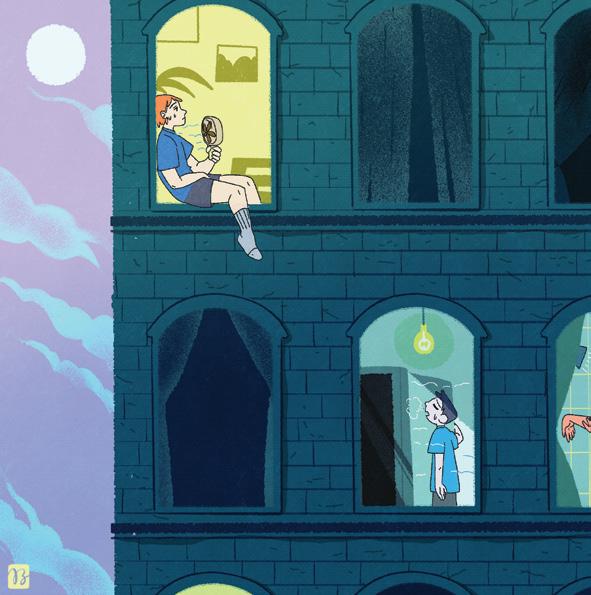
IF THE SUMMER OF 2025 is anything like last year's, get ready to sweat. July and August of 2024 were among the hottest months on record in the U.S. Phoenix, Ariz., saw daytime temperatures higher than 100 degrees Fahrenheit for more than 100 days. But now temperatures are staying high at night, too, which increases health dangers. When it stays hot after the sun goes down, more people die than typically would. Emergency room visits and hospital admissions go up. Premature births increase. Sleep and mental health suffer. But there are simple and practical methods you can use to stay cooler and healthier, beyond cranking up your expensive air conditioner.
“Most heat exposure is chronic,” says Ashley Ward, director of the Heat Policy Innovation Hub at Duke University’s Nicholas Institute. She and others are increasingly focused on the cumulative effect of warmer nights following warmer days. Nighttime temperatures are rising twice as fast as daytime temperatures because increasing cloud cover at night, created by the greenhouse effect, traps heat and sends it back to the ground. In parts of the Southeast, for example, there are now more than 30 days a year when the temperature stays above 75 degrees F at night, Ward says. Urban heat islands, which are parts of cities with lots of concrete and few shade trees, trap warmth and add to the effect, but rural areas are also suffering.

このストーリーは、Scientific American の July/August 2025 版からのものです。
Magzter GOLD を購読すると、厳選された何千ものプレミアム記事や、10,000 以上の雑誌や新聞にアクセスできます。
すでに購読者ですか? サインイン
Scientific American からのその他のストーリー

Scientific American
Let There Be Weapons
The Department of Energy’s new Genesis Mission promises AI-accelerated discovery. Seven of its first 26 challenges focus on nuclear weapons and national security

4 mins
July/August 2026

Scientific American
How to Fix Science
The federal funding system for scientific research in the U.S. needs reform
9 mins
July/August 2026

Scientific American
Robots Can Now Fold Your Laundry
Home-helper tasks are becoming easier for robotic assistants
4 mins
July/August 2026

Scientific American
50, 100 & 150 Years
NATURAL FISSION REACTOR
3 mins
July/August 2026

Scientific American
Anna Ho
Describing the characteristics of short-lived astrophysical events
1 mins
July/August 2026

Scientific American
THE SOLILOQUY OF SCHRÖDINGER'S CAT
A MEDITATION ON LIFE AND THE VON NEUMANN–WIGNER INTERPRETATION OF QUANTUM MECHANICS
1 min
July/August 2026

Scientific American
Mikhail Kolmogorov
Developing software to reveal large genetic changes that lead to cancer
1 mins
July/August 2026

Scientific American
Jaye Gardiner
Learning how the matrix around cells and tissues impacts cancers
1 mins
July/August 2026

Scientific American
Timnit Gebru
On safeguarding independent research in the age of big tech
3 mins
July/August 2026

Scientific American
A Youthful Illusion Sharpens Memory
By making people feel as if their face is a younger version of itself, researchers can bring childhood memories into sharper focus
4 mins
July/August 2026
Listen
Translate
Change font size