試す 金 - 無料
Can We Survive the Death of the Sun?
Scientific American
|October 2025
In a few billion years the sun will turn into a red giant star
-
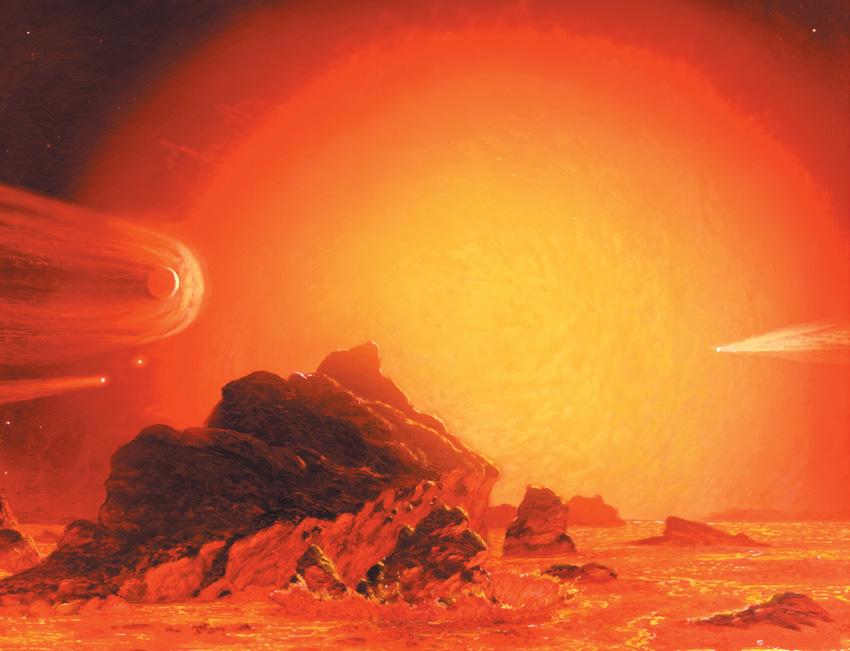
Adapting to the whims of a star is no small task, however.
The sun may appear to be constant from day to day, but let time stretch out for millions or even billions of years, and things will change—a lot. And not always for the better.
For example, in its thermonuclear-driven core, the sun fuses about 700 million tons of hydrogen into 695 million tons of helium every second. The missing five million tons are converted into energy (via everyone's favorite equation, E = mc²). This energy is enough, it turns out, to power a star. If you like mind-boggling numbers, the sun produces 4 × 1026 watts of power— 400 trillion trillion watts. In other words, the energy our star emits in a single second is sufficient to satisfy humanity’s total consumption for about 650,000 years.
It’s also enough to warm our planet to its current comfy clime. In fact, by using some basic physics principles, it’s possible to mathematically calculate how warm Earth should be given the sun's energy-emission rate. That solar energy flows into space in all directions around the sun, and a tiny fraction (about half of one billionth) of it is intercepted by Earth, heating our planet. Just how much heating takes place is a bit complicated and depends on the actual radiant flux from the sun, Earth's distance from it and reflectivity, and more. When we run the numbers, Earth's average calculated temperature today is approximately -15 degrees Celsius, colder than the freezing point of water.
Actual measurements of Earth's temperature, however, give an average that's much warmer: about 15 degrees C. The difference exists because greenhouse gases in the air essentially trap heat from the sun, warming Earth above the calculated temperature.

このストーリーは、Scientific American の October 2025 版からのものです。
Magzter GOLD を購読すると、厳選された何千ものプレミアム記事や、10,000 以上の雑誌や新聞にアクセスできます。
すでに購読者ですか? サインイン
Scientific American からのその他のストーリー

Scientific American
The Quiet Math Problem That Runs the Planet
How Diffie-Hellman key exchange secures everything from your text messages to government secrets

7 mins
May 2026

Scientific American
The Fog of Science
Did an adversary just invent a world-changing weapon, or are they making it up? DARPA is building an AI to instantly call their bluff
4 mins
May 2026

Scientific American
The Hubble Space Telescope Is Still Awesome
Hubble is going strong despite its decades in space and next-generation successors
4 mins
May 2026

Scientific American
Meet America's Native Bees
Scientists estimate there are about 4,000 species of native bees in the U.S.
5 mins
May 2026

Scientific American
The Chemistry of Desire
Inside the secretive laboratories where scientists build novel molecules to make luxury fragrance feel like pure emotion
5 mins
May 2026

Scientific American
Scanning the Stone
As ore gets harder to find, the mining industry is turning to subatomic-particle sensors to push deep underground
8 mins
May 2026

Scientific American
YOUR HEART IN FLAMES
Inflammation may be the true cause of cardiovascular diseaseand there's a drug to treat it
13 mins
May 2026

Scientific American
Ancient Lexicon
Stone Age art may reveal a 40,000-year-old precursor to writing
2 mins
May 2026

Scientific American
Thermal Breakthrough
A new super heat conductor challenges fundamental physics
2 mins
May 2026

Scientific American
How to Vacation in Space
Planned orbital hotels promise luxury, but can they deliver?
4 mins
May 2026
Listen
Translate
Change font size