試す 金 - 無料
Are AI Chatbots Healthy for Teens?
Scientific American
|December 2025
Kids crave approval from their peers. Chatbots offer an alternative to real-life relationships, but they can come at a price
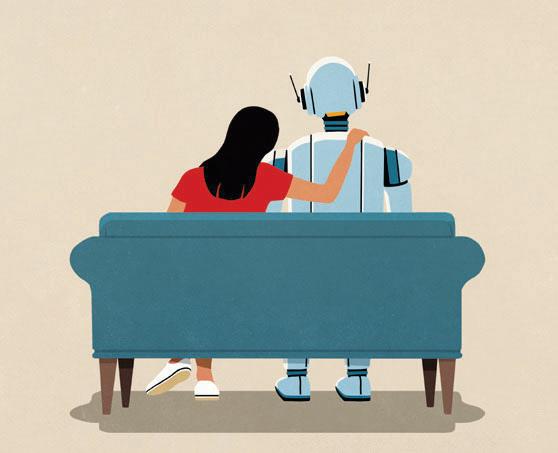
RELATIONSHIPS ARE MESSY, whether you are an adult with lots of experience or a kid navigating tough times with a best friend, boyfriend or girlfriend. You can’t predict moods, interests or desires. For teens learning the ins and outs of relationships for the first time, disagreements, fights and breakups can be crushing.
But what if your teen’s best friend weren’t human? It may seem far-fetched, but it’s not. A recent report from Common Sense Media says 72 percent of teens surveyed have used artificial-intelligence chatbot companions, and 33 percent have relationships or friendships with them.
The language that AI companions use, the responses they offer and the empathy they exude can make a user think they truly understand and sympathize. These chatbots can make someone feel liked or even loved. They are programmed to give users the experience of a real connection. And adolescents have a natural interest in romance and sexuality; if they feel ignored by the kids in their high school, well, now on the nearest screen there is a hot girlfriend who is constantly fascinated by them and their video games or a supercute boyfriend whom they never have to engage in small talk with to form a bond.
This may be perplexing to some parents, but if your child is navigating the complex worlds of technology, social media and AI, the likelihood of their being curious about an AI companion is pretty high. Here’s what you need to know to guide them.

このストーリーは、Scientific American の December 2025 版からのものです。
Magzter GOLD を購読すると、厳選された何千ものプレミアム記事や、10,000 以上の雑誌や新聞にアクセスできます。
すでに購読者ですか? サインイン
Scientific American からのその他のストーリー

Scientific American
Probiotic Hope and Hype
Despite their popularity, supplements with billions of \"good\" microbes help only a few illnesses, research shows

3 mins
January 2026

Scientific American
Mondays Really Are More Stressful
The start of the workweek can be a biologically measurable stressor, with consequences for long-term health that can stretch into retirement
4 mins
January 2026

Scientific American
Tiny Display
An e-paper breakthrough brings extremely high-resolution color
2 mins
January 2026

Scientific American
Fine-Feathered Snack
A bat's tracker documents a dramatic midair hunt
2 mins
January 2026

Scientific American
OUR ROBOTIC PICTURE
Will mechanical helpers ever be commonplace at home, at work and beyond?
11 mins
January 2026

Scientific American
"Use Your Words" Can Be Good for Kids' Health
Writing or expressing feelings can help adults mentally and physically. Kids are no different
5 mins
January 2026

Scientific American
Distant Diplomacy
Unrelated species “talk” and understand one another to avoid threats
2 mins
January 2026

Scientific American
Behind the Nobel
A 2025 winner reflects on the mysterious T cells that won him the prize
5 mins
January 2026

Scientific American
A Suite of Killers
Heart ailments, kidney diseases and type 2 diabetes actually may be part of just one condition. It's called CKM syndrome
10 mins
January 2026

Scientific American
Static Launch
Tiny worms leap toward their fruit fly hosts with an electric “tractor beam”
3 mins
January 2026
Listen
Translate
Change font size