試す 金 - 無料
AFTER MY VISIT TO Memorial Sloan Kettering,
Scientific American
|December 2025
Balachandran's team shared a chart that plotted Brigham's immune response to her personalized mRNA vaccine.
-
uate alternative dosage and delivery mechanisms, Lee says.
Although current protocol is for vaccines to target micrometastases—small groups of cancer cells that spread to other parts of the body and linger after cancerous tumors are removed surgically—there’s no shortage of adjustments that might follow from more data or improved screening. Could one deliver a therapeutic vaccine to tackle a tumor before it is large enough to operate on? Or maybe one could even administer a prophylactic shot that prevents tumor formation in the first place?
With a unified health system and world-class research and manufacturing facilities, Lee says, the U.K. is well positioned to advance research that would answer such questions. Fully realizing the potential of personalized mRNA vaccines for cancer, however, will require more trials in the U.S., which has many more cancer research centers than the U.K. But the ability of the U.S. to lead this effort is now in jeopardy.
The federal government has long been the dominant source of funding for cancer research in the U.S. Miriam Merad, a cancer immunologist at the Icahn School of Medicine at Mount Sinai in New York City, says that in a typical year, funding from the NIH accounts for more than half of the research budget at her institution.
In President Donald Trump’s first term, threatened cuts to the NIH never quite materialized. Society is not going to let that happen, Merad thought. But just weeks into Trump’s second term, the NIH announced plans to limit indirect contributions to research grants to 15 percent, meaning that for every $100 in funding awarded, only $15 extra would be included for overhead—a dramatic departure from historical rates in the range of 50 to 60 percent.
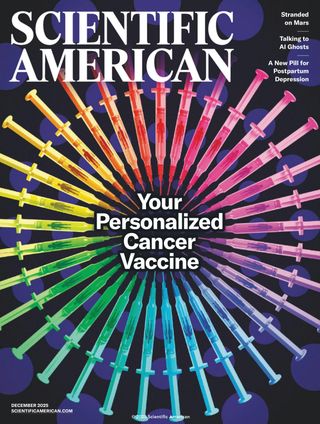

このストーリーは、Scientific American の December 2025 版からのものです。
Magzter GOLD を購読すると、厳選された何千ものプレミアム記事や、10,000 以上の雑誌や新聞にアクセスできます。
すでに購読者ですか? サインイン
Scientific American からのその他のストーリー

Scientific American
Probiotic Hope and Hype
Despite their popularity, supplements with billions of \"good\" microbes help only a few illnesses, research shows

3 mins
January 2026

Scientific American
Mondays Really Are More Stressful
The start of the workweek can be a biologically measurable stressor, with consequences for long-term health that can stretch into retirement
4 mins
January 2026
Scientific American
Tiny Display
An e-paper breakthrough brings extremely high-resolution color
2 mins
January 2026
Scientific American
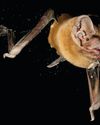
Fine-Feathered Snack
A bat's tracker documents a dramatic midair hunt
2 mins
January 2026

Scientific American
OUR ROBOTIC PICTURE
Will mechanical helpers ever be commonplace at home, at work and beyond?
11 mins
January 2026

Scientific American
"Use Your Words" Can Be Good for Kids' Health
Writing or expressing feelings can help adults mentally and physically. Kids are no different
5 mins
January 2026

Scientific American
Distant Diplomacy
Unrelated species “talk” and understand one another to avoid threats
2 mins
January 2026
Scientific American
Behind the Nobel
A 2025 winner reflects on the mysterious T cells that won him the prize
5 mins
January 2026

Scientific American
A Suite of Killers
Heart ailments, kidney diseases and type 2 diabetes actually may be part of just one condition. It's called CKM syndrome
10 mins
January 2026
Scientific American
Static Launch
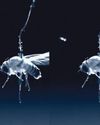
Tiny worms leap toward their fruit fly hosts with an electric “tractor beam”
3 mins
January 2026
Listen
Translate
Change font size