試す 金 - 無料
The Next Pandemic
Down To Earth
|June 16, 2024
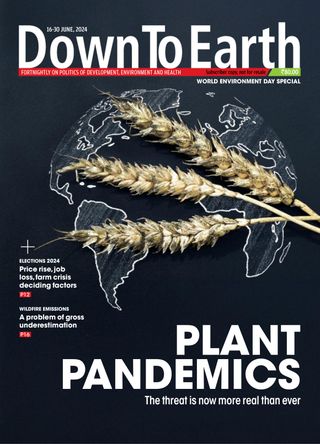
Buoyed by climate change and global trade, pathogens that cause disease outbreaks in food crops are spreading far and wide. They are also evolving fast to reproduce quickly and infect new hosts

FOR THE past seven years, Raizul Mondal and several other residents of Jalangi village in West Bengal's Murshidabad district have been guarding India's eastern borders. They have even sacrificed their livelihoods to prevent a catastrophe. Lurking across the international boundary in Bangladesh is an invisible enemy-Magnaporthe oryzae Triticum (MOT), a fungus that attacks wheat crops and can wipe out the entire harvest in a matter of days.
Before reaching Bangladesh in February 2016, the fungus had periodically ravaged 3 million hectares (ha) of wheat fields in South America since it was first identified in Brazil in 1985. An outbreak in 2009 had cost Brazil one-third of that year's crop. The 2016 outbreak in Bangladesh-this is when the fungus made its first appearance in Asia was equally rapid and devastating.
Estimates by the country's Department of Agricultural Extension show that the fungus caused wheat blast disease in 15,000 ha-3.4 per cent of the area under the crop in Bangladesh-reducing yield by 51 per cent in the affected fields. Since then, MOT has spread to 14 districts, including Jashore, Jhenaidah, Chadanga and Rajshahi that border India. By 2018, the fungus invaded Africa and wheat blast appeared in experimental plots and farms of Zambia.
With its presence simultaneously on three continents, MOT has emerged as a global threat to food security. The fungus' presence in South America could derail the efforts by Brazil and Argentina to tackle the global wheat supply shortage caused by Russia's invasion of Ukraine, while its arrival in Zambia has put southern Africa's wheat-producing countries at risk. In Asia, the Bangladesh outbreak is a grave concern as India and China are global leaders in wheat production.

このストーリーは、Down To Earth の June 16, 2024 版からのものです。
Magzter GOLD を購読すると、厳選された何千ものプレミアム記事や、10,000 以上の雑誌や新聞にアクセスできます。
すでに購読者ですか? サインイン
Down To Earth からのその他のストーリー

Down To Earth
THINK TWICE BEFORE FELLING SAL TREES
Many trees considered to be affected by sal borer in the 1990s are still alive today

1 mins
February 16, 2026

Down To Earth
EDGE OF SURVIVAL
Caste divides deny marginalised communities land, resources and essential aid, leaving them more vulnerable to climate disasters
6 mins
February 16, 2026

Down To Earth
A WISH LIST?
Union Budget for 2026-27 conveys the impression of a roll-call of intentions and ambitious proposals, with little detail on their formulation
6 mins
February 16, 2026
Down To Earth
Break down the gender wall
THE RULING National Democratic Alliance (NDA) government has been heavily invested in the goal to make India a developed economy by 2047.
2 mins
February 16, 2026

Down To Earth
MENSTRUAL HEALTH, NOW A FUNDAMENTAL RIGHT
In a landmark judgement, the Supreme Court has recognised menstrual health and hygiene as a fundamental right under Article 21 of the Constitution of India, which guarantees the right to life and dignity.
8 mins
February 16, 2026

Down To Earth
Of devolution and new disasters
The 16th Finance Commission pushes for changes in view of new fiscal and climatic conditions
11 mins
February 16, 2026
Down To Earth
Rising risks of plastics
NEGATIVE IMPACTS on human health due to emissions linked to the plastic lifecycle could double by 2040, according to a study published in The Lancet Planetary Health in January.
1 min
February 16, 2026

Down To Earth
GAP BETWEEN EPIDEMICS NARROWING
A watershed-based and landscape-level approach is needed to address forest degradation
2 mins
February 16, 2026
Down To Earth
WAITING TO STRIKE
Sal heartwood borer is considered the biggest threat to forestry in India, especially to the sal tree, where it lives and breeds.
11 mins
February 16, 2026

Down To Earth
A SPRING DELIGHT
Mustard flowers are not meant only for the eyes. Invite them to your plate once in a while
3 mins
February 16, 2026
Listen
Translate
Change font size