
Magzter GOLDで無制限に
10,000以上の雑誌、新聞、プレミアム記事に無制限にアクセスできます。
試す 金 - 無料
TRICKY TRAJECTORY
Down To Earth
|June 16, 2025
Indirect emissions from land-use changes, overexploitation of water resources must not be ignored in the pursuit of biofuel
-

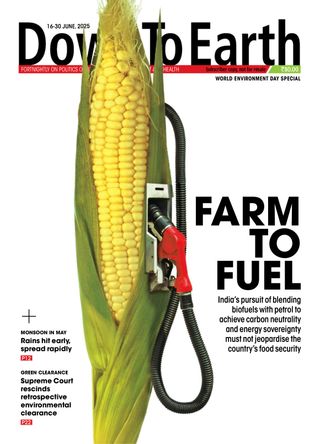
BY NOW, it is clear that food crops and feed crops are the major sources of biofuels worldwide. Growing these feedstocks also require an enormous amount of land and water. As India navigates its own biofuel ambition, looking abroad can offer some lessons on striking the right balance between energy security and food security.
Brazil is one of the first few countries which started commercially producing biofuels in the form of ethanol from sugarcane in the 1970s, as an outcome of the global oil price shocks. However, as the country leans heavily on crop-based biofuels, the expansion of its ethanol industry has raised serious climate concerns from time to time—especially given the fragility of its rainforests and tropical savanna. The link between biofuels and induced land-use changes has been a flashpoint in the biofuel debate in Brazil. “Because of ethanol production, there has been an increasing pressure on land. Biofuel policies over the past 30 or 40 years have driven indirect land-use changes in the country. Over the long run, this has increased the inflation in sugar, although this varies year by year,” says André Campos, manager of Repórter Brasil’s Research Program, an investigative journal. Campos has closely followed local impacts of biofuel production in Brazil.

このストーリーは、Down To Earth の June 16, 2025 版からのものです。
Magzter GOLD を購読すると、厳選された何千ものプレミアム記事や、10,000 以上の雑誌や新聞にアクセスできます。
すでに購読者ですか? サインイン
Down To Earth からのその他のストーリー

Down To Earth
SAJANA SAJEEVAN - CRICKETER
In April 2024, Sajana Sajeevan got her maiden call up to the national women's cricket team on the back of a 12-year domestic career that began in the paddy fields of Wayanad, Kerala.

4 mins
January 01, 2026

Down To Earth
JINALI MODY - ENTREPRENEUR
In September 2025, UN Environment Programme announced Mumbai-based Jinali Mody, founder of material-science startup Banofi Leather, as a Young Champion of the Earth.
2 mins
January 01, 2026

Down To Earth
IT'S AN ENDLESS BATTLE
A decade spent tackling waste still feels vanishingly small
2 mins
January 01, 2026

Down To Earth
'NUMB, AND UNABLE TO ACT
As disasters grow more frequent, I find myself wondering how long I can continue living here, waiting for the next storm
2 mins
January 01, 2026

Down To Earth
NILA MADHAB PANDA - FILMMAKER
Few storytellers bring dramatic despair of ecological loss to the big screen like Nila Madhab Panda. The national-award winning filmmaker often makes nature his central character, be it in his 2017 film Kadvi Hawa or in the 2023 web series The Jengaburu Curse.
4 mins
January 01, 2026

Down To Earth
CHETAN SINGH SOLANKI: SCIENTIST | SOCIAL ENTREPRENEUR
For the past five years, Chetan Singh Solanki has been on a singular journey.
2 mins
January 01, 2026

Down To Earth
ʻLIVING SLOWLY, RELUCTANTLY
The pleasures and burdens of attempting a sustainable life in a fast-moving world
2 mins
January 01, 2026

Down To Earth
KIRAN RAO
Filmmaker and producer Kiran Rao has mastered the art of mainstreaming social commentary, as seen in her early films like Dhobi Ghat and more recently in Laapataa Ladies and Humans in the Loop.
4 mins
January 01, 2026

Down To Earth
I SEE THE RISE OF DEFENDERS
When a species disappears from a land, the loss extends far beyond the species itself.
2 mins
January 01, 2026

Down To Earth
MANISH MEHROTRA - CHEF | RESTAURATEUR
Manish Mehrotra is globally recognised for his innovative approach to preserving India's culinary heritage.
4 mins
January 01, 2026
Listen
Translate
Change font size