試す 金 - 無料
'Tax the carbon content of investments of the rich'
Down To Earth
|November 16, 2025
The world's billionaires hold more capital than many governments, and wield greater political power to influence future growth trajectories. The transition to a carbon-neutral future is a once-in-a-century opportunity to rebalance private and public investment in ways that can reduce both wealth and climate inequalities, say Lucas Chancel and Cornelia Mohren, editors of the "Climate Inequality Report 2025". Excerpts:
-
Could you elaborate on the nexus of wealth and climate inequality?
Lucas Chancel: Wealth inequality between countries is closely linked to the colonial periods. Extraction of resources by colonial powers is linked to the wealth creation, and the inequality that started with it.
This also marks the beginning of climate inequality. Both wealth and climate inequality are deeply intertwined.
This [inequality] led to climate space appropriation by the western countries. You [the western countries] are burning the coal to run the industries; you are also appropriating the carbon space. It is the historical responsibility [the western countries hold] for emissions. This is closely linked to the broader pattern of wealth inequality since the beginning of 19th century. And this is deepening due to the Industrial Revolution, that is, both a colonial and also an environmental extraction.
Cornelia Mohren: What we see in the historical data, both between countries and within countries, [is that] inequality is very high. The transition-to a carbon neutral future and also to a wealth-equal situation-is going to be very tough, even though it needs to be equal.
The climate discourse is centred on industrialised countries versus developing nations. You have focused on wealthy individuals irrespective of countries. Is it an indicator that wealth inequality is so high that just a few wealthy individuals define or decide everything, including the carbon budget?
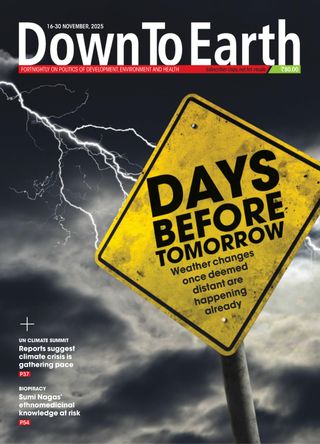

このストーリーは、Down To Earth の November 16, 2025 版からのものです。
Magzter GOLD を購読すると、厳選された何千ものプレミアム記事や、10,000 以上の雑誌や新聞にアクセスできます。
すでに購読者ですか? サインイン
Down To Earth からのその他のストーリー

Down To Earth
THE GREAT PIVOT
China's moves to transition to clean energy offer critical lessons to India

4 mins
March 01, 2026

Down To Earth
COAL V CORRIDOR
A proposal to mine coal along a corridor that links two tiger reserves in central India is a step away from getting final clearance. The move could affect movement and genetic diversity of tiger populations in the region
8 mins
March 01, 2026

Down To Earth
India's challenging AI predicament
Hobbled by lack of innovation and AI skills in its crucial technology sector, India is focusing on a ruinous plan to host data centres
4 mins
March 01, 2026
Down To Earth
China to implement zero tariffs across Africa
CHINA ON February 14 announced that it will implement zero tariffs for imports from all the 53 African nations it has diplomatic relations with, starting from May 1.
1 min
March 01, 2026
Down To Earth
Poverty, sans the threshold
MEASUREMENT OF poverty is a fundamental exercise, needed to direct development programmes.
2 mins
March 01, 2026

Down To Earth
A bridge across forever
For two decades, a Chhattisgarh village remains stuck in a loop of building temporary river crossings to access markets and sell forest produce
4 mins
March 01, 2026
Down To Earth
Liveable cities need a new model
CRY FOR my Delhi. This is my city—my family records many generations who have lived here.
3 mins
March 01, 2026

Down To Earth
Real impacts of the changing seasons
This refers to the article \"1,500 days, and an alarm for new climate\" (1-15 December, 2025).
1 mins
March 01, 2026

Down To Earth
‘It’s a systematic effort by US to dismantle climate policy’
The US, the world's largest historical emitter of greenhouse gases, has overturned its “endangerment finding”, the legal foundation for regulating emissions under the Clean Air Act since 2009.
4 mins
March 01, 2026
Down To Earth
Amazon turned carbon source in 2023 drought
EXTREME DROUGHT and a prolonged heatwave in 2023 pushed parts of the Amazon rainforest from acting as a carbon sink to becoming a carbon source for three months, according to a February 13 study published in the journal AGU Advances of the American Geophysical Union.
1 min
March 01, 2026
Listen
Translate
Change font size