試す 金 - 無料
RAISE THE BAR
Down To Earth
|August 01, 2025
From consumer incentives to bulk procurement and strict efficiency standards, India has many options to promote efficient appliances
-

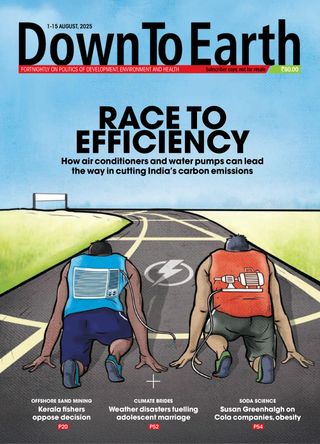
AS India looks to scale up its energy efficiency ambitions, global experiences offer important lessons. In 1998, Japan introduced the Top Runner Programme, a policy that turned the conventional approach to energy efficiency regulation on its head. Instead of setting arbitrary performance benchmarks for appliances, Japan's strategy was to identify the most energy-efficient product currently available in each appliance category and make that performance level the minimum standard for all manufacturers to meet within a fixed timeframe—typically four to eight years. The logic was simple but powerful. By rewarding manufacturers whose products were ahead of the curve—and by publicly naming those who failed to comply—the policy created a competitive environment that encouraged constant innovation. A 2017 report by the US' Lawrence Berkeley National Laboratory cited the success of this model: the energy efficiency of room air conditioners (ACs) in Japan nearly doubled between 1995 and 2005. “Manufacturers want their technology to be the minimum market standard. This set off intense competition between the different players, creating a market that rewarded innovations for improvement in energy efficiency,” says Nikit Abhyankar of the University of California, Berkeley.

このストーリーは、Down To Earth の August 01, 2025 版からのものです。
Magzter GOLD を購読すると、厳選された何千ものプレミアム記事や、10,000 以上の雑誌や新聞にアクセスできます。
すでに購読者ですか? サインイン
Down To Earth からのその他のストーリー

Down To Earth
GREAT NICOBAR DILEMMA
In the fragile ecosystem of Nicobar, strategic development must align with constitutional commitment to protect environment, indigenous dignity

3 mins
March 16, 2026
Down To Earth
CATCH BY THE ROOTS
Sabai grass could be a game-changer for the marginalised economies of West Bengal's dry uplands. All it needs is an efficient market strategy
4 mins
March 16, 2026

Down To Earth
POWERING TRANSITION
India's renewable ambitions are rising rapidly, with half of its installed power capacity now coming from non-fossil sources. Yet the gap between capacity and generation remains wide. The experiences of two pioneering states, Karnataka and Tamil Nadu, which together generate over a fifth of the country's renewable energy, offer crucial lessons for accelerating the transition, reports PUJA DAS from Bengaluru, Chennai, Mumbai and New Delhi
16 mins
March 16, 2026

Down To Earth
At core of survival
Water scarcity defines life in a village inside Sariska Tiger Reserve's critical habitat, as debates over its relocation drag on
5 mins
March 16, 2026

Down To Earth
What's on your plate
An upcoming digital tool can help people learn about the origin of their meals and make climate-positive food choices
2 mins
March 16, 2026

Down To Earth
'Bad environment can never be good economics'
The Supreme Court of India and even the high courts were once very active and took a proactive role in protecting the environment; unfortunately, that is no longer true
4 mins
March 16, 2026
Down To Earth
Things fall apart
IN THE past year, the world has counted more missiles and bombs than hours.
2 mins
March 16, 2026

Down To Earth
Universities in crisis, innovation is stifled
Political control and skewed policies have led to unrest in academia, stifling creativity and meaningful research
4 mins
March 16, 2026

Down To Earth
SPARK IN THE GAME
The Reserve Bank of India's restored recognition of Default Loss Guarantees re-enables credit flow into last-mile electric mobility
3 mins
March 16, 2026

Down To Earth
Ushering in new eras
An appraisal of the state of biodiversity conservation, pollution reduction and climate adaptation regimes in India
3 mins
March 16, 2026
Listen
Translate
Change font size