試す 金 - 無料
Illusive oilseed
Down To Earth
|August 16, 2022
Without the Centre's push, niger seed might vanish from the tribal food plate in near future

ONE OF the 14 kharif crops for which the Centre releases a minimum support price (MSP) every year is an unlikely plant called niger or ramtil (Guizotia abyssinica). This lesser known oilseed commands one of the highest MSPS, fixed on the basis of the cost of production and market demand. Yet, the area under its cultivation has been steadily shrinking over the past three decades. In 1985-86, niger was cultivated on around 0.6 million hectares (ha), as per a 2013 report by the All India Coordinated Research Project on Sesame and Niger (AICRP), Jabalpur. In 2020-21, the cultivated area shrunk by 80 per cent to a little over 0.1 million ha, the lowest among the 14 kharif crops with MSP. Paddy, the most widely grown kharif crop, is cultivated on almost 40 million ha (see 'High price, low interest' on p18).
The primary reason such a sparsely grown crop is part of the exclusive MSP list is because niger seed has traditionally "been the lifeline of tribal agriculture and economy in several states across India", states the 2013 AICRP report. The tribal population uses niger seed oil for cooking, the press cake post oil-extractionas livestock feed, and also consume the seeds as a condiment. Niger seed oil has medicinal properties, which is the reason for its commercial demand by the cosmetics, perfumeries and other allied industries.
Besides, the crop can grow on denuded soil and its cultivation method is fairly basic: after the first rain when the soil is moist, farmers need to plough the field and sprinkle the seeds. The crop neither requires much water nor fertilisers and pesticides. Why then are the tribal communities increasingly avoiding the oilseed despite such advantages and government support?
VANISHING ACT
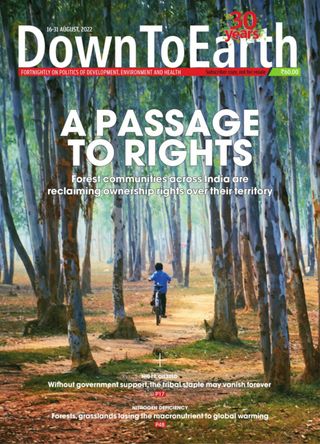

このストーリーは、Down To Earth の August 16, 2022 版からのものです。
Magzter GOLD を購読すると、厳選された何千ものプレミアム記事や、10,000 以上の雑誌や新聞にアクセスできます。
すでに購読者ですか? サインイン
Down To Earth からのその他のストーリー

Down To Earth
SAJANA SAJEEVAN - CRICKETER
In April 2024, Sajana Sajeevan got her maiden call up to the national women's cricket team on the back of a 12-year domestic career that began in the paddy fields of Wayanad, Kerala.

4 mins
January 01, 2026

Down To Earth
JINALI MODY - ENTREPRENEUR
In September 2025, UN Environment Programme announced Mumbai-based Jinali Mody, founder of material-science startup Banofi Leather, as a Young Champion of the Earth.
2 mins
January 01, 2026

Down To Earth
IT'S AN ENDLESS BATTLE
A decade spent tackling waste still feels vanishingly small
2 mins
January 01, 2026

Down To Earth
'NUMB, AND UNABLE TO ACT
As disasters grow more frequent, I find myself wondering how long I can continue living here, waiting for the next storm
2 mins
January 01, 2026

Down To Earth
NILA MADHAB PANDA - FILMMAKER
Few storytellers bring dramatic despair of ecological loss to the big screen like Nila Madhab Panda. The national-award winning filmmaker often makes nature his central character, be it in his 2017 film Kadvi Hawa or in the 2023 web series The Jengaburu Curse.
4 mins
January 01, 2026

Down To Earth
CHETAN SINGH SOLANKI: SCIENTIST | SOCIAL ENTREPRENEUR
For the past five years, Chetan Singh Solanki has been on a singular journey.
2 mins
January 01, 2026

Down To Earth
ʻLIVING SLOWLY, RELUCTANTLY
The pleasures and burdens of attempting a sustainable life in a fast-moving world
2 mins
January 01, 2026

Down To Earth
KIRAN RAO
Filmmaker and producer Kiran Rao has mastered the art of mainstreaming social commentary, as seen in her early films like Dhobi Ghat and more recently in Laapataa Ladies and Humans in the Loop.
4 mins
January 01, 2026

Down To Earth
I SEE THE RISE OF DEFENDERS
When a species disappears from a land, the loss extends far beyond the species itself.
2 mins
January 01, 2026

Down To Earth
MANISH MEHROTRA - CHEF | RESTAURATEUR
Manish Mehrotra is globally recognised for his innovative approach to preserving India's culinary heritage.
4 mins
January 01, 2026
Translate
Change font size