
Magzter GOLDで無制限に
10,000以上の雑誌、新聞、プレミアム記事に無制限にアクセスできます。
試す 金 - 無料
HIDDEN COSTS
Down To Earth
|November 01, 2022
Estimations of loss and damage after weather events do not account for non-economic consequences

FOR 40 days and 40 nights a biblical flood poured down on us, smashing centuries of weather records, challenging everything we knew about disaster, and how to manage it," Pakistan Prime Minister Muhammad Shehbaz Sharif told the UN General Assembly on September 23, describing the incessant rainfall the country received throughout the monsoon months from June to September. In July and August, Pakistan recorded 391 mm rainfallnearly 190 per cent more than the 30-year average-triggering flash floods and landslides, and inundating one-third of the country.
The southern province of Sindh received 466 per cent more rain than average. "When we have a 100 km lake that has developed in the middle of Pakistan, tell me how big of a drain can I build to manage this? There is no man-made structure that can evacuate this water," said Pakistan's foreign minister Bilawal Bhutto-Zardari at a news conference.
Rising waters forced temporary displacement of 7.9 million people, as per a recent report by the UN Office for the Coordination of Humanitarian Affairs (OCHA). The agency said as of October 1, some 1,700 people had died. Over 33 million peoplemore than the population of Australia-were affected by floods.
Just as the water began to recede in Pakistan, Nigeria too reported one of the worst flooding events it has seen in recent history. Death toll in the West African nation has crossed the 600-mark, the country's humanitarian affairs ministry tweeted on October 16. The flood, which has spread across all the 36 states, has affected 2.5 million people and destroyed more than 200,000 homes.
Large swathes of farmland have also been destroyed, the ministry said.
Nigeria's meteorological agency has warned flooding could continue until the end of November in some states.
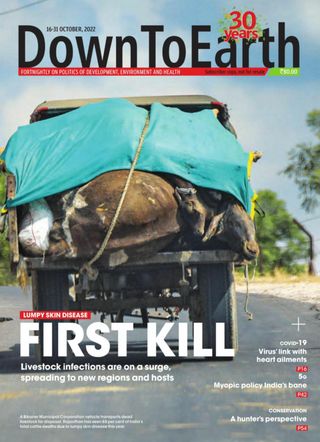

このストーリーは、Down To Earth の November 01, 2022 版からのものです。
Magzter GOLD を購読すると、厳選された何千ものプレミアム記事や、10,000 以上の雑誌や新聞にアクセスできます。
すでに購読者ですか? サインイン
Down To Earth からのその他のストーリー
Down To Earth
THINK TWICE BEFORE FELLING SAL TREES
Many trees considered to be affected by sal borer in the 1990s are still alive today

1 mins
February 16, 2026

Down To Earth
EDGE OF SURVIVAL
Caste divides deny marginalised communities land, resources and essential aid, leaving them more vulnerable to climate disasters
6 mins
February 16, 2026

Down To Earth
A WISH LIST?
Union Budget for 2026-27 conveys the impression of a roll-call of intentions and ambitious proposals, with little detail on their formulation
6 mins
February 16, 2026
Down To Earth
Break down the gender wall
THE RULING National Democratic Alliance (NDA) government has been heavily invested in the goal to make India a developed economy by 2047.
2 mins
February 16, 2026

Down To Earth
MENSTRUAL HEALTH, NOW A FUNDAMENTAL RIGHT
In a landmark judgement, the Supreme Court has recognised menstrual health and hygiene as a fundamental right under Article 21 of the Constitution of India, which guarantees the right to life and dignity.
8 mins
February 16, 2026

Down To Earth
Of devolution and new disasters
The 16th Finance Commission pushes for changes in view of new fiscal and climatic conditions
11 mins
February 16, 2026
Down To Earth
Rising risks of plastics
NEGATIVE IMPACTS on human health due to emissions linked to the plastic lifecycle could double by 2040, according to a study published in The Lancet Planetary Health in January.
1 min
February 16, 2026
Down To Earth
GAP BETWEEN EPIDEMICS NARROWING
A watershed-based and landscape-level approach is needed to address forest degradation
2 mins
February 16, 2026
Down To Earth
WAITING TO STRIKE
Sal heartwood borer is considered the biggest threat to forestry in India, especially to the sal tree, where it lives and breeds.
11 mins
February 16, 2026

Down To Earth
A SPRING DELIGHT
Mustard flowers are not meant only for the eyes. Invite them to your plate once in a while
3 mins
February 16, 2026
Translate
Change font size