試す 金 - 無料
Emerging risks
Down To Earth
|September 16, 2024
Even as the world gets set to eliminate substances threatening the ozone layer, climate change and space advancement pose new challenges.
-

IN JUNE this year, the world's 35-year-long effort to restore and preserve its ozone layer got a major boost, when researchers confirmed dropping levels of chemicals which deplete this shield that protects us from the sun's ultraviolet radiation.
These chemicals, hydrochlorofluorocarbons (HCFCS), are part of a set of 100-odd substances which have elements like chlorine and bromine that destroy ozone molecules.
Their release thus depletes the ozone layer 15 to 35 km above the Earth's surface. The ozone layer is the thinnest over the poles, especially in the Antarctic stratosphere, where the depletion is known as the "ozone hole".
But the June study, led by a scientist from Bristol University, UK and published in Nature Climate Change, indicated signs of ozone healing by noting that for the first time since the 1970s, the impact of HCFCS on the Earth's energy balance and the amount of chlorine from these gases in the atmosphere have decreased after reaching a peak in 2021.
This is five years ahead of the projected peak year of 2026. More encouraging news came the same month, with a study led by researchers from the Indian Institute of Technology (IIT), Kharagpur, refuting claims made in 2022 of a "severe" ozone hole in the tropical stratosphere. Analysing ground-based and satellite data, the study says, "Current understanding and observational evidence do not provide any support for the possibility of an ozone hole occurring outside Antarctica today."
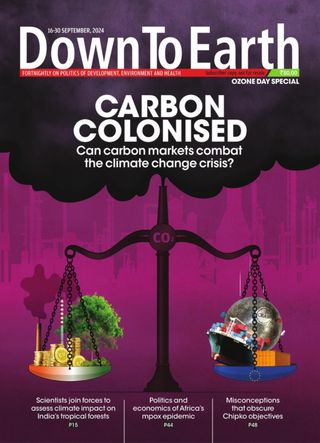

このストーリーは、Down To Earth の September 16, 2024 版からのものです。
Magzter GOLD を購読すると、厳選された何千ものプレミアム記事や、10,000 以上の雑誌や新聞にアクセスできます。
すでに購読者ですか? サインイン
Down To Earth からのその他のストーリー

Down To Earth
THE GREAT PIVOT
China's moves to transition to clean energy offer critical lessons to India

4 mins
March 01, 2026

Down To Earth
COAL V CORRIDOR
A proposal to mine coal along a corridor that links two tiger reserves in central India is a step away from getting final clearance. The move could affect movement and genetic diversity of tiger populations in the region
8 mins
March 01, 2026

Down To Earth
India's challenging AI predicament
Hobbled by lack of innovation and AI skills in its crucial technology sector, India is focusing on a ruinous plan to host data centres
4 mins
March 01, 2026
Down To Earth
China to implement zero tariffs across Africa
CHINA ON February 14 announced that it will implement zero tariffs for imports from all the 53 African nations it has diplomatic relations with, starting from May 1.
1 min
March 01, 2026
Down To Earth
Poverty, sans the threshold
MEASUREMENT OF poverty is a fundamental exercise, needed to direct development programmes.
2 mins
March 01, 2026

Down To Earth
A bridge across forever
For two decades, a Chhattisgarh village remains stuck in a loop of building temporary river crossings to access markets and sell forest produce
4 mins
March 01, 2026
Down To Earth
Liveable cities need a new model
CRY FOR my Delhi. This is my city—my family records many generations who have lived here.
3 mins
March 01, 2026

Down To Earth
Real impacts of the changing seasons
This refers to the article \"1,500 days, and an alarm for new climate\" (1-15 December, 2025).
1 mins
March 01, 2026

Down To Earth
‘It’s a systematic effort by US to dismantle climate policy’
The US, the world's largest historical emitter of greenhouse gases, has overturned its “endangerment finding”, the legal foundation for regulating emissions under the Clean Air Act since 2009.
4 mins
March 01, 2026
Down To Earth
Amazon turned carbon source in 2023 drought
EXTREME DROUGHT and a prolonged heatwave in 2023 pushed parts of the Amazon rainforest from acting as a carbon sink to becoming a carbon source for three months, according to a February 13 study published in the journal AGU Advances of the American Geophysical Union.
1 min
March 01, 2026
Listen
Translate
Change font size