試す 金 - 無料
AT A CROSSROADS ROADS
Down To Earth
|August 01, 2025
With the right push, air conditioners can shift from energy guzzlers to climate allies in India’s energy efficiency story
-

ONCE CONSIDERED a luxury, room air conditioners (ACs) have become an essential for home comfort amid rising temperatures and rapid urbanisation. Estimates indicate that India’s AC market is expanding swiftly. In 2021-22, over 8.4 million units were sold; by 2023-24, this number had increased to 10.9 million, according to “India Energy Scenario 202324” report by the Bureau of Energy Efficiency (bee). Alliance for an Energy Efficient Economy (aeee), a Delhi-based non-profit, estimates that nearly one in 10 Indian households now owns an AC—a figure comparable to car ownership. This number is expected to quadruple by 2037-38. And this is just the beginning. The key question, then, is how these energy guzzling yet essential cooling devices can be made more energy-efficient, so that household electricity bills can be lower and reduce overall power demand, ultimately saving the government valuable resources.
The effort to regulate the energy efficiency of ACs began in the 2000s. In 2009, bee mandated star-rating for ACs using Energy Efficiency Ratio (eer). The methodology required calculating the ratio of an AC unit’s cooling output (in watts) to its total power input (in watts), under fixed conditions: an outdoor temperature of 35°C, an indoor temperature of 27°C, and 50 per cent relative humidity. However, this approach was flawed, as it did not account for seasonal variations in outdoor temperatures, which influence cooling demand and, consequently, energy consumption. For instance, an AC works harder and consumes more energy to cool a room when the outdoor temperature is 40oC, compared to 35oC. To address this issue, bee in 2015 introduced a new star-rating methodology: the Indian Seasonal Energy Efficiency Ratio (iseer). This approach considers varying temperature conditions and operating hours throughout the year, providing a more accurate estimate of energy efficiency. iseer was made mandatory in 2018.
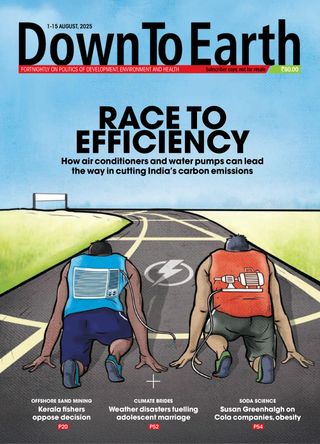

このストーリーは、Down To Earth の August 01, 2025 版からのものです。
Magzter GOLD を購読すると、厳選された何千ものプレミアム記事や、10,000 以上の雑誌や新聞にアクセスできます。
すでに購読者ですか? サインイン
Down To Earth からのその他のストーリー

Down To Earth
BEYOND COLLATERAL DAMAGE
Recent geopolitical conflicts are urging a reconsideration of what constitutes environmental harm in war and the limits of existing legal frameworks

3 mins
April 01, 2026

Down To Earth
Masterstroke
Residents of a small Kerala town reject an inadequate state-led development blueprint and create their own master plan that prioritises protection of historic water systems and urban commons
4 mins
April 01, 2026

Down To Earth
Rethinking E20
It is pertinent to explore potential of ethanol as high-value industrial feedstock
4 mins
April 01, 2026
Down To Earth
Food in the age of climate change
WHEN WE eat, we contribute to climate change. But food is also about livelihoods, about nutrition and about nature.
3 mins
April 01, 2026

Down To Earth
FADING WINTER
India's winters are warming, becoming shorter, shifting and spilling beyond their traditional bounds. The consequences are already evident in meltwater availability, forest-fire intensity and changes in flowering cycles and insect behaviour.
20 mins
April 01, 2026

Down To Earth
War on Iran strikes India's pharmaceuticals sector
Shortages of critical raw materials and rising input costs for the drug industry will have global consequences
4 mins
April 01, 2026

Down To Earth
POWER IN AN AGE OF INSECURITY
Energy transition is no longer solely about emission reduction but also about energy security
3 mins
April 01, 2026
Down To Earth
Re-discovery of fuelwood
THE WEST Asia conflict has made visible a multi-billion dollar energy market in India.
2 mins
April 01, 2026

Down To Earth
A CASE THAT RESHAPED INDIA'S ENVIRONMENT
The case of MC Mehta v Union of India stands as proof that a proactive judiciary can accelerate action even when the executive drags its feet
4 mins
April 01, 2026

Down To Earth
FOREVER DEPENDENT
India depends on global fertiliser supply chains for 70 per cent of its needs, leaving its food security exposed to geopolitical disruptions
6 mins
April 01, 2026
Listen
Translate
Change font size